


Page 138 - IJPS-2-2
P. 138
Utilization of institutional delivery services across successive births in India

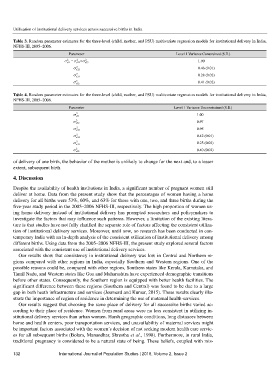
       Table 3. Random parameter estimates for the three-level (child, mother, and PSU) multivariate regression models for institutional delivery in India,
       NFHS-III, 2005–2006.
                              Parameter                                     Level 1 Variance Constrained (S.E.)
                            σ  e 2 11  = σ  e 2 22 =σ  2 e 33                        1.00
                                σ e 2 21                                             0.46 (0.01)
                                σ e 2 31                                             0.28 (0.02)
                                σ e 2 32                                             0.41 (0.02)

       Table 4. Random parameter estimates for the three-level (child, mother, and PSU) multivariate regression models for institutional delivery in India,
       NFHS-III, 2005–2006.
                              Parameter                                    Level 1 Variance Unconstrained (S.E.)
                                σ e 2 11                                             1.00
                                σ e 2 22                                             0.97
                                σ e 2 33                                             0.95
                                σ e 2 21                                             0.42 (0.01)
                                σ e 2 31                                             0.25 (0.02)
                                σ e 2 32                                             0.40 (0.02)

       of delivery of one birth, the behavior of the mother is unlikely to change for the next and, to a lesser
       extent, subsequent birth.
       4. Discussion

       Despite the availability of health institutions in India, a significant number of pregnant women still
       deliver at home. Data from the present study show that the percentages of women having a home
       delivery for all births were 53%, 60%, and 63% for those with one, two, and three births during the
       five-year study period in the 2005–2006 NFHS-III, respectively. The high proportion of women us-
       ing home delivery instead of institutional delivery has prompted researchers and policymakers to
       investigate the factors that may influence such patterns. However, a limitation of the existing litera-
       ture is that studies have not fully clarified the separate role of factors affecting the consistent utiliza-
       tion of institutional delivery services. Moreover, until now, no research has been conducted in con-
       temporary India with an in-depth analysis of the consistent utilization of institutional delivery among
       different births. Using data from the 2005–2006 NFHS-III, the present study explored several factors
       associated with the consistent use of institutional delivery services.
         Our results show that consistency in institutional delivery was low in Central and Northern re-
       gions compared with other regions in India, especially Southern and Western regions. One of the
       possible reasons could be, compared with other regions, Southern states like Kerala, Karnataka, and
       Tamil Nadu, and Western states like Goa and Maharashtra have experienced demographic transitions
       before other states. Consequently, the Southern region is equipped with better health facilities. The
       significant difference between these regions (Southern and Central) was found to be due to a large
       gap in both heath infrastructure and services (Joumard and Kumar, 2015). These results clearly illu-
       strate the importance of region of residence in determining the use of maternal health-services.
         Our results suggest that choosing the same place of delivery for all successive births varied ac-
       cording to their place of residence. Women from rural areas were no less consistent in utilizing in-
       stitutional delivery services than urban women. Harsh geographic conditions, long distances between
       home and health centers, poor transportation services, and unavailability of maternal services might
       be important factors associated with the women’s decision of not seeking modern health care servic-
       es for all subsequent births (Bolam, Manandhar, Shrestha et al., 1998). Furthermore, in rural India,
       traditional pregnancy is considered to be a natural state of being. These beliefs, coupled with mis-

       132                International Journal of Population Studies | 2016, Volume 2, Issue 2

