


Page 116 - IMO-1-1
P. 116
Innovative Medicines & Omics                             Rocuronium versus succinylcholine in general anesthesia


            and 40  patients from Group  1 and forty patients from   in any of the groups. One patient from Group 1 and three
            Group 2 had strong jaw relaxation (score of 3). When the   from Group 2 had a mild cough (score of 1). Six patients
            two groups’ jaw relaxations are compared, it is discovered   from Group 1 and 23 patients from Group 2 exhibited the
            that the difference between the groups is statistically not   diaphragm movement (scoring of 2). It is interesting to
            significant (P = 0.507) and that the P-value is more than   note that 24 patients in Group 2 and 43 patients in Group 1
            0.05. The closed vocal cord movement (score of 0) was   did not react to intubation (score of 3). The P-value for
            not found in any of the groups. The closing vocal cord   intubating response is observed to be <0.005. It follows
            movement (score of 1) was found in 2 patients of Group 2.   that there is a highly significant difference in the intubating
            The moving vocal cord movement (score of 2) was found   response between the two groups (P = 0.000).
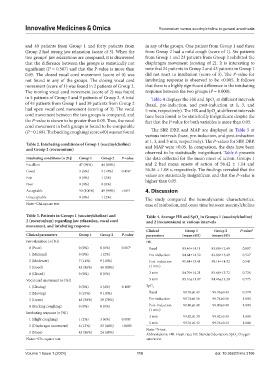
            in 5 patients of Group 1 and 9 patients of Group 2. A total   Table 4 displays the HR and SpO  at different intervals
                                                                                            2
            of 45 patients from Group 1 and 39 patients from Group 2   (basal, pre-induction, and post-induction at 1, 3, and
            had open vocal cord movement (scoring of 3). The vocal   5 min, respectively). The HR and SpO  at different intervals
                                                                                             2
            cord movement between the two groups is compared, and   have been found to be statistically insignificant despite the
            the P-value is shown to be greater than 0.05. Thus, the vocal   fact that the P-value for both variables is more than 0.05.
            cord movement in both groups is found to be comparable
            (P = 0.168). The bucking coughing (score of 0) was not found   The SBP, DBP, and MAP are displayed in  Table 5  at
                                                               various intervals (base, pre-induction, and post-induction
                                                               at 1, 3, and 5 min, respectively). The P-values for SBP, DBP,
            Table 2. Intubating conditions of Group 1 (succinylcholine)
            and Group 2 (rocuronium)                           and MAP were >0.05. In comparison, the data have been
                                                               observed to be statistically insignificant. Table 6 presents
            Intubating conditions (n [%])  Group 1  Group 2  P‑value  the data collected for the mean onset of action. Groups 1
            Excellent              47 (94%)  44 (88%)          and  2  had  mean  onsets  of  action  of  56.42  ±  1.14  and
            Good                   3 (6%)   5 (10%)  0.456 a   56.36 ± 1.08 s, respectively. The findings revealed that the
            Fair                   0 (0%)   1 (2%)             values are statistically insignificant and that the P-value is
                                                               higher than 0.05.
            Poor                   0 (0%)   0 (0%)
            Acceptable             50 (100%)  49 (98%)  >0.05  4. Discussion
            Unacceptable           0 (0%)   1 (2%)             The study compared the hemodynamic characteristics,
            Note:  Chi-square test.                            ease of intubation, and onset time between succinylcholine
                a
            Table 3. Patients in Groups 1 (succinylcholine) and   Table 4. Average HR and SpO  in Groups 1 (succinylcholine)
                                                                                     2
            2 (rocuronium) regarding jaw relaxation, vocal cord   and 2 (rocuronium) at various intervals
            movement, and intubating response
                                                               Clinical         Group 1     Group 2    P‑value b
            Clinical parameters    Group 1  Group 2  P‑value   parameters      (mean±SD)   (mean±SD)
            Jaw relaxation (n [%])                             HR
             0 (Poor)              0 (0%)   0 (0%)   0.507 a    Basal          83.46±14.11  83.08±12.49  0.887
             1 (Minimal)           0 (0%)   1 (2%)              Pre-induction  84.64±14.52  82.86±13.49  0.527
             2 (Moderate)          7 (14%)  9 (18%)             Post-induction   91.84±13.41  90.14±14.32  0.541
             3 (Good)              43 (86%)  40 (80%)           (1 min)
             0 (Closed)            0 (0%)   0 (0%)              3 min          84.70±14.21  85.68±13.72  0.726
            Vocal cord movement (n [%])                         5 min          85.16±11.07  84.46±13.20  0.775
             1 (Closing)           0 (0%)   2 (4%)   0.168 a   SpO 2
             2 (Moving)            5 (10%)  9 (18%)             Basal          99.76±0.43  99.76±0.43   0.378
             3 (Open)              45 (90%)  39 (78%)           Pre-induction  99.74±0.56  99.74±0.56   1.000
             0 (Bucking coughing)  0 (0%)   0 (0%)              Post-induction   99.80±0.40  99.80±0.40  1.000
                                                                (1 min)
            Intubating response (n [%])
                                                                3 min          99.82±0.39  99.82±0.39   1.000
             1 (Slight coughing)   1 (2%)   3 (6%)   0.000 a
                                                                5 min          99.76±0.43  99.76±0.43   1.000
             2 (Diaphragm movement)  6 (12%)  23 (46%)  <0.005
                                                               Note: * t-test.
                                                                    b
             3 (None)              43 (86%)  24 (48%)          Abbreviations: HR: Heart rate; SD: Standard deviation; SpO : Oxygen
            Notes:  Chi-square test.                           saturation.                           2
                 a
            Volume 1 Issue 1 (2024)                        110                               doi: 10.36922/imo.3196

