


Page 117 - IMO-1-1
P. 117
Innovative Medicines & Omics                             Rocuronium versus succinylcholine in general anesthesia


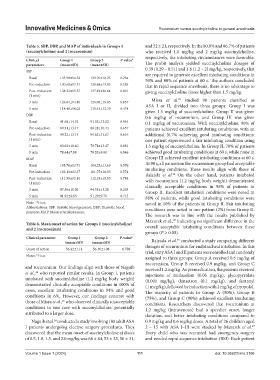
            Table 5. SBP, DBP, and MAP of individuals in Groups 1   and 52 ± 21, respectively. In the 80.0% and 86.7% of patients
            (succinylcholine) and 2 (rocuronium)               who received 1.0  mg/kg and 2  mg/kg succinylcholine,
                                                               respectively, the intubating circumstances were favorable.
            Clinical       Group 1     Group 2      P‑value b
            parameters     (mean±SD)   (mean±SD)               The probit analysis yielded succinylcholine dosages of
            SBP                                                0.39 (0.29 – 0.51) and 1.6 (1.2 – 2) mg/kg, respectively, that
                                                               are required to generate excellent intubating conditions in
             Basal         133.98±14.52  129.70±18.23  0.234   50% and 80% of patients at 60 s. The authors concluded
             Pre-induction  130.68±17.51  128.68±13.93  0.528  that in rapid sequence anesthesia, there is no advantage to
             Post-induction   138.32±15.37  137.82±20.64  0.891  giving succinylcholine doses higher than 1.5 mg/kg.
             (1 min)
                                                                             25
             3 min         126.64±14.10  126.08±16.85  0.857     Misra  et  al.  studied 90  patients classified as
             5 min         118.48±16.02  116.44±12.39  0.478   ASA I or II, divided into three groups: Group  I was
                                                               given 1.5  mg/kg of succinylcholine, Group  II was given
            DBP                                                0.6  mg/kg of rocuronium, and Group  III was given
             Basal         91.68±14.52  91.52±13.02  0.954     0.1 mg/kg of vecuronium. With succinylcholine, 90% of
             Pre-induction  89.34±13.17  88.28±10.44  0.657    patients achieved excellent intubating conditions, with an
             Post-induction   98.22±13.14  99.62±14.67  0.616  additional l6.7% achieving good intubating conditions;
             (1 min)                                           one patient experienced a fair intubating condition using
             3 min         83.02±10.40  78.78±13.47  0.081     1.5 mg/kg of succinylcholine. In Group II, 70% of patients
             5 min         78.64±7.88  78.52±9.80   0.946      achieved good intubating conditions at 60 s, while none in
            MAP                                                Group III achieved excellent intubating conditions at 60 s.
             Basal         105.78±13.71  104.25±13.60  0.576   At 90 s, all patients in the rocuronium group had acceptable
             Pre-induction  103.12±13.37  101.75±10.83  0.574  intubating conditions. These results align with those of
                                                               Raizada  et al.   On  the  other  hand, patients  intubated
                                                                          26
             Post-induction   111.59±12.10  112.35±15.53  0.784  with rocuronium (1.2 mg/kg body weight) demonstrated
             (1 min)
             3 min         97.56±10.02  94.55±13.28  0.203     clinically acceptable conditions in 98% of patients in
                                                               Group  II. Excellent intubation conditions were noted in
             5 min         91.92±8.83  91.20±9.70   0.715      88% of patients, while good intubating conditions were
            Note: * t-test.                                    noted in 10% of the patients in Group II. Fair intubating
                 b
            Abbreviations: SBP: Systolic blood pressure; DBP: Diastolic blood   conditions were noted in one patient (2%) from Group II.
            pressure; MAP: Mean arterial pressure.
                                                               The research was in line with the results published by
                                                               Mazurek et al.,  indicating no significant difference in the
                                                                           27
            Table 6. Mean onset of action for Groups 1 (succinylcholine)
            and 2 (rocuronium)                                 overall acceptable intubating conditions between these
                                                               groups (P ≥ 0.05).
            Clinical parameter  Group 1   Group 2   P‑value b               26
                             (mean±SD)  (mean±SD)                Raizada et al.  conducted a study comparing different
            Onset of action  56.42±1.14  56.36±1.08  0.788     dosages of rocuronium for endotracheal intubation. In this
                                                               trial, sixty ASA I and II patients were enrolled and randomly
            Notes:  t-test.
                 b
                                                               assigned to three groups: Group A received 0.6 mg/kg of
                                                               rocuronium, Group B received 0.9 mg/kg, and Group C
            and rocuronium. Our findings align with those of Naguib   received 1.2 mg/kg. As premedication, the patients received
            et al.,  who reported similar results. In Group 1, patients   injections of midazolam (0.05  mg/kg), glycopyrrolate
                24
            intubated with succinylcholine (1.2  mg/kg body weight)   (0.001  mg/kg), dansetron (0.1  mg/kg), and fentanyl
            demonstrated clinically acceptable conditions in 100% of   (1 mcg/kg), followed by induction with 2 mg/kg of propofol.
            cases, excellent intubating conditions in 94% and good   The majority of patients in Group  A (50%), Group  B
            conditions  in  6%.  However,  our  findings  contrast  with   (75%), and Group C (90%) achieved excellent intubating
            those of Misra et al.,  who observed clinically unacceptable   conditions. Researchers discovered that rocuronium at
                           25
            conditions in one case with succinylcholine, potentially   1.2  mg/kg (intravenous) had a speedier onset, longer
            attributed to a larger dose.                       duration, and better intubating conditions compared to
              Naguib et al.  conducted a study involving 180 adult ASA   0.9 mg/kg and 0.6 mg/kg doses. A total of 26 children aged
                        24
            I patients undergoing elective  surgery  procedures.  They   2 – 15 with ASA I–III were studied by Mazurek  et al.
                                                                                                            27
            discovered that the mean onset of succinylcholine at doses   Every child who was recruited had emergency surgery
            of 0.5, 1.0, 1.5, and 2.0 mg/kg was 68 ± 44, 53 ± 23, 56 ± 31,   and needed rapid sequence intubation (RSI). Each patient


            Volume 1 Issue 1 (2024)                        111                               doi: 10.36922/imo.3196

