


Page 115 - IMO-1-1
P. 115
Innovative Medicines & Omics                             Rocuronium versus succinylcholine in general anesthesia


            prospective, randomized, single-blind, and controlled   shifted to the recovery unit, where oxygen supplementation
            investigation was approved by the institutional ethics   was delivered through face mask.
            committee. Written informed consent was obtained from
            all participating patients.                        3. Results
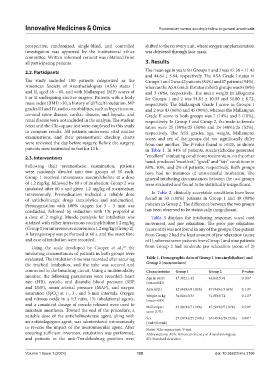
            2.2. Participants                                  The mean age in years for Groups 1 and 2 was 47.38 ± 11.42
                                                               and 44.84 ± 5.94, respectively. The ASA Grade I status in
            The study included 100  patients categorized as the   Groups 1 and 2 was 42 patients (84%) and 47 patients (94%),
            American Society of Anesthesiologists (ASA) status I   whereas the ASA Grade II status in both groups was 8 (16%)
            and II, aged 18 – 60, and with Mallampati (MP) scores of   and 3  (6%), respectively. The mean weight in kilograms
            I or II undergoing elective surgery. Patients with a body   for Groups 1 and 2 was 54.84 ± 10.33 and 51.80 ± 8.72,
            mass index (BMI) >30, a history of difficult intubation, MP   respectively. The Mallampati Grade  I score in Groups  1
            grades III and IV, and co-morbidities, such as hypertension,   and 2 was 43 (86%) and 45 (90%), whereas the Mallampati
            cervical spine disease, cardiac disease, and hepatic, and   Grade II score in both groups was 7 (14%) and 5 (10%),
            renal disease were not included in the analysis. The student   respectively. In Group 1 and Group 2, the male-to-female
            t-test and the Chi-square test were employed in this study   ratios were 25  (50%)/25  (50%) and 24  (48%)/26  (52%),
            to compare results. All patients underwent vital routine   respectively. The ASA grades, age, weight, Mallampati
            examinations,  and  their  preanesthetic  checkup  charts   score, and sex of the groups did not significantly differ
            were reviewed the day before surgery. Before the surgery,   from one another. The P-value found is >0.05, as shown
            patients were instructed to fast for 12 h.         in Table 1. In 94% of patients, succinylcholine generated
            2.3. Interventions                                 “excellent” intubating conditions; rocuronium, on the other
                                                               hand, produced “excellent,” “good,” and “fair” conditions in
            Following their preanesthetic examination, patients   88%, 10%, and 2% of patients, respectively. Both groups
            were randomly divided into two groups of 50 each.   have had no instances of unsuccessful intubation. The
            Group  1 received intravenous succinylcholine at a dose   general intubating circumstances between the two groups
            of 1.2 mg/kg, followed by 60 s of intubation. Group 2 was   were evaluated and found to be statistically insignificant.
            intubated after 60 s and given 1.2 mg/kg of rocuronium
            intravenously. Premedication included a reliable dose   In Table 2, clinically acceptable conditions have been
            of anticholinergic drugs (anxiolytics and antiemetics).   found in 50  (100%) patients in Group  1 and 49  (98%)
            Preoxygenation with 100% oxygen for 3 – 5  min was   patients in Group 2. The difference between the two groups
            conducted, followed by induction with 1% propofol  at   has been observed to be statistically insignificant.
            a  dose  of  2  mg/kg.  Muscle  paralysis  for  intubation  was   Table 3 displays the intubating response, vocal cord
            attained with either intravenous succinylcholine 1.2 mg/kg   movement,  and  jaw  relaxation.  The  poor  jaw  relaxation
            (Group 1) or intravenous rocuronium 1.2 mg/kg (Group 2).   (score of 0) was not found in any of the groups. One patient
            A laryngoscopy was performed at 60 s, and the onset time   from Group 2 had the least amount of jaw relaxation (score
            and ease of intubation were recorded.              of 1), whereas seven patients from Group 1 and nine patients
              Using the scale developed by Cooper  et al.,  the   from Group  2 had moderate jaw relaxation (score of 2)
                                                     23
            intubating circumstances of patients in both groups were
            evaluated. The intubation time was recorded after securing   Table 1. Demographic data of Group 1 (succinylcholine) and
            the tracheal intubation, and the tube was secured and   Group 2 (rocuronium)
            connected to the breathing circuit. Using a multimodality   Characteristics  Group 1  Group 2  P‑value
            monitor, the following parameters were recorded: heart   Age in years   47.38±11.42  44.84±5.94  0.166 b
            rate (HR), systolic and diastolic blood pressure (SBP   (mean±SD)
            and DBP), mean arterial pressure  (MAP), and oxygen   ASA (I/II)  42 (84%)/8 (16%)  47 (94%)/3 (6%)  0.110 a
            saturation (SpO ) at 1-, 3-, and 5-min intervals. Oxygen   Weight in kg   54.84±10.33  51.80±8.72  0.115 b
                         2
            and nitrous oxide in a 1:3 ratio, 1% inhalational agents,   (mean±SD)
            and a consistent dosage of muscle relaxant were used to   Mallampati   43 (86%)/7 (14%)  45 (90%)/5 (10%)  0.538 a
            maintain anesthesia. Toward the end of the procedure, a   score (I/II)
            suitable dose of the anticholinesterase agent, along with   Sex   25 (50%)/25 (50%)  24 (48%)/26 (52%)  0.841 a
            an antisialagogues agent, was administered intravenously   (male/female)
            to reverse the impact of the neuromuscular agent. After   Notes:  Chi-square test;  t-test.
                                                                    a
                                                                               b
            ensuring sufficient inversion, extubation was performed,   Abbreviations: ASA: American Society of Anesthesiologists;
            and patients  in  the anti-Trendelenburg  position were   SD: Standard deviation.

            Volume 1 Issue 1 (2024)                        109                               doi: 10.36922/imo.3196

