


Page 12 - IMO-2-1
P. 12
Innovative Medicines & Omics                                       Incretin mimetics in diabetes management


            improve blood glucose regulation and promote weight   4.2. Liraglutide
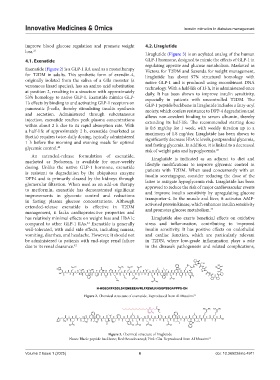
            loss. 21                                           Liraglutide (Figure 3) is an acylated analog of the human
            4.1. Exenatide                                     GLP-1 hormone, designed to mimic the effects of GLP-1 in
                                                               regulating appetite and glucose metabolism. Marketed as
            Exenatide (Figure 2) is a GLP-1 RA used as a monotherapy   Victoza for T2DM and Saxenda for weight management,
            for T2DM in adults. This synthetic form of exendin-4,   liraglutide has about 97% structural homology with
            originally isolated from the saliva of a Gila monster (a   native GLP-1 and is produced using recombinant DNA
            venomous lizard species), has an amino acid substitution   technology. With a half-life of 13 h, it is administered once
            at position 2, resulting in a structure with approximately   daily. It has been shown to improve insulin sensitivity,
            53% homology to native GLP-1. Exenatide mimics GLP-  especially in patients with uncontrolled T2DM. The
            1’s effects by binding to and activating GLP-1 receptors on   GLP-1 peptide backbone in liraglutide includes a fatty-acyl
            pancreatic  β-cells, thereby stimulating insulin synthesis   moiety, which confers resistance to DPP-4 degradation and
            and secretion.  Administered  through subcutaneous   allows non-covalent binding to serum albumin, thereby
            injection, exenatide reaches peak plasma concentrations   extending its half-life. The recommended starting dose
            within about 2  h due to its rapid absorption rate. With   is  0.6  mg/day  for  1  week,  with  weekly  titration  up  to  a
            a half-life of approximately 2  h, exenatide (marketed as   maximum of 1.8 mg/day. Liraglutide has been shown to
            Byetta) requires twice-daily dosing, typically administered   significantly decrease HbA1c levels, postprandial glycemia,
            1  h before the morning and evening meals for optimal   and fasting glycemia. In addition, it is linked to a decreased
            glycemic control. 40
                                                               risk of weight gain and hypoglycemia. 43
              An extended-release formulation of  exenatide,
                                                                 Liraglutide is indicated as an adjunct to diet and
            marketed as Bydureon, is available for once-weekly   lifestyle modifications to improve glycemic control in
            dosing.  Unlike the  native GLP-1  hormone, exenatide   patients with T2DM. When used concurrently with an
            is resistant to degradation by the ubiquitous enzyme   insulin secretagogue, consider reducing the dose of the
            DPP4 and is primarily cleared by the kidneys through   latter to mitigate hypoglycemia risk. Liraglutide has been
            glomerular filtration. When used as an add-on therapy   approved to reduce the risk of major cardiovascular events
            to  metformin,  exenatide  has  demonstrated  significant   and improve insulin sensitivity by upregulating glucose
            improvements  in  glycemic  control  and  reductions   transporter-4. In the muscle and liver, it activates AMP-
            in fasting plasma glucose concentrations. Although   activated protein kinase, which enhances insulin sensitivity
            extended-release exenatide is effective in T2DM    and promotes glucose metabolism. 44
            management,  it  lacks  cardioprotective  properties  and
            has relatively minimal effects on weight loss and HbA1c   Liraglutide also  exerts beneficial effects on  oxidative
            compared to other GLP-1 RAs.  Exenatide is generally   stress and inflammation, contributing to improved
                                      41
            well-tolerated, with mild side effects, including nausea,   insulin sensitivity. It has positive effects on endothelial
            vomiting, diarrhea, and headache. However, it should not   and cardiac function, which are particularly relevant
            be administered to patients with end-stage renal failure   in T2DN, where low-grade inflammation plays a role
            due to its renal clearance. 42                     in the disease’s pathogenesis and related complications,


                                     Figure 2. Chemical structure of exenatide. Reproduced from Al Musaimi 12


                                               Figure 3. Chemical structure of liraglutide
                              Notes: Black: peptide backbone; Red: hexadecanoyl; Pink: Glu. Reproduced from Al Musaimi 12


            Volume 2 Issue 1 (2025)                         6                                doi: 10.36922/imo.4911

