


Page 17 - IMO-2-1
P. 17
Innovative Medicines & Omics                                       Incretin mimetics in diabetes management


            which the dose can be increased to 5  mg once weekly.   GLP-1.  Following  subcutaneous  injection,  lixisenatide  is
            Depending on individual patient needs and response,   rapidly absorbed, reaching peak plasma concentration in
            the dosage may be further increased up to a maximum of   about 2 h, with a half-life of approximately 3 h. 85
            15 mg once weekly. 82
                                                                 The primary elimination pathway for lixisenatide
              Zepbound is prescribed alongside a calorie-restricted   is glomerular filtration. Cytochrome P450 isoenzymes
            diet and increased physical activity to aid weight   remain unaffected by lixisenatide. However, due to its
            management in obese or overweight adults with at least   effect on delaying gastric emptying, lixisenatide may
            one weight-related comorbidity, such as hypertension,   slow the absorption of orally administered medications,
            dyslipidemia,  T2DM,  obstructive  sleep  apnea,  or   such as warfarin, ethinyl estradiol, and acetaminophen.
            cardiovascular disease. Zepbound  is administered   Caution is advised when administering lixisenatide with
            subcutaneously, starting at 2.5  mg  once  weekly and   medications that have a narrow therapeutic range, such as
            potentially increasing to a maximum of 15 mg once weekly   warfarin, or with drugs that rely on precise dosing, such as
            based on patient response and tolerance. The dual agonist   antibiotics. For drugs that require timely absorption, it is
            action on pancreatic β-cells promotes insulin production,   recommended to administer them at least an hour before
            while GIP activity enhances white adipose tissue function.   lixisenatide. For oral contraceptives, the administration
            In addition, signals of both receptor pathways in the brain   should occur either 1 h before or 11 h after the lixisenatide
            contribute to  a stronger  anorexigenic effect, supporting   injection. 53
            both glycemic control and weight reduction.  The most
                                                 81
            frequently reported side effects include gastrointestinal-  Lixisenatide has a prolonged half-life due to its exendin-4
            related events (nausea, diarrhea, and vomiting) and   backbone and is administered once daily at an initial dose
            decreased appetite.  Some psychiatric adverse events have   of 10 mcg via injection. After 2 weeks, the dose may be
                           83
            also been noted. 84                                increased to 20 mcg. Lixisenatide slows gastric emptying,
                                                               which significantly impacts postprandial glycemia. As
            4.7. Lixisenatide                                  monotherapy, it effectively reduces HbA1c, fasting glucose,
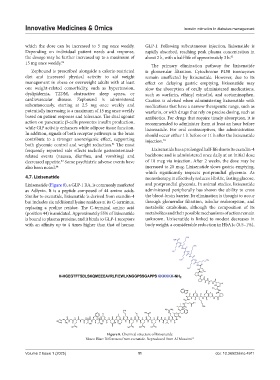
            Lixisenatide (Figure 8), a GLP-1 RA, is commonly marketed   and postprandial glycemia. In animal studies, lixisenatide
            as Adlyxin. It is a peptide composed of 44 amino acids.   administered peripherally has shown the ability to cross
            Similar to exenatide, lixisenatide is derived from exendin-4   the blood-brain barrier. Its elimination is thought to occur
            but includes six additional lysine residues at its C-terminus,   through glomerular filtration, tubular reabsorption, and
            replacing a proline residue. The C-terminal amino acid   metabolic catabolism, although the composition of  its
            (position 44) is amidated. Approximately 55% of lixisenatide   metabolites and their possible mechanisms of action remain
            is bound to plasma proteins, and it binds to GLP-1 receptors   unknown. Lixisenatide is linked to modest decreases in
            with an affinity up to 4 times higher than that of human   body weight, a considerable reduction in HbA1c (0.5–1%),


                                               Figure 8. Chemical structure of lixisenatide
                                      Notes: Blue: Differences from exenatide. Reproduced from Al Musaimi 12


            Volume 2 Issue 1 (2025)                         11                               doi: 10.36922/imo.4911

