


Page 18 - IMO-2-1
P. 18
Innovative Medicines & Omics                                       Incretin mimetics in diabetes management


            and decreases in postprandial and fasting plasma glucose.   GIP, and glucagon receptors. This unique mechanism
            Studies have shown that, for HbA1c reduction, lixisenatide   addresses both glycemic control and weight management,
            is non-inferior to twice-daily exenatide and is generally   making it particularly relevant in the treatment of obesity
            well tolerated. 86                                 and T2DM. Recent clinical trials have demonstrated
              The most commonly reported side effects of lixisenatide   retatrutide’s potential to induce significant weight loss and
            are gastrointestinal symptoms, such as nausea, vomiting,   improve metabolic parameters in individuals with obesity
            and diarrhea. These side effects are typically dose-dependent   and T2DM. By acting on both glucose metabolism and
            and often diminish in intensity within the first 3 – 6 weeks   appetite regulation, retatrutide offers a promising avenue
            of treatment. Immunogenic effects have been reported   for enhanced patient outcomes. 89,90
            with lixisenatide; patients who develop anti-lixisenatide   In a Phase 2 clinical trial, retatrutide was administered
            antibodies may experience a slightly higher frequency of   to participants with a BMI of 30 or higher, resulting in
            allergic responses and injection site reactions compared   substantial weight loss over 24 weeks. Participants receiving
            to  those  without  antibodies.  Routine  antibody  testing  is   retatrutide achieved an average weight reduction of 12 – 15%
            not required, but patients may consider switching to an   compared to the placebo group. In addition, improvements
            alternative antidiabetic therapy if they experience significant   in glycemic control were observed, with reductions in
            glycemic control issues or persistent injection site reactions. 87  HbA1c levels and fasting plasma glucose. These trial results

              When lixisenatide is introduced to existing regimens, such   indicate that retatrutide not only promotes weight loss but
            as basal insulin therapy or sulfonylurea treatment, adjustments   also has a positive impact on associated metabolic disorders,
            to all diabetes medications may be required to mitigate the   positioning it as a compelling option for patients with obesity
            risk of hypoglycemia. Although mild-to-moderate renal   and  T2DM. 91,92   The  safety  profile  of  retatrutide  has  been
            impairment does not necessitate a dosage adjustment, close   generally favorable, with most adverse events being mild–
            monitoring is recommended, as these individuals may be   to-moderate in severity. Common side effects included
            more  susceptible  to  adverse  effects,  such  as  dehydration,   gastrointestinal symptoms such as nausea, diarrhea, and
            which could deteriorate kidney function. Individuals with   abdominal pain, which typically resolved with continued
            severe renal impairment should be constantly monitored for   treatment. Notably, the incidence of hypoglycemia was low,
            worsening renal function and a higher likelihood of adverse   a significant advantage over some existing therapies for
            events, especially gastrointestinal issues. 86,88  T2DM. Although long-term safety and effectiveness are still
                                                               under investigation, initial findings suggest that retatrutide
            4.8. Retatrutide                                   may become a valuable addition to the therapeutic option
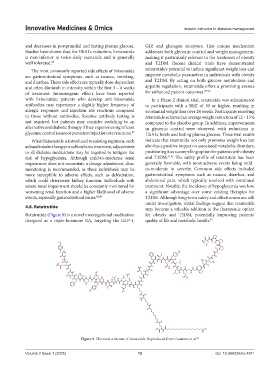
            Retatrutide (Figure 9) is a novel investigational medication   for  obesity and  T2DM,  potentially improving  patients’
            designed as a triple-hormone RA, targeting the GLP-1,   quality of life and metabolic health. 93


                                    Figure 9. Chemical structure of retatrutide. Reproduced from Caturano et al. 94


            Volume 2 Issue 1 (2025)                         12                               doi: 10.36922/imo.4911

