


Page 14 - IMO-2-1
P. 14
Innovative Medicines & Omics                                       Incretin mimetics in diabetes management


            against sepsis-induced myocardial injury.  In sepsis,   the most common form of heart failure, with its onset and
                                                55
            nitric oxide synthase overactivity leads to excessive nitric   progression significantly influenced by obesity and T2DM.
            oxide production, which, along with superoxide radicals,   Patients with heart failure and preserved ejection fraction
            forms peroxynitrite. Peroxynitrite interferes with cardiac   (HFpEF)) are more likely to have T2DM individuals
            function by modifying cardiac load, downregulating   without heart failure, and this association is linked to
            β-adrenergic receptors, impairing Type I calcium channel   worse hemodynamic and clinical outcomes, such as higher
            function, and reducing the efficiency of the mitochondrial   symptom burden and reduced functional capacity. Few
            electron  transport  chain  complex  in  cardiac  cells.    effective treatment options exist for this population. 59
                                                         55
            Dulaglutide therapy drastically reduces nitric oxide   Ozempic, a semaglutide-based GLP-1 RA, is indicated
            production and nitric oxide synthase expression induced   for T2DM management, with dosing that begins at
            by LPS, indicating that dulaglutide may inhibit nitric oxide   0.25  mg weekly for 4  weeks, then increases to 0.5  mg,
            synthase activation driven by inflammatory factors. 56  and may reach 1  mg if needed for glycemic control.

            4.4. Semaglutide                                   Administered subcutaneously, Ozempic enhances insulin
                                                               secretion, suppresses glucagon release, and slows gastric
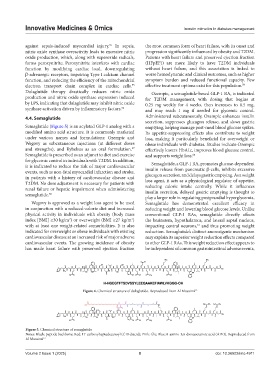
            Semaglutide (Figure 5) is an acylated GLP-1 analog with a   emptying, helping manage post-meal blood glucose spikes.
            modified amino acid structure. It is commonly marketed   Its appetite-suppressing effects also contribute to weight
            under various names and formulations: Ozempic and   loss, making it particularly beneficial for overweight or
            Wegovy as subcutaneous injections (at different doses   obese individuals with diabetes. Studies indicate Ozempic
            and strengths), and Rybelsus as an oral formulation.    effectively lowers HbA1c, improves blood glucose control,
                                                         57
            Semaglutide is prescribed as an adjunct to diet and exercise   and supports weight loss. 60
            for glycemic control in individuals with T2DM. In addition,
            it is indicated to reduce the risk of major cardiovascular   Semaglutide, a GLP-1 RA, promotes glucose-dependent
            events, such as non-fatal myocardial infarction and stroke,   insulin release from pancreatic β-cells, inhibits excessive
                                                               glucagon secretion, and delays gastric emptying. As a weight
            in patients with a history of cardiovascular disease and   loss agent, it acts as a physiological regulator of appetite,
            T2DM. No dose adjustment is necessary for patients with   reducing  caloric intake centrally. While it  influences
            renal  failure or  hepatic  impairment when  administering   insulin secretion, delayed gastric emptying is thought to
            semaglutide. 58
                                                               play a larger role in regulating postprandial hyperglycemia.
              Wegovy is approved as a weight loss agent to be used   Semaglutide has demonstrated excellent efficacy in
            in conjunction with a reduced-calorie diet and increased   reducing weight and lowering blood glucose levels. Unlike
            physical  activity  in  individuals  with  obesity  (body  mass   conventional  GLP-1  RAs,  semaglutide  directly  affects
            index [BMI] ≥30 kg/m ) or overweight (BMI ≥27 kg/m )   the brainstem, hypothalamus, and lateral septal nucleus,
                              2
                                                         2
            with at least one weight-related comorbidities. It is also   impacting central neurons,  and thus promoting weight
                                                                                     61
            indicated for overweight or obese individuals with existing   reduction. Semaglutide’s distinct anorexigenic mechanism
            cardiovascular disease at an increased risk of major adverse   may explain its superior weight reduction effects compared
            cardiovascular events. The  growing  incidence  of  obesity   to other GLP-1 RAs. This weight reduction effect appears to
            has made heart failure with preserved ejection fraction   be independent of common gastrointestinal adverse events,


                                    Figure 4. Chemical structure of dulaglutide. Reproduced from Al Musaimi 12


            Figure 5. Chemical structure of semaglutide
            Notes: Black: peptide backbone; Red: 17-carboxyheptadecanoyl (C18 diacid); Pink: Glu; Blue: 8-amino-3,6-dioxaoctanoic acid (ADO). Reproduced from
            Al Musaimi 12


            Volume 2 Issue 1 (2025)                         8                                doi: 10.36922/imo.4911

