


Page 47 - IMO-2-2
P. 47
Innovative Medicines & Omics                                           Alzheimer’s disease and clinical trials


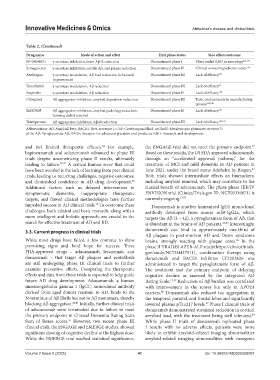
            Table 2. (Continued)
            Drug name              Mode of action and effect        Trial phase status    Side effects/outcome
            PF-06648671  γ-secretase inhibition, brain Aβ42 reduction  Discontinued phase I  Pfizer ended R&D in neurology 112,136
            Semagacestat  γ-secretase inhibition, soluble Aβ, and plaque reduction  Discontinued phase II  Clinical worsening/adverse events 126
            Azeliragon  γ-secretase modulation, Aβ load reduction, behavioral   Discontinued phase III  Lack of efficacy 137
                       improvement
            Tarenflurbil  γ-secretase modulation, Aβ reduction   Discontinued phase III  Lack of efficacy 94
            Ibuprofen  γ-secretase modulation, Aβ reduction      Discontinued phase II  Lack of efficacy 138
            Clioquinol  Aβ aggregation inhibition, amyloid deposition reduction  Discontinued phase III  Toxic contaminants in manufacturing
                                                                                    process 139,140
            ELND005    Aβ aggregation inhibition, amyloid pathology reduction,   Discontinued phase II  Lack of efficacy 141
                       learning deficit restored
            Tramiprosate  Aβ aggregation inhibition, Aβ40 reduction  Discontinued phase III  Lack of efficacy 142,143
            Abbreviations: Aβ: Amyloid-beta; BACE1: Beta-secretase 1; CSF: Cerebrospinal fluid; mGluR5: Metabotropic glutamate receptor 5;
            pGlu-Aβ: Pyroglutamate Aβ; RAGE: Receptor for advanced glycation end-products; R&D: Research and development.

            and (iv) limited therapeutic efficacy.  For example,   the ENGAGE trial did not meet the primary endpoint.
                                            54
                                                                                                            17
            bapineuzumab and solanezumab advanced to phase III   Based on these results, the US FDA approved aducanumab,
            trials despite unconvincing phase II results, ultimately   through an “accelerated approval pathway,” for the
            leading  to  failure. 75-77  A  critical human error  that  could   treatment of MCI and mild dementia in AD patients in
                                                                                                            82
            have been avoided is the lack of learning from past clinical   June 2021, under the brand name Aduhelm by Biogen.
            trials, leading to recurring challenges, negative outcomes,   Both  trials  showed intermediate  effects  on biomarkers,
                                                         78
            and diminished confidence in AD drug development.    including amyloid removal, which may contribute to the
            Additional factors such as delayed intervention in   clinical benefit of aducanumab. The phase phase IIIb/IV
            symptomatic  dementia,  inappropriate  therapeutic  ENVISION trial (ClinicalTrials.gov ID: NCT05310071) is
            targets, and flawed clinical methodologies have further   currently ongoing. 17,57
            impeded success in AD clinical trials.  To overcome these   Donanemab is another humanized IgG1 monoclonal
                                          79
            challenges, both clinical and basic research, along with a   antibody  developed  from  mouse  mE8-IgG2a,  which
            more intelligent and holistic approach, are crucial in the   targets the Aβ (3 – 42), a pyroglutamate form of Aβ, that
            search for effective treatment of AD and RD.       is abundant in the brains of AD patients. 83,84  Interestingly,

            3.3. Current progress in clinical trials           donanemab can bind to approximately one-third of
                                                               Aβ plaques in post-mortem AD and Down syndrome
            While  most  drugs  have  failed,  a  few  continue  to  show   brains, strongly reacting with plaque cores.  In the
                                                                                                     85
            promising signs and hold hope for success. Three   phase II TRAILBLAZER-ALZ study (https://clinicaltrials.
            FDA-approved  drugs  –  aducanumab,  lecanemab,  and   gov/study/NCT04437511), combination therapy using
            donanemab – that target Aβ plaques and protofibrils   donanemab and BACE1 inhibitor LY3202626 was
            are still undergoing phase III clinical trials to further   administered to target the pyroglutamate form of Aβ.
            examine preventive effects. Comparing the therapeutic   The treatment met the primary endpoint of delaying
            effects and data from these trials is expected to help guide   cognitive decline as assessed by the Integrated AD
            future  AD  drug  development. Aducanumab, a  human   Rating Scale. 17,57  Reduction of Aβ burden was correlated
            immunoglobulin  gamma  1  (IgG1)  monoclonal  antibody   with improvement in the scores but only in APOE4
            derived from aged donors resistant to AD, binds to the   carriers.   Donanemab also  reduced  tau  aggregation  in
                                                                      86
            N-terminus of Aβ fibrils but not to Aβ monomers, thereby   the temporal, parietal, and frontal lobes and significantly
            blocking Aβ aggregation. 80,81  Initially, further clinical trials   lowered plasma pTau217 levels.  Phase I clinical trials of
                                                                                         87
            of aducanumab were terminated due to failure to meet   donanemab demonstrated sustained reduction in cortical
            the primary endpoint in Clinical Dementia Rating Scale   amyloid load, with the treatment being well tolerated.
                                                                                                            88
            Sum of Boxes scores.  However, two recent phase III   While  phase  II  trials  of  donanemab  replicated  phase
                              57
            clinical trials, the ENGAGE and EMERGE studies, showed   I results with no adverse effects, patients were more
            significant slowing of cognitive decline at the highest dose.   likely to exhibit amyloid-related imaging abnormalities
            While the EMERGE trial reached statistical significance,   amyloid-related imaging abnormalities with vasogenic


            Volume 2 Issue 2 (2025)                         41                          doi: 10.36922/IMO025050007

