


Page 59 - IMO-2-2
P. 59
Innovative Medicines & Omics                                        Open source bioinformatics tools in Africa


            1.3. Overview of open-source bioinformatics tools     still lacking in many parts of Sub-Saharan Africa,

            Tools such as Bioconductor, Galaxy, R, and Python     preventing large-scale bioinformatics projects
            libraries (e.g., Biopython) provide accessible, robust   (ii)  Training  needs:  The  shortage  of  skilled
            functionalities for data analysis, molecular docking, and   bioinformaticians is another challenge, stemming
            genomic sequencing. By reducing financial barriers,   from a lack of formal education programs. Initiatives
            they democratize research, allowing African scientists   such asthe Pan African Bioinformatics Network for
            to perform sophisticated bioinformatics tasks without   the Human Heredity and Health in Africa aim to
            relying on expensive proprietary software. Many       bridge this gap by offering specialized training and
                                                                                    14
            platforms also support collaborative cloud-based research,   building local capacity
            addressing infrastructural challenges faced by African   (iii) Data  ownership:  African  researchers  often  face
            institutions. 38                                      challenges maintaining control over their data, due
                                                                  to reliance on international collaborators with more
            1.4. Applications in genomics and healthcare          advanced infrastructure.
            Several real-world examples highlight the transformative   The literature highlights the transformative role of
            potential of open-source tools in Africa:          open-source bioinformatics tools in  resource-limited
            (i)  Genomic studies: Platforms have supported crop   settings. These tools are essential for addressing specific
               genome sequencing, facilitating the development of   African challenges in healthcare, agriculture, and disease
               drought-resistant varieties. This is vital for improving   research. However, more documentation of practical
               food security in the face of climate change 39  applications is needed. This study aims to fill that gap by
            (ii)  Infectious disease research: During outbreaks such   showcasing concrete examples and success stories across
               as Ebola and COVID-19, tools such as Galaxy and   the continent.
               Nextstrain helped analyze viral genomes, track
               mutations, and model epidemics in real-time, shaping   2. Methodology
               public health responses                         2.1. Data collection
            (iii) Drug discovery: Open-source platforms such as
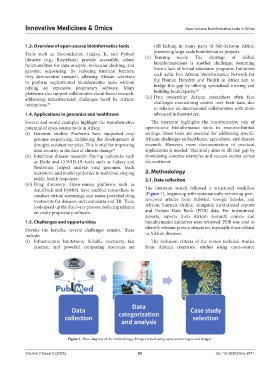
               AutoDock and PyMOL have enabled researchers to   The literature  search  followed a  structured workflow
               conduct virtual screenings and assess potential drug   (Figure 1), beginning with systematically retrieving peer-
               treatments for diseases such asmalaria and TB. These   reviewed articles from PubMed, Google Scholar, and
               tools speed up the discovery process, reducing reliance   African Journals Online, alongside institutional reports
               on costly proprietary software.                 and Protein Data Bank (PDB) data. For institutional
                                                               reports, reports from African research centers and
            1.5. Challenges and opportunities                  bioinformatics initiatives were reviewed. PDB was used to
            Despite the benefits, several challenges remain. These   identify relevant protein structures, especially those related
            include:                                           to African diseases.
            (i)  Infrastructure limitations: Reliable electricity, fast   The inclusion criteria of the review included studies
               internet,  and  powerful  computing  resources  are   from African countries, studies using open-source


                              Figure 1. Flow diagram of the methodology. Image created using open-source logos and images.


            Volume 2 Issue 2 (2025)                         53                               doi: 10.36922/imo.8111

