


Page 60 - IMO-2-2
P. 60
Innovative Medicines & Omics                                        Open source bioinformatics tools in Africa


            bioinformatics tools, and studies encompassing the fields   (e.g., how structural biology tools support disease research
            of genomics, drug discovery, and disease surveillance.  or agricultural advancements) for a more comprehensive
                                                               insight.
            2.2. Data categorization
            Data was organized into three key categories: (i) genomics   2.4. Case study selection
            (human and agricultural genomic studies), (ii) infectious   Representative examples were chosen from impactful
            disease research (viral genome analysis), and (iii) drug   case studies illustrating the use of open-source tools and
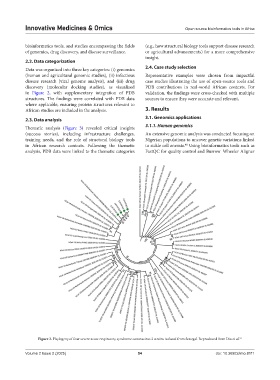
            discovery (molecular docking studies), as visualized   PDB contributions in real-world African contexts. For
            in  Figure  2, with supplementary integration of PDB   validation, the findings were cross-checked with multiple
            structures. The findings were correlated with PDB data   sources to ensure they were accurate and relevant.
            where applicable, ensuring protein structures relevant to
            African studies are included in the analysis.      3. Results

            2.3. Data analysis                                 3.1. Genomics applications
            Thematic analysis (Figure  3) revealed critical insights   3.1.1. Human genomics
            (success stories), including infrastructure challenges,   An extensive genomic analysis was conducted focusing on
            training needs, and the role of structural biology tools   Nigerian populations to uncover genetic variations linked
                                                                                40
            in African research contexts. Following the thematic   to sickle cell anemia.  Using bioinformatics tools such as
            analysis, PDB data were linked to the thematic categories   FastQC for quality control and Burrow–Wheeler Aligner


                 Figure 2. Phylogeny of four severe acute respiratory syndrome coronavirus 2 strains isolated from Senegal. Reproduced from Dia et al. 59


            Volume 2 Issue 2 (2025)                         54                               doi: 10.36922/imo.8111

