


Page 89 - IMO-2-2
P. 89
Innovative Medicines & Omics                                        Femtomolar inhibition of pseudoeriocitrin


            worldwide were infected with Enterobius vermicularis in   A                B
            2015. 3
              β-tubulin, carnitine o-palmitoyltransferase-2 (CPT 2),
            and fumarate reductase have recently been the primary
            antinematodal targets for the development of several
            anthelmintics,  such as albendazole, mebendazole,
            ivermectin, and thiabendazole. Due to the unknown
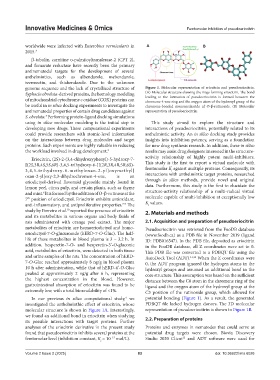
            genome sequence and the lack of crystallized structure of   Figure  1. Molecular representation of eriocitrin and pseudoeriocitrin.
            Syphacia obvelata-derived proteins, the homology modeling   (A) Molecular structure showing the rings forming eriocitrin. The bond
            of mitochondrial cytochrome c oxidase (COX) proteins can   leading to the formation of pseudoeriocitrin is formed between the
                                                               chromene-4-one ring and the oxygen atom of the hydroxyl group of the
            be useful in in silico docking experiments to investigate the   chromene-bonded monosaccharide of O-β-rutinoside. (B) Molecular
            antinematodal properties of certain drug candidates against   representation of pseudoeriocitrin.
            S. obvelata.  Performing protein-ligand docking simulations
                    4
            using  in silico molecular modeling is the initial step in   This study aimed to explore the structure and
            developing new drugs. These computational experiments   interactions of pseudoeriocitrin, potentially related to its
            could provide researchers with atomic-level information   anthelmintic activity. An in silico docking study provides
            on the interactions between drug molecules and target   insights into inhibition potency, serving as a foundation
            proteins. Such experiments are highly valuable in reducing   for new drug synthesis research. In addition, these in silico
            the workload involved in drug development. 5       results may assist drug designers interested in the structure-

              Eriocitrin, (2S)-2-(3,4-dihydroxyphenyl)-5-hydroxy-7-  activity  relationship  of  highly  potent  multi-inhibitors.
            [(2S,3R,4S,5S,6R)-3,4,5-trihydroxy-6-[[(2R,3R,4R,5R,6S)-  This study is the first to report a virtual molecule with
            3,4,5-trihydroxy-6-methyloxan-2-yl]oxymethyl]      femtomolar K against multiple proteins. Consequently, its
                                                                          i
            oxan-2-yl]oxy-2,3-dihydrochromen-4-one,  is  an    interactions with anthelmintic target proteins, researched
            eriodictyol-derived flavonoid glycoside mainly found in   through  in silico  methods, provide novel and original
            lemon peel, citrus pulp, and certain plants, such as thyme   data. Furthermore, this study is the first to elucidate the
            and mint.  It is formed by the addition of O-β-rutinose at the   structure-activity relationship of a multi-radical virtual
                   6
            7  position of eriodictyol. Eriocitrin exhibits antioxidant,   molecule capable of multi-inhibition at exceptionally low
             th
            anti-inflammatory, and antiproliferative properties.  The   K values.
                                                     7-9
                                                                i
            study by Ferreira et al.  reported the presence of eriocitrin   2. Materials and methods
                             10
            and its metabolites in various organs and body fluids of
            rats administered with orange peel extract. The major   2.1. Acquisition and preparation of pseudoeriocitrin
            metabolites of eriocitrin are homoeriodictyol and homo-  Pseudoeriocitrin was retrieved from the FooDB database
            eriodictyol-7-O-glucuronide (hERD-7-O-Gluc). The half-  (www.foodb.ca) as a PDB file in November 2019 (ligand
            life of these metabolites in blood plasma is 3 – 3.2 h. In   ID: FDB016547). In the PDB file, deposited as eriocitrin
            addition, hesperetin-7-O-  and hesperetin-3’-O-gluconic   in the FooDB database, all Z coordinates were set to 0.
            acid, metabolites of eriocitrin, were detected in both tissue   This PDB file was converted to a PDBQT file using the
            and urine samples of the rats. The concentration of hERD-  AutoDock Tool (ADT). 11,12  When the Z coordinates were
            7-O-Gluc reached approximately 8 ng/g in blood plasma   0, the ADT program ignored the hydrogen atoms in the
            10 h after administration, while that of hERD-4’-O-Gluc   hydroxyl groups and assumed an additional bond in the
            peaked at approximately 2  ng/g after 6  h, representing   core structure. This assumption was based on the sufficient
            the highest concentration in the blood. However,   distance between the C8 atom in the chromene ring of the
            gastrointestinal absorption of eriocitrin was found to be   ligand and the oxygen atom of the hydroxyl group at the
            extremely low, with a total bioavailability of <1%.  C3 position of the rutinoside group, which allowed for
              In our previous  in silico computational study,  we   potential bonding (Figure  1). As a result, the generated
                                                      4
            investigated the anthelminthic effect of eriocitrin, whose   PDBQT  file  lacked  hydrogen  donors.  The  3D  molecular
            molecular structure is shown in Figure 1A. Interestingly,   representation of pseudoeriocitrin is shown in Figure 1B.
            we found an additional bond in eriocitrin when studying
            its  possible  interactions with  target  proteins. Further   2.2. Preparation of proteins
            analyses of the eriocitrin derivative in the present study   Proteins and enzymes in nematodes that could serve as
            found that pseudoeriocitrin inhibits several proteins at the   potential drug targets were chosen. Biovia Discovery
            femtomolar level (inhibition constant, K = 10  mol/L).  Studio 2020 Client  and ADT software were used for
                                                                               13
                                                −17
                                            i
            Volume 2 Issue 2 (2025)                         83                               doi: 10.36922/imo.6026

