


Page 92 - IMO-2-2
P. 92
Innovative Medicines & Omics                                        Femtomolar inhibition of pseudoeriocitrin


                         A                                    B


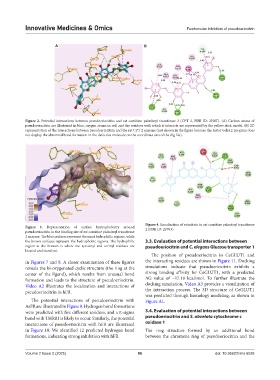
            Figure  2. Potential interactions between pseudoeriocitrin and rat carnitine palmitoyl transferase 2 (CPT 2, PDB ID: 2H4T). (A)  Carbon atoms of
            pseudoeriocitrin are illustrated in blue, oxygen atoms in red, and the residues with which it interacts are represented by the yellow stick model. (B) 2D
            representation of the interactions between pseudoeriocitrin and the rat CPT 2 enzyme (not shown in the figure because the AutoDock4.2 program does
            not display the abnormal bond formation in the defective molecule on the coordinate axis of the dlg file).


                                                               Figure 4. Localization of eriocitrin in rat carnitine palmitoyl transferase
            Figure  3.  Representation  of  surface  hydrophobicity  around   2 (PDB ID: 2FW3)
            pseudoeriocitrin in the binding site of rat carnitine palmitoyl transferase
            2 enzyme. The blue surfaces represent the most hydrophilic regions, while
            the brown surfaces represent the hydrophobic regions. The hydrophilic   3.3. Evaluation of potential interactions between
            region at the bottom is where the tyrosinyl and serinyl residues are   pseudoeriocitrin and C. elegans Glucose transporter 1
            located and stand out.
                                                                 The position of pseudoeriocitrin in CeGLUT1 and
            in Figures 7 and 8. A closer examination of these figures   the interacting residues are shown in Figure 11. Docking
            reveals the bi-oxygenated cyclic structure (the ring at the   simulations  indicate  that  pseudoeriocitrin  exhibits  a
            center of the ligand), which results from unusual bond   strong binding affinity for CeGLUT1, with a predicted
            formation and leads to the structure of pseudoeriocitrin.   ΔG value of −17.18 kcal/mol. To  further  illustrate the
            Video A2 illustrates the localization and interactions of   docking simulation, Video A3 provides a visualization of
            pseudoeriocitrin in hFR.                           the interaction process. The 3D structure of CeGLUT1
                                                               was predicted through homology modeling, as shown in
              The potential interactions of pseudoeriocitrin with   Figure A1.
            AsFR are illustrated in Figure 9. Hydrogen bond formations
            were predicted with five different residues, and a π-sigma   3.4. Evaluation of potential interactions between
            bond with THR81 is likely to occur. Similarly, the potential   pseudoeriocitrin and S. obvelata cytochrome c
            interactions of pseudoeriocitrin with hFR are illustrated   oxidase 1
            in Figure 10. We identified 12 predicted hydrogen bond   The ring structure formed by an additional bond
            formations, indicating strong inhibition with hFR.  between the chromene ring of pseudoeriocitrin and the


            Volume 2 Issue 2 (2025)                         86                               doi: 10.36922/imo.6026

