


Page 96 - IMO-2-2
P. 96
Innovative Medicines & Omics                                        Femtomolar inhibition of pseudoeriocitrin


              The  selectivity  index  for  pseudoeriocitrin  was   4. Discussion
            calculated to be 152,542, comparing the SoCOX1 enzyme               28
            to  the  SoCOX2  enzyme  based  on  their  K  values.  The   Recent in silico studies  demonstrated that a new interaction
                                                i
            3D structures of both enzymes were predicted using   can be formed within a morin molecule by calculating
            homology modeling through the SwissModel web server.   and comparing the enthalpy changes necessary for the
            This  in silico analysis indicates that pseudoeriocitrin is   conformational change that enables an intramolecular
            more effective at inhibiting the SoCOX1 enzyme than the   bond.  This  new  conformation  allows  morin  to  enhance
            SoCOX2 enzyme.                                     its  radical  scavenging  activity  while  adopting  a  planar
                                                               structure. As a flavone, morin achieves a planar extension
              Pseudoeriocitrin inhibits both AsFR and hFR homolog   of its flavone core, leading to the formation of a ring, that
            enzymes. In this case, the selectivity of pseudoeriocitrin   is, parallel to this core. This condition mirrors the flavone
            for nematode FR is lower than that for human FR, making   structure examined in our study. The bonds that form
            it less ideal as a ligand for FR inhibition.       between the flavone core and the rutinoside group increase
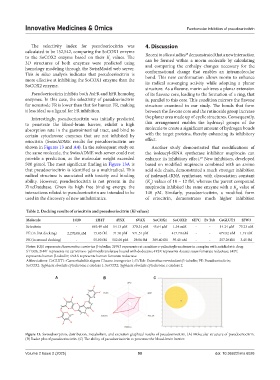
              Interestingly, pseudoeriocitrin was initially predicted   the planar area made up of cyclic structures. Consequently,
            to penetrate the blood-brain barrier, exhibit a high   this arrangement enables the hydroxyl groups of the
            absorption rate in the gastrointestinal tract, and bind to   molecule to create a significant amount of hydrogen bonds
            certain cytochrome enzymes that are not inhibited by   with the target proteins, thereby enhancing its inhibitory
            eriocitrin (SwissADME results for pseudoeriocitrin are   effect.
            shown in Figures 13 and A4). In the subsequent study on   Another study demonstrated that modifications of
            the same molecule, the SwissADME web server could not   the isoleucyl-tRNA synthetase inhibitor mupirocin can
            provide a prediction, as the molecular weight exceeded   enhance its inhibitory effect.  New inhibitors, developed
                                                                                      29
            500 g/mol. The most significant finding in Figure 13A is   based on modified mupirocin combined with an amino
            that pseudoeriocitrin is identified as a multiradical. This   acid side chain, demonstrated a much stronger inhibition
            radical structure is associated with toxicity and binding   of isoleucyl-tRNA synthetase, with dissociation constant
            ability. However, pseudoeriocitrin is not present in the   (K ) values of 10 – 12 fM, whereas the parent compound
                                                                 d
            ZincDatabase. Given its high free binding energy, the   mupirocin inhibited the same enzyme with a K  value of
                                                                                                      d
            interactions related to pseudoeriocitrin are intended to be   140  pM.  Similarly, pseudoeriocitrin, a  modified  form
            used in the discovery of new anthelmintics.        of eriocitrin, demonstrates much higher inhibition

            Table 2. Docking results of eriocitrin and pseudoeriocitrin (Ki values)

            Molecule            1OJ0      2H4T    4YSX     6VAX   SoCOX1   SoCOX2  6E7C  Ev Tub  CeGLUT1  2FW3
            Eriocitrin           -      663.49 nM  14.13 µM  370.31 pM  45.64 µM  1.34 mM  -  -  14.24 µM  75.23 nM
            PE (in first docking)  2,270.00 µM  15.83 fM  71.76 pM  971.51 pM  -  417.70 nM  -  -  479.82 nM  1.19 nM
            PE (in second docking)  -    55.00 fM  512.00 pM  29.86 fM  389.40 fM  59.40 nM  -  -  257.26 fM  3.45 fM
            Notes: 1OJ0 represents Haemonchus contortus β-tubulin; 2FW3 represents rat carnitine o-palmitoyltransferase in complex with antidiabetic drug
            ST1326; 2H4T represents rat carnitine o-palmitoyltransferase bound with dodecane; 4YSX represents Ascaris suum fumarate reductase; 6E7C
            represents human β-tubulin; 6VAX represents human fumarate reductase.
            Abbreviations: CeGLUT1: Caenorhabditis elegans Glucose transporter 1; EvTub: Enterobius vermicularis β-tubulin; PE: Pseudoeriocitrin;
            SoCOX1: Syphacia obvelata cytochrome c oxidase 1; SoCOX2: Syphacia obvelata cytochrome c oxidase 2.

                         A                   B                    C


            Figure 13. Swissabsorption, distribution, metabolism, and excretion graphical results of pseudoeriocitrin. (A) Molecular structure of pseudoeriocitrin.
            (B) Radar plot of pseudoeriocitrin. (C) The ability of pseudoeriocitrin to penetrate the blood-brain barrier.


            Volume 2 Issue 2 (2025)                         90                               doi: 10.36922/imo.6026

