


Page 84 - IMO-2-3
P. 84
Innovative Medicines & Omics                                  Synthesis and docking of diorganotin (IV) chelates


            including Glu060, Met148, Gly189, Arg220, His257, and   penetration. Furthermore, compounds should possess no
            Ile020,  thereby  considerably  expanding  its  interaction   more than five hydrogen bond donors and 10 hydrogen
            network. These additional contacts are likely to strengthen   bond acceptors to ensure good membrane permeability.
            binding affinity through a combination of hydrogen   The number of rotatable bonds should ideally be 10 or
            bonding, electrostatic interactions, and hydrophobic   fewer, which contributes to conformational flexibility
            effects. Overall, these findings suggest that ligand L-4,   and oral bioavailability. Finally, zero to one violation of
            followed by L-3, holds significant potential as a promising   Lipinski’s rules is generally acceptable for a compound to
            antibacterial agent targeting dihydropteroate synthase and   be considered drug-like.
            transpeptidase enzymes.                              As shown in Table 8, the four ligands exhibit distinct
            3.4. Prediction of drug-likeness of ligands by the   drug-likeness profiles, determined by their compliance with
            SwissADME tool                                     Lipinski’s rule of five and core physicochemical properties.
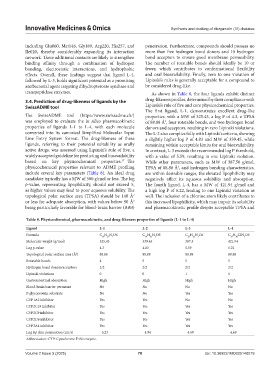
                                                               The first ligand, L-1, demonstrates excellent drug-like
            The SwissADME tool (https://www.swissadme.ch/)     properties, with a MW of 325.43, a log P of 4.3, a TPSA
            was employed to evaluate the  in silico pharmacokinetic   of 88.88 Å , four rotatable bonds, and two hydrogen bond
                                                                       2
            properties of ligands L-1 to L-4, with each molecule   donors and acceptors, resulting in zero Lipinski violations.
            converted into its canonical Simplified Molecular Input   The L-2 also complies fully with Lipinski’s criteria, showing
            Line  Entry  System  format.  The  drug-likeness  of  these   a slightly higher log P of 4.83 and MW of 339.45, while
            ligands, referring to their potential suitability as orally   remaining within acceptable limits for oral bioavailability.
            active drugs, was assessed using Lipinski’s rule of five, a   In contrast, L-3 exceeds the recommended log P threshold,
            widely accepted guideline for predicting oral bioavailability   with a value of 5.59, resulting in one Lipinski violation.
            based on key physicochemical properties. 37   The   While other parameters, such as MW of 387.50  g/mol,
            physicochemical properties relevant to ADME profiling   TPSA of 88.88 Å , and hydrogen bonding characteristics,
                                                                             2
            include several key parameters (Table 8). An ideal drug   are within desirable ranges, the elevated lipophilicity may
            candidate typically has a MW of 500 g/mol or less. The log   negatively  affect  its  aqueous  solubility  and absorption.
            p-value, representing lipophilicity, should not exceed 5,   The fourth ligand, L-4, has a MW of 421.94  g/mol and
            as higher values may lead to poor aqueous solubility. The   a high log P of 6.22, leading to one Lipinski violation as
            topological polar surface area (TPSA) should be 140 Å    well. The inclusion of a chlorine atom likely contributes to
                                                          2
            or less for adequate absorption, with values below 90 Å    this increased lipophilicity, which may impair its solubility
                                                          2
            being particularly favorable for blood-brain barrier (BBB)   and pharmacokinetic profile despite acceptable TPSA and

            Table 8. Physicochemical, pharmacokinetic, and drug‑likeness properties of ligands (L‑1 to L‑4)
            Ligand                         L‑1                L‑2               L‑3               L‑4
            Formula                        C H N OS           C H N OS          C H N OS          C H ClN OS
                                            18  19  3          19  21  3         23  21  3         23  20  3
            Molecular weight (g/mol)       325.43             339.45            387.5             421.94
            Log p-value                    4.3                4.83              5.59              6.22
            Topological polar surface area (Å )  88.88        88.88             88.88             88.88
                                 2
            Rotatable bonds                4                  5                 5                 5
            Hydrogen bond donors/acceptors  2/2               2/2               2/2               2/2
            Lipinski violations            0                  0                 1                 1
            Gastrointestinal absorption    High               High              High              High
            Blood-brain barrier permeant   No                 No                No                No
            P-glycoprotein substrate       No                 No                Yes               Yes
            CYP1A2 inhibitor               Yes                Yes               No                No
            CYP2C19 inhibitor              Yes                Yes               Yes               Yes
            CYP2C9 inhibitor               Yes                Yes               Yes               Yes
            CYP2D6 inhibitor               Yes                Yes               Yes               Yes
            CYP3A4 inhibitor               Yes                Yes               Yes               Yes
            Log Kp skin permeation (cm/s)  −5.23              −4.94             −4.69             −4.69
            Abbreviation: CYP: Cytochrome P450 enzyme.


            Volume 2 Issue 3 (2025)                         78                          doi: 10.36922/IMO025140019

