


Page 82 - IMO-2-3
P. 82
Innovative Medicines & Omics                                  Synthesis and docking of diorganotin (IV) chelates


            Table 7. Comparative binding energies and key residue   Table 7. (Continued)
            interactions of test ligands (L‑1 to L‑4) and control drugs
            (cephalosporin and sulfamethoxazole) with bacterial   Ligands   Target   Binding  Active amino acid and
            target proteins: transpeptidase (5TW8, 6NTW) and                protein  energy hydrogen bond interaction
            dihydropteroate synthase (1AD4, 5V7A)               L-3         5V7A    −7.48  Arg 063, Thr 062, Phe 190,
                                                                                          Lys 221, Arg 255, His 257, Ser
            Ligands      Target   Binding  Active amino acid and                          219, Asp 096
                         protein  energy hydrogen bond interaction  L-4     5V7A    −9.10  Glu 060, Ser 061, Met 148,
            Cephalosporin  5TW8  −5.72  Ser 139, Ser 262, Arg 186,                        Phe 190, Gly 189, Arg 220,
                                       Glu 183, Ser 075, Ser 116, Lys                     His 257, Ile 020, Thr 062, Arg
                                       078, Ala 074                                       063, Arg 255
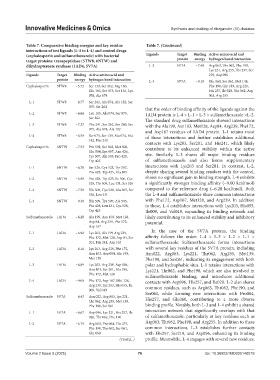
             L-1         5TW8    −6.77  Ser 262, Ala 074, Ala 182, Ser
                                       075, Ser 262            that the order of binding affinity of the ligands against the
             L-2         5TW8    −6.66  Leu 115, Ala 074, Ser 075,   1AD4 protein is L-4 > L-1 > L-3 > sulfamethoxazole >L-2.
                                       Ser 262                 The standard drug sulfamethoxazole showed interactions
             L-3         5TW8    −7.27  Phe 241, Ser 262, Ser 260, Ser   with the Ala199, Asn103, Met128, Asp84, Arg239, Phe172,
                                       075, Ala 074, Ala 182   and Asp167 residues of 1AD4 protein. L-1 retains most
             L-4         5TW8    −8.50  Ser 075, Ser 139, Ala 074, Ala   of these interactions and further establishes additional
                                       182, Phe 241            contacts  with  Lys203,  Ser201,  and  His241,  which  likely
            Cephalosporin  6NTW  −7.53  Pro 501, Ser 502, Met 500,   contribute to its enhanced stability within the active
                                       Glu 504, Lys 497, Asn 426,
                                       Tyr 507, Ala 505, Pro 428,   site. Similarly, L-3 shares all major binding residues
                                       Trp 425                 of sulfamethoxazole and also forms supplementary
             L-1         6NTW    −6.78  Ser 526, Cys 528, Tyr 507,   interactions with Lys203 and Ser201. In contrast, L-2,
                                       Pro 428, Trp 425, Ala 505  despite sharing several binding residues with the control,
             L-2         6NTW    −6.88  Pro 428, Trp 425, Ile 506, Cys   shows no significant gain in binding strength. L-4 exhibits
                                       528, His 509, Leu 431, Ser 526  a significantly stronger binding affinity (−9.00 kcal/mol)
             L-3         6NTW    −7.50  His 509, Cys 528, Ala 505, Ser   compared to the reference drug (−6.20 kcal/mol). Both
                                       526, Leu 431            the L-4 and sulfamethoxazole share common interactions
             L-4         6NTW    −9.48  His 509, Tyr 507, Ala 505,   with  Phe172,  Asp167,  Met128,  and  Arg239.  In  addition
                                       Pro 428, Leu 431, Cys 528,   to these, L-4 establishes interactions with Lys203, His055,
                                       Trp 425                 Ile009, and Val049, expanding its binding network and
            Sulfamethoxazole  1AD4  −6.20  Ala 199, Asn 103, Met 128,   likely contributing to its enhanced stability and inhibitory
                                       Asp 84, Arg 239, Phe 172,   potential.
                                       Asp 167
             L-1         1AD4    −6.98  Lys 203, Ala 199 Arg 239,   In the case of the 5V7A protein, the binding
                                       Phe 172, Met 128, Asp 84, Ser   affinity  follows  the  order:  L-4  >  L-3  >  L-2  >  L-1  >
                                       201, His 241, Asn 103   sulfamethoxazole. Sulfamethoxazole forms interactions
             L-2         1AD4    −6.16  Lys 203, Arg 239, Phe 172,   with several key residues of the 5V7A protein, including
                                       Asn 103, Asp 084, Ala 199,   Asn022, Arg063, Lys221, Thr062, Arg255, Met139,
                                       Met 128                 Phe190, and Ser061, indicating its engagement with both
             L-3         1AD4    −6.89  Lys 203, Arg 239, Asp 084,   polar and hydrophobic sites. L-1 retains interactions with
                                       Asn 103, Ser 201, Ala 199,   Lys221, Thr062, and Phe190, which are also involved in
                                       Phe 172, Met 128        sulfamethoxazole binding, and introduces additional
             L-4         1AD4    −9.00  Phe 172, Asp 167, Met 128,   contacts with Asp096, His257, and Ile020. L-2 also shares
                                       Arg 239, Lys 203, His 055, Ile   common residues, such as Arg063, Thr062, Phe190, and
                                       009, Val 049
            Sulfamethoxazole  5V7A  −6.43  Asn 022, Arg 063, Lys 221,   Ser061, while forming new interactions with Pro064,
                                                               His257, and Glu060, contributing to a more diverse
                                       Thr 062, Arg 255, Met 139,
                                       Phe 190, Ser 061        binding profile. Notably, both L-3 and L-4 exhibit a shared
             L-1         5V7A    −6.67  Asp 096, Lys 221, His 257, Ile   interaction network that significantly overlaps with that
                                       020, Thr 062, Phe 190   of sulfamethoxazole, particularly at key residues such as
             L-2         5V7A    −6.79  Arg 063, Pro 064, His 257,   Arg063, Thr062, Phe190, and Arg255. In addition to these
                                       Phe 190, Thr 062, Ser 061,   common interactions, L-3 establishes further contacts
                                       Glu 060                 with His257, Ser219, and Asp096, enhancing its binding
                                                    (Cont'd...)   profile. Meanwhile, L-4 engages with several new residues,

            Volume 2 Issue 3 (2025)                         76                          doi: 10.36922/IMO025140019

