


Page 78 - IMO-2-3
P. 78
Innovative Medicines & Omics                                  Synthesis and docking of diorganotin (IV) chelates


            chemical shift values are summarized in Table 4. Comparing   substituents are δ −116.2 and −105.9, respectively, whereas
            the position of the C  carbon signal in organotin (IV)   for ethyl group is observed at δ −143.6.
                              6
            chelates with its position in the Schiff bases,  an up-field   The MW analysis conducted in chloroform solution
                                                4
            shift is observed. Further, a downfield shift is observed for   at 45°C demonstrated that these compounds exist as
            the C  and C  carbon signals. The signal for the ring methyl   monomers. Spectroscopic analysis revealed that the Schiff
                      4
                3
            carbon resonates in the range of δ 15.20 – 17.51 ppm. In   bases act as bifunctional tridentate ligands. Analysis of
            Chelate-2 and Chelate-4, the terminal carbon signals are   the  Sn NMR spectra indicated that the Sn atom exhibits
                                                                  119
            observed at δ 9.17 – 11.87 ppm for the –CH  group and δ   pentacoordinate geometry. 35
                                               2
            32.84 – 33.32 ppm for the –CH  group. The carbon atom
                                     3
            of the methyl group bonded to the Sn atom shows a signal   3.2. DFT calculations
            in the range of δ 7.87 – 8.87 ppm. The butyl carbon signals
            attached to the central Sn atom are observed at δ 13.52 –   Using DFT, we analyzed the comparative reactivity patterns
            29.30 ppm. The terminal C H /C H Cl, ring phenyl, and   of various Sn complexes. The analysis incorporated
                                         4
                                  6
                                    5
                                       6
            thiophenol ring carbon atoms are observed at δ 115.09 –   multiple reactivity descriptors, examining both global
            149.09 ppm. Therefore,  C NMR spectral evidence is also   parameters (electrophilic and nucleophilic character) and
                               13
            in agreement with IR and  H NMR spectral studies.  their localized counterparts.
                                 1
                                                                 The study included calculations of fundamental
            3.1.4.  Sn NMR spectra                             electronic properties, such as the highest occupied electron
                 119
            The   119 Sn NMR spectra of these chelates were recorded   orbital (HOMO) and lowest unoccupied molecular orbital
            in chloroform, with tetramethyltin used as an external   (LUMO) energy levels. These molecular orbital energies
            reference.  Sn NMR spectroscopy is one of the specialized   were used to derive key chemical descriptors, including
                    119
            techniques  that provide necessary information on the   the molecule’s ability to donate (ionization potential) and
                    34
            structures of organotin compounds. Values of chemical   accept (electron affinity) electrons, chemical hardness and
            shift observed in the case of phenyl and chlorophenyl   electronegativity, electrophilic behavior, and electronic
                                                               chemical  potential.  These  correlations  provide  insights
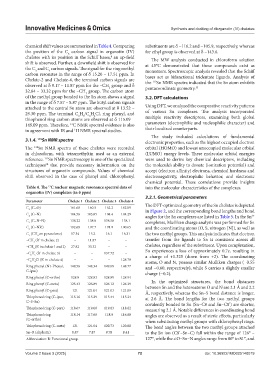
            Table 4. The  C nuclear magnetic resonance spectral data of   into the molecular characteristics of the complexes.
                      13
            organotin (IV) complexes (in δ ppm)
                                                               3.2.1. Geometrical parameters
            Parameter         Chelate 1 Chelate 2 Chelate 3 Chelate 4
            C  (C=O)           161.68  160.5  162.2  162.09    The DFT-optimized geometry of the Sn chelates is depicted
             3                                                 in Figure 2, and the corresponding bond lengths and bond
            C  (C=N)           104.56  103.85  104.4  104.29   angles for the Sn complexes are listed in Table 5. In the Sn
                                                                                                            2+
             4
            C  (C=N–N)         138.22  138.8  138.58  138.1
             5                                                 complexes, Mulliken charge analysis was performed for Sn
            C  (C=NR’)         192.68  197.7  191.9  190.65    and the coordinating atoms (O, S, nitrogen [N]), as well as
             6
            C  (CH  on pyrazolone)  17.34  15.2  16.1  16.31   the two methyl groups. This analysis indicates that electron
             7   3
            –CH  (R’ in chelate 2)  –  11.87   –      –        transfer from the ligands to Sn is consistent across all
               2
            –CH  (R’ in chelate 1 and 2)  27.82  33.32  –  –   chelates, regardless of the substituent. Upon complexation,
               3
            –C H  (R’ in chelate 3)  –  –    137.72   –        Sn experiences a loss of approximately 0.7e, resulting in
              6
                5
                                                               a  charge  of  +1.325  (down  from  +2).  The  coordinating
            –C H Cl (R’ in chelate 4)  –  –    –     128.78
              6  4                                             atoms, O and N, possess similar Mulliken charges (−0.55
            Ring phenyl (N1-Phenyl,   148.56  148.34  149.09  148.77  and −0.60, respectively), while S carries a slightly smaller
            C-ipso)                                            charge (−0.2).
            Ring phenyl (C-ortho)  128.8  128.83  128.89  128.94
                                                                 In  the optimized  structures,  the  bond  distances
            Ring phenyl (C-meta)  125.43  126.89  126.12  126.39  between Sn and the heteroatoms O and N are 2.1 Å and 2.2
            Ring phenyl (C-para)  121  121.04  121.03  121.09  Å, respectively, whereas the Sn–S bond distance is longer,
            Thiophenol ring (C-ipso,   115.16  115.29  115.44  115.24  at 2.6 Å. The bond lengths for the two methyl groups
            C–S–Sn)                                            covalently bonded to Sn (Sn–C8 and Sn–C8’) are shorter,
            Thiophenol ring (C-para)  118.67  119.08  119.63  118.62  measuring 2.1 Å. Notable differences in coordinating bond
            Thiophenol ring    118.14  117.68  118.9  116.68   angles are observed as a result of steric effects, particularly
            (C-ortho)                                          when substituting methyl groups with chlorophenyl rings.
            Thiophenol ring (C-meta)  121  121.04  120.73  120.88  The bond angles between the two methyl groups attached
            Sn–R (aliphatic)    8.87   7.87   8.78   8.41      to the Sn ion (C8’–Sn–C) fall within the range of 126° –
            Abbreviation: R: Functional group.                 127°, while the ∠O–Sn–N angles range from 80° to 81°, and
            Volume 2 Issue 3 (2025)                         72                          doi: 10.36922/IMO025140019

