


Page 77 - IMO-2-3
P. 77
Innovative Medicines & Omics                                  Synthesis and docking of diorganotin (IV) chelates


            Table 2. Synthetic, physical, and elemental data of the diorganotin (IV) complexes, with calculated values given in parentheses
            No.   Compound   Melting   Yield (%)  Molecular weight (g/mol)   Sodium chloride filtered (g)   Elemental analysis (%)
                             point (°C)          analyzed (calculated)    (calculated)          (calculated)
                                                                                            Tin (Sn)  Sulfur (S)
            1     Chelate-1    110       78         470.00 (470.18)        0.19 (0.20)     25.18 (25.24)  6.75 (6.82)
            2     Chelate-2    130       68         482.00 (484.18)        0.22 (0.24)     24.48 (24.51)  6.58 (6.62)
            3     Chelate-3    108       72         530.00 (532.23)        0.35 (0.36)     22.38 (22.30)  5.95 (6.02)
            4     Chelate-4    112       79         570.00 (566.67)        0.38 (0.39)     20.86 (20.95)  5.63 (5.66)

                                                                         1
            to –OH and > NH groups, disappeared in the spectra of   Table 3. The  H nuclear magnetic resonance spectral data of
            the corresponding organotin (IV) chelates. In addition,   organotin (IV) complexes (in δ ppm)
            the appearance of a new band in the 1,625 – 1,645 cm    Chelate  Ring  Ring/terminal   Terminal   Sn‑R  2 J(Sn‑H)
                                                         −1
            range indicates the presence of the stretching frequency   methyl C H /C H Cl   protons
                                                                                   4
                                                                                5
                                                                              6
                                                                                  6
            (ν) > C=N–group.  In addition, a band detected in the            thiophenol   >CH  –CH
                           33
                               −1
                                                         13
            range of 660 – 625 cm  is assigned to ν S–oxygen (O)                ring      2    3
            (asymmetric ν). The presence of the Sn-S bond is supported   Chelate-1 2.42 bs  6.54 – 7.99 m  -  2.42 bs 0.83 bs 100.59 Hz
            by the appearance of the ν Sn-S  absorption band in the   Chelate-2  2.45 s  6.90 – 8.28 m 2.86 q 1.05 t 1.05 bs  -
                                      6,7
            region  422  –  402  cm .  A  weak  absorption  band  of low   Chelate-3  1.88 s  6.84 – 8.24 m  -  -  1.08 s  -
                             −1
            intensity in the region 456 – 425 cm  is associated with   Chelate-4  1.97 s  7.26 – 8.22 m  -  -  1.45 s  -
                                          −1
            Sn–N bonds.  The presence of these bands indicates the
                      2
            formation of Sn–O, Sn–S, and Sn–N bonds, supporting   Abbreviations: bs: Broad singlet; q: Quartet; R: functional group;
                                                               s: Singlet; t: Triplet.
            the bifunctional tridentate coordination mode of the Schiff
            bases in the organotin (IV) chelates.
            3.1.2.  H NMR
                 1
            The  H NMR spectra were recorded in CDCl /DMSO-d
               1
                                                          6
                                                 3
            using TMS as the internal standard. A  summary of the
            chemical shifts observed is presented in Table 3. The broad
            signal at δ 4.96 ppm, attributed to >NH/–SH protons in
            the Schiff bases,  is absent in the spectra of the organotin
                         3
            (IV) chelates, indicating deprotonation of these functional
            groups. The signal for ring methyl protons is observed at δ
            1.69 – 2.46 ppm as a singlet.
              No significant shifts were detected in their position
            compared with their positions in parent ligands. In
            Chelate-1, the signal for the terminal proton appears at δ
            2.42 ppm as a broad singlet. In contrast, for Chelate-2 and
            Chelate-4, the terminal protons resonate as a quartet at δ
            2.78 – 2.86 ppm, corresponding to > CH  protons, and as
                                             2
            a triplet at δ 1.05 – 1.11 ppm, attributed to –CH  protons.
                                                   3
            The methyl protons bonded to the Sn atom are observed as
            a singlet in the range of δ 0.83 – 1.45 ppm, while the butyl
            protons attached to the Sn atom exhibit a complex pattern
            between δ 0.61 and 2.48 ppm. The value of Sn-hydrogen
            (H) J coupling,  J(Sn-H) for Chelate-1 was found to be
                         2
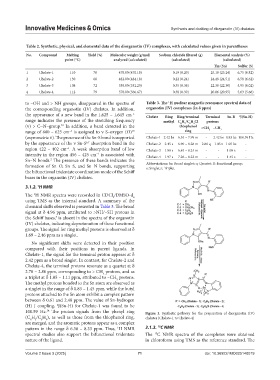
            100.59  Hz.  The proton signals from the phenyl ring   Figure  1.  Synthetic  pathway  for  the  preparation of  diorganotin  (IV)
                     34
            (C H /C H ), as well as those from the thiophenol ring,   chelates (Chelate-1 to Chelate-4)
              6
                5
                     4
                  6
            are merged, and the aromatic protons appear as a complex
                                                                    13
            pattern in the range δ 6.38 – 8.33 ppm. Thus,  H NMR   3.1.3.  C NMR
                                                   1
            spectral studies  also  support  the bifunctional tridentate   The  C NMR spectra of the complexes were obtained
                                                                   13
            nature of the ligand.                              in chloroform using TMS as the reference standard. The
            Volume 2 Issue 3 (2025)                         71                          doi: 10.36922/IMO025140019

