


Page 76 - IMO-2-3
P. 76
Innovative Medicines & Omics                                  Synthesis and docking of diorganotin (IV) chelates


            on their physical properties,  percentage yields,  MW   targets of antibiotics and are summarized in Table 1. These
            estimations, and elemental analyses.               proteins are also relevant for exploring potential avenues
                                                               for  minimizing  microbial  resistance  to  antimicrobial
            2.2. Computational methods                         agents.  Cephalosporins act as bacterial transpeptidase
                                                                    28
            The geometrical parameters of the ligands (L-1, L-2, L-3,   inhibitors, 29,30  while sulfamethoxazole targets the
            and L-4) and their corresponding Sn complexes, referred   bacterial enzyme dihydropteroate synthase by acting as a
            to  as chelates (Chelate-1, Chelate-2,  Chelate-3,  and   competitive inhibitor. 31,32  Accordingly, molecular docking
            Chelate-4), were optimized using the DFT/B3LYP method   of cephalosporins was performed with target proteins
            with the LanL2DZ basis set, performed through the   5TW8 and 6NTW, and sulfamethoxazole was docked with
            Gaussian 03W software package (Revision 03, Gaussian,   1AD4 and 5V7A. The docking analysis utilized automated
            Inc., USA).  No initial symmetry constraints were applied   docking procedures with Gasteiger charge assignments
                     23
            during the optimization process. The normal frequencies   applied to all molecular structures. A visualization software
            for the optimized structures were calculated through   package enabled detailed examination of the interactions
            Hessian analysis.                                  between the ligands and their protein targets. The docking
                                                               region was defined by a cubic grid with dimensions of
            2.2.1. Molecular docking                           60 units in each direction and a grid spacing of 0.375 Å,
            Molecular docking simulations predicted ligand-protein   centered on the protein’s active site (Table 1). 28
            interactions and binding energies for Sn complexes,
            investigating their antibacterial activity. Two protein targets,   3. Results and discussion
            one  from  Gram-positive  (Staphylococcus aureus)  and   Dimethyltin dichloride reacts with the Schiff bases in its
            one from Gram-negative (Escherichia coli) bacteria, were   disodium salt form derived from substituted pyrazolones in
            selected to represent different antibacterial mechanisms.   an equal molar ratio in a solution of benzene (Figure 1). The
            DFT-optimized ligands (L-1 to L-4), along with control   formation of the desired chelates was confirmed through
            molecules (cephalosporin  and sulfamethoxazole),  were   the analysis of physical properties, percentage yields, MW
            analyzed to provide a comparative assessment. Docking   estimations, and elemental content. A summary of these
            was performed using the standard operating procedure   data is presented in Table 2. Melting points of the complexes
            and default settings of AutoDock (Version 4.2.6, Scripps   ranged from 108°C to 130°C, indicating moderately high
            Research, USA), which employs an empirical free energy   thermal stability, which is characteristic of organotin
            function. All water molecules were removed from the   (IV) complexes. Yields varied from 68% to 79%, with
            bacterial protein structures (protein database codes:   Chelate-4 showing the highest yield, suggesting efficient
            5TW8, 6NTW, 1AD4, and 5V7A) during preparation in   complexation under the adopted reaction conditions. The
            AutoDock tools, and only polar hydrogens were added   experimental values of Sn% and sulfur (S)% were in good
            to the proteins. The different ligand conformers were   agreement with the calculated values, further confirming
            generated using a Lamarckian genetic algorithm with an   the proposed compositions.
            adaptive search method in AutoDock, and the interactions
            between the ligands and the target receptor were analyzed   3.1. Spectroscopic studies
            using Discovery Studio Visualizer (Discovery Studio  24.1,   3.1.1. IR spectra
                                                     ®
            BIOVIA, USA).
                                                               The  IR spectra  of  the complexes,  recorded  using  KBr
                                                                                       −1
            2.2.2. Ligands, control ligands, and protein       pellets in the 4,000 – 400 cm  range, showed significant
            preparation                                        changes upon coordination. The broad band observed
                                                               between 3,440 and 3,295 cm  in the free ligand, attributed
                                                                                     −1
            DFT-optimized structures of ligands (chelates devoid of
                                2+
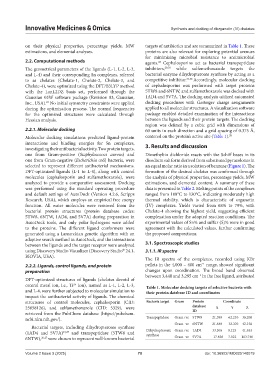
            central metal ion, i.e., Ti  ion), named as L-1, L-2, L-3,   Table 1. Molecular docking targets of selective bacteria with
            and L-4, were further subjected to molecular simulation to   their protein database ID and coordinates
            inspect the antibacterial activity of ligands. The chemical
            structures of control molecules, cephalosporin (CID:   Bacteria target  Gram  Protein   Coordinate
            25058126),  and  sulfamethoxazole  (CID:  5329),  were                 database   X    Y      Z
                                                                                   ID
            retrieved from the PubChem database (https://pubchem.
            ncbi.nlm.nih.gov/).                                Transpeptidase  Gram+ve 5TW8  21.390  −62.210  36.200
                                                                           Gram−ve 6NTW    21.480  −32.370  42.150
              Bacterial targets, including dihydropteroate synthase
            (1AD4 and 5V7A) 24,25  and transpeptidase (5TW8 and   Dihydropteroate  Gram+ve 1AD4  33.106  8.125  41.463
                                                               synthase
            6NTW), 26,27  were chosen to represent well-known bacterial    Gram−ve 5V7A    −17.836  7.522  103.740

            Volume 2 Issue 3 (2025)                         70                          doi: 10.36922/IMO025140019

