


Page 143 - ITPS-7-2
P. 143
INNOSC Theranostics and
            Pharmacological Sciences                                                Dapsone enhance skin flap survival


                                     A                         B


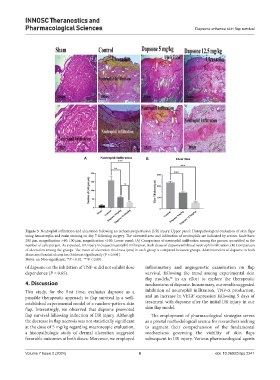
            Figure 3. Neutrophil infiltration and ulceration following an ischemia/reperfusion (I/R) injury. Upper panel: Histopathological evaluation of skin flaps
            using hematoxylin and eosin staining on day 7 following surgery. The ulcerated area and infiltration of neutrophils are indicated by arrows. Scale bars:
            200 µm, magnification ×40; 100 µm, magnification ×100. Lower panel: (A) Comparison of neutrophil infiltration among the groups, quantified as the
            number of cells per µm. As expected, I/R injury increased neutrophil infiltration. Both doses of dapsone inhibited neutrophil infiltration. (B) Comparison
            of ulceration among the groups. The mean of ulceration thickness (µm) in each group is compared between groups. Administration of dapsone in both
            doses ameliorated ulceration thickness significantly (P < 0.001).
            Notes: ns: Non-significant; **P < 0.01, ***P < 0.001.
            of dapsone on the inhibition of TNF-α did not exhibit dose   inflammatory  and  angiogenetic  examination  on  flap
            dependence (P = 0.65).                             survival, following the trend among experimental skin
                                                               flap models,  in an effort to explore the therapeutic
                                                                         36
            4. Discussion                                      mechanisms of dapsone. In summary, our results suggested
            This  study,  for  the  first  time,  evaluates  dapsone  as  a   inhibition of neutrophil infiltration, TNF-α production,
            possible therapeutic approach to flap survival in a well-  and an increase in VEGF expression following 5 days of
            established experimental model of a random-pattern skin   treatment with dapsone after the initial I/R injury in our
            flap.  Interestingly, we  observed  that dapsone promoted   skin flap model.
            flap survival following induction of I/R injury. Although   The employment of pharmacological strategies serves
            the decrease in flap necrosis was not statistically significant   as a pivotal methodological avenue for researchers seeking
            at the dose of 5 mg/kg regarding macroscopic evaluation,   to augment their comprehension of the fundamental
            a histopathologic study of dermal ulceration suggested   mechanisms governing the  viability of  skin  flaps
            favorable outcomes at both doses. Moreover, we employed   subsequent to I/R injury. Various pharmacological agents


            Volume 7 Issue 2 (2024)                         6                                doi: 10.36922/itps.2241

