


Page 52 - JCAU-4-1
P. 52
Two Water Towns in the Qingpu District of Shanghai                                                                            Semprebon


               4.3  Case two: Liantang Water Town as an       and primary school are the main attractions to
                    undeveloped historical settlement         visitors. A monument named “Memorial Hall
               Liantang  is  a  water  town  of  about  1,000   of  Former  Residence  of  Chen  Yun  &
               inhabitants  with  more  than  1,100  years  of   Revolutionary History of Qingpu” was built
               history.  The  settlement  is  situated  in  the   in 2000 to commemorate his life and service
               Qingpu  District,  on  the  Shi  River  banks,  a   to  the  country  as  a  hero  of  the  revolution
                                                                          7
               watercourse  insisting  in  the  south-western   [Figure  13]   . He lived in an old-fashioned
               canal network of Shanghai. Originally, it was   Jiangnan-style residence with brick walls and
               called Zhangliantang, and was known as “a      timber carpentry. Liantang also has the oldest
               land of fish and rice” and as “a land of water   art  museum  in  Shanghai,  showcasing
               bamboo”  because  of  the  rice  market  that   calligraphy and painting works and an ancient
               flourished  at  the  end  of  the  Qing  dynasty   tree.
               (1644‒1911).  The  town  has  more  than            In  the  fringe  areas,  the  urban
               100,000 sqm of historic buildings dating from   environment  abruptly  loses  its  traditional
               the  Ming  to  Qing  dynasties,  with  two  sites   connotations.  Medium-rise  condominiums
               listed  as  provincial  and  municipal  culture   have  been  erected  in  repeated  arrays,
               relict protection areas.                       determining  a  generic  urban  environment
                    Liantang  urban  space  is  organized     [Figure 14]. Despite these modern presences,
               according to the shape of the Yangtze River’s   the integrity and distinctiveness of both the
               canal  network,  which  was  the  principal    settlement pattern and the architectural form
               infrastructural system for goods and people to   make  Liantang  an  original  historical  site,
               circulate.  As  in  other  famous  water  towns,   expressing  tangible and  intangible  forms  of
               wares arrived on small boats and were stored   heritage  [67] .
               on the houses’ ground-floor spaces along the
               canal. The trading spaces were on the other
               sides of these residences, where narrow alleys
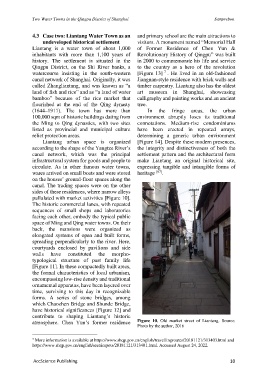
               pullulated with market activities [Figure 10].
               The historic commercial lanes, with repeated
               sequences  of  small  shops  and  laboratories
               facing each other, embody the typical public
               space of Ming and Qing water towns. On their
               back,  the  mansions  were  organized  as
               elongated  systems  of  open  and  built  forms,
               spreading perpendicularly to the river. Here,
               courtyards  enclosed  by  pavilions  and  side
               walls    have   constituted   the   morpho-
               typological  structure  of  past  family  life
               [Figure 11]. In these compactedly built areas,
               the formal characteristics of local urbanism,
               encompassing low-rise density and traditional
               ornamental apparatus, have been layered over
               time,  surviving  to  this  day  in  recognizable
               forms.  A  series  of  stone  bridges,  among
               which Chaozhen Bridge and Shunde Bridge,
               have historical significances [Figure 12] and
               contribute  to  shaping  Liantang’s  historic
               atmosphere.  Chen  Yun’s  former  residence    Figure  10.  Old  market  street  of  Liantang.  Source:
                                                              Photo by the author, 2016

               7  More information is available at https://www.shqp.gov.cn/english/travellingroutes/20181121/313403.html and
               https://www.shqp.gov.cn/english/scenicspots/20181121/313401.html. Accessed August 24, 2022.


                AccScience Publishing                                                                  10

