


Page 34 - JCAU-5-3
P. 34
Journal of Chinese
            Architecture and Urbanism                                           Walkability evaluation of Beijing Old Town


            for World Heritage List, the volume of modern residential
            buildings  and commercial buildings  in  the  Southern
            district of the city and the Eastern and Western districts
            of the city within the Second Ring Road is very different
            from that of the historic district, thus it is not included in
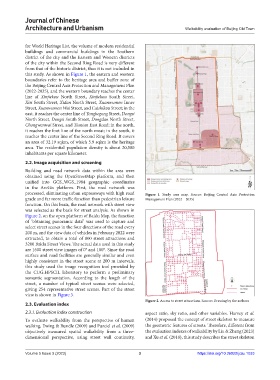
            this study. As shown in Figure 1, the eastern and western
            boundaries refer to the heritage area and buffer zone of
            the Beijing Central Axis Protection and Management Plan
            (2022-2035), and the western boundary reaches the center
            line of  Xinjiekou North Street,  Xinjiekou South Street,
            Xisi South Street, Xidan North Street, Xuanwumen Inner
            Street, Xuanwumen Wai Street, and Caishikou Street; in the
            east, it reaches the center line of Yonghegong Street, Dongsi
            North Street, Dongsi South Street, Dongdan North Street,
            Chongwenwai Street, and Tiantan East Road; in the north,
            it reaches the foot line of the north moat; in the south, it
            reaches the center line of the Second Ring Road. It covers
            an area of 32.19 sqkm, of which 5.9 sqkm is the heritage
            area. The residential population density is about 20,500
            inhabitants per square kilometer.
            2.2. Image acquisition and screening
            Building and road network data within the area were
            obtained  using  the OpenStreetMap  platform, and  then
            unified into GCS_WGS_1984 geographic coordinates
            in the ArcGis platform. First, the road network was
            processed, eliminating urban expressways with high road   Figure  1. Study area map. Source: Beijing Central Axis Protection
            grade and far more traffic function than pedestrian leisure   Management Plan (2022 – 2035)
            function. On this basis, the road network with street view
            was selected as the basis for street analysis. As shown in
            Figure 2, on the open platform of Baidu Map, the function
            of “obtaining panoramic data” was used to capture and
            select street scenes in the four directions of the road every
            200 m, and the view data of vehicles in February 2022 were
            extracted, to obtain a total of 800 street attractions and
            3200 Baidu Street Views. The actual data used in this study
            are 1600 street view images of 0° and 180°. Since the road
            surface and road facilities are generally similar and even
            highly consistent in the street scene at 200  m intervals,
            this  study  used  the  image  recognition tool  provided by
            the CUG.HPSCIL laboratory to perform a preliminary
            semantic segmentation. According to the length of the
            street, a number of typical street scenes were selected,
            giving 254 representative street scenes. Part of the street
            view is shown in Figure 3.
                                                               Figure 2. Access to street attractions. Source: Drawing by the authors
            2.3. Evaluation index
            2.3.1. Evaluation index construction               aspect ratio, sky ratio, and other variables. Harvey et al.
            To evaluate walkability from the perspective of human   (2014) proposed the concept of street skeleton to measure
            walking, Ewing & Rundle (2009) and Purciel et al. (2009)   the geometric features of streets. Therefore, different from
            objectively measured spatial walkability from a three-  the evaluation indexes of walkability by Liu & Zheng (2023)
            dimensional perspective, using street wall continuity,   and Xu et al. (2018), this study describes the street skeleton


            Volume 5 Issue 3 (2023)                         3                        https://doi.org/10.36922/jcau.1033

