


Page 26 - JCBP-1-2
P. 26
Journal of Clinical and
            Basic Psychosomatics                               Psychological control, sense of benefit, and burden on caregivers


            the sense of benefit (M); “b” represents the indirect effect   4. Conclusions
            of the sense of benefit (M) on the burden of care (Y) under
            the condition of control X; “c” is the direct effect of the   In this study, a total of 182 caregivers of children with
            sense of psychological control (X) on the burden of care   congenital bone malformation treated  at Hospital L
            (Y) of the mediation variable (M). Therefore, in this study,   of  Shanghai were  assessed using general demographic
            the sense of psychological control of the independent   information scale, general sense of control scale, sense
            variable,  the  burden  of  the  dependent  variable,  and   of benefit scale, and care burden scale to study the care
            the sense of benefit of the intermediary variable were   burden and explore its influencing factors and underlying
            successively input to establish the schematic diagram of   mechanism. The results are concluded as follows:
            the intermediary variable, as shown in Figures 1 and 2:  (i).  The burden score of the 182 caregivers for children
                                                                  with congenital bone malformation ranged from
              Bootstrap is a non-parametric Monte Carlo method    3 to 73, with an average score of 36.46, indicating
            used to resample the observed information and then    that the caregiver burden was at a mild-to-moderate
            make  statistical  inferences  about  the  distribution   level [19,20] . Specifically, the personal burden scores
            characteristics of the population. In the present study,   ranged from 1 to 40, with an average score of 21.13,
            the mediation effect was tested using the Bootstrap test   while the responsibility burden scores ranged from 0
            method proposed by Zhonglin et al. , and the results are   to 21, with an average score of 8.55. The results reveal
                                         [18]
            as follows (Table 4):                                 that the personal burden of the caregiver was higher
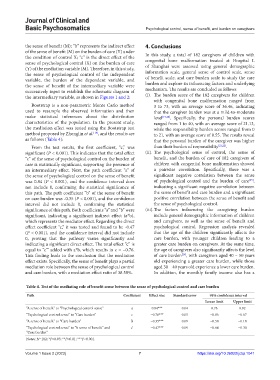
              From the test results, the first coefficient, “c,” was   than their burden of responsibility [21,22] .
            significant (P < 0.001). This indicates that the total effect   (ii). The psychological sense of control, the sense of
            “c” of the sense of psychological control on the burden of   benefit, and the burden of care of 182 caregivers of
            care is statistically significant, supporting the presence of   children with congenital bone malformation showed
            an intermediary effect. Next, the path coefficient “a” of   a pairwise correlation. Specifically, there was a
            the sense of psychological control on the sense of benefit   significant negative correlation between the sense
                                                                                                           [23]
            was 0.84 (P  < 0.001), and the confidence interval does   of psychological control and the burden of care ,
            not include 0, confirming the statistical significance of   indicating a significant negative correlation between
            this path. The path coefficient “b” of the sense of benefit   the sense of benefit and care burden and a significant
            on care burden was -0.35 (P < 0.001), and the confidence   positive correlation between the sense of benefit and
            interval  did  not  include  0,  confirming  the  statistical   the sense of psychological control.
            significance of this path. Both coefficients “a” and “b” were   (iii). The factors influencing the caregiving burden
            significant, indicating a significant indirect effect (a*b),   include general demographic information of children
            which represents the mediator effect. Regarding the direct   and caregivers, as well as the sense of benefit and
            effect coefficient “c,” it was tested and found to be -0.47   psychological control. Regression analysis revealed
            (P < 0.001), and the confidence interval did not include   that the age of the children significantly affects the
            0, proving that the pathway varies significantly and   care burden, with younger children leading to a
            indicating a significant direct effect. The total effect “c” is   greater care burden on caregivers. At the same time,
            equal to “c’” added with a*b, which results in c = −0.76.   the age of caregivers also significantly affects the level
            This  finding leads to  the  conclusion  that  the mediation   of care burden , with caregivers aged 40 – 50 years
                                                                              [24]
            effect exists. Specifically, the sense of benefit plays a partial   old experiencing a greater care burden, while those
            mediation role between the sense of psychological control   aged 30 – 40 years old experience a lower care burden.
            and care burden, with a mediation effect ratio of 38.58%.  In addition, the monthly family income also has a

            Table 4. Test of the mediating role of benefit sense between the sense of psychological control and care burden

             Path                                     Coefficient  Effect size  Standard error  95% confidence interval
                                                                                        Lower limit   Upper limit
            “A sense of benefit” to “Psychological control sense”  a  0.84***  0.04        0.76        0.92
            “Psychological control sense” to “Care burden”  c    −0.76***     0.05        −0.86       −0.67
            “A sense of benefit” to “Care burden”        B       −0.35***     0.09        −0.58       −0.18
            “Psychological control sense” to “A sense of benefit” and   c’  −0.47***  0.09  −0.64     −0.30
            “Care burden”
            Notes: N=182; *P<0.05; **P<0.01; ***P<0.001.


            Volume 1 Issue 2 (2023)                         7                        https://doi.org/10.36922/jcbp.1041

