


Page 23 - JCBP-1-2
P. 23
Journal of Clinical and
            Basic Psychosomatics                               Psychological control, sense of benefit, and burden on caregivers


            Table 1. Results of the reliability and validity analysis
             Dimension                   Clone Bach,    Clone Bach Alpha based on   Kaiser‑Meyer‑Olkin   Number
                                           Alpha         the normalization term      coefficient      of terms
            Care burden scale              0.949                0.948                  0.927            22
             Personal burden               0.892                0.891                  0.888            12
             Burden of responsibility      0.893                0.894                  0.858             6
            Benefit Scale                  0.963                0.964                  0.927            22
             Accept                        0.847                0.848                  0.679             3
             Family relation               0.880                0.881                  0.807             6
             Personal growth               0.920                0.923                  0.866             7
             Human relations in society    0.941                0.942                  0.746             3
             Health behavior               0.889                0.889                  0.730             3
            Sense of psychological control scale  0.964         0.964                  0.929            15
             Positive sense of control     0.963                0.963                  0.918            10
             Negative sense of control     0.943                0.944                  0.882             5


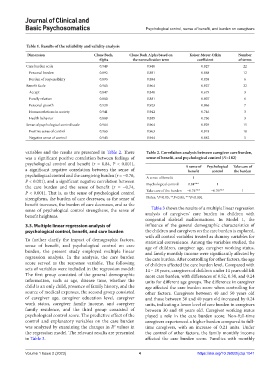
            variables and the results are presented in Table 2. There   Table 2. Correlation analysis between caregiver care burden,
            was a significant positive correlation between feelings of   sense of benefit, and psychological control (N=182)
            psychological control and benefit (r  = 0.84,  P  < 0.001),         A sense of   Psychological   Take care of
            a significant negative correlation between the sense of              benefit   control   the burden
            psychological control and the caregiving burden (r = −0.76,   A sense of benefit  1
            P < 0.001), and a significant negative correlation between
            the care burden and the sense of benefit (r  = −0.74,   Psychological control  0.84***  1
            P < 0.001). That is, as the sense of psychological control   Take care of the burden  −0.74***  −0.76***  1
            strengthens, the burden of care decreases; as the sense of   Notes: *P<0.05; **P<0.01; ***P<0.001.
            benefit increases, the burden of care decreases, and as the
            sense of psychological control strengthens, the sense of   Table 3 shows the results of a multiple linear regression
            benefit heightens.                                 analysis of caregivers’ care burden in children with
                                                               congenital skeletal malformations. In Model 1, the
            3.3. Multiple linear regression analysis of        influence of the  general demographic  characteristics of
            psychological control, benefit, and care burden    the children and caregivers on the care burden is explored,
                                                               with all control variables treated as dummy variables for
            To further clarify the impact of demographic factors,   statistical convenience. Among the variables studied, the
            sense of benefit, and psychological control on care   age of children, caregiver age, caregiver working status,
            burden, the present study employed multiple linear   and family monthly income were significantly affected by
            regression analysis. In the analysis, the care burden   the care burden. After controlling for other factors, the age
            score served as the response variable. The following   of children affected the care burden level. Compared with
            sets of variables were included in the regression model:   14 – 18 years, caregivers of children under 14 years old felt
            The first group consisted of the general demographic   more care burden, with differences of 0.52, 0.38, and 0.24
            information, such as age, disease time, whether the   units for different age groups. The difference in caregiver
            child is an only child, presence of family history, and the   age affected the care burden score when controlling for
            source of medical expenses, the second group consisted   other factors. Caregivers between 40 and 50  years old
            of caregiver age, caregiver education level, caregiver   and those between 30 and 40 years old increased by 0.24
            work status, caregiver family income, and caregiver   units, indicating a lower level of care burden in caregivers
            family residence, and the third group consisted of   between  30  and 40  years  old.  Caregiver working  status
            psychological control score. The predictive effect of the   played a role in the care burden score. Non-full-time
            control and explanatory variables on the care burden   caregivers experienced a higher burden compared to full-
            was analyzed by examining the changes in R  values in   time caregivers, with an increase of 0.21 units. Under
                                                  2
            the regression model. The relevant results are presented   the control of other factors, the family monthly income
            in Table 3.                                        affected the care burden score.  Families with monthly


            Volume 1 Issue 2 (2023)                         4                        https://doi.org/10.36922/jcbp.1041

