


Page 25 - JCBP-1-2
P. 25
Journal of Clinical and
            Basic Psychosomatics                               Psychological control, sense of benefit, and burden on caregivers


            model alongside the control variables. The benefit variable   the ages of 30 – 40 years old. Moreover, caregivers with
            improved the R  of Model 2 by 0.17 – 0.68, indicating that   higher  household  monthly  incomes  experienced  a
                        2
            the explanatory power of Model 2 is enhanced compared to   lower care burden, whereas those with lower household
            Model 1. The conclusion regarding the effect of the control   monthly incomes felt a higher care burden.
            variable on care burden in Model 2 is generally consistent   (ii). When controlling for other factors, it was found that
            with Model 1, except for the variable of caregiver working   the higher the caregiver’s sense of benefit, the lower
            status, which was not found to be significantly different in   the care burden. The sense of benefit of the caregiver
            Model 2. In addition, in the new Model 2, the caregiver   negatively affects the care burden, which verifies the
            benefit score demonstrated a significant negative effect   third hypothesis of the research.
            on  the  care  burden  score  at  a  0.001  significance  level.   (iii). When controlling for other factors, it was observed
            After controlling for other variables, an average increase   that a higher sense of psychological control is
            of 1 unit in caregiver benefit perception was associated   associated  with a  lower  level  of  care  burden.  This
            with a decrease of 0.57 units in care burden. The other   finding confirms the first hypothesis of the research,
            variables reached the same conclusions as those observed   which  suggests  a negative relationship  between  the
            in Model 1.                                           sense of psychological control and the care burden.
              In Model 3 of Table 3, both the sense of psychological   3.4. Analysis of the mediation effect of
            control and benefit (explanatory variables) were added   psychological control feeling, benefit feeling, and
            to the regression model along with the control variables.   care burden
            The results in Model 3 are consistent with those in Model   The correlation analysis between the above variables
            2. Specifically, the newly included sense of psychological   reveals a significant pairwise correlation among
            control score showed a significant negative influence   caregivers’ sense of psychological control, benefit, and
            on care burden, with a significant level of 0.001. After   care burden. Consequently, the present study further
            controlling for other factors, an average increase of 1   tested the mediation effect of psychological control and
            unit in the sense of psychological control was associated   benefit on care burden. According to Zhonglin  et al.,
            with a decrease of 0.44 units in the care burden score.   “Considering the influence of the independent variable X
            This implies that the caregivers who have a higher sense   on the dependent variable Y, if the independent variable
            of psychological control experienced a lower level of care   X has an effect on the dependent variable Y by affecting
            burden. R  of Model 3 increased to 0.72 after adding the   the mediation variable M, M is called the intermediary
                    2
            psychological control variables, which is an improvement   variable. Among them, the mediation effect belongs
            of 0.04 compared to Model 2, indicating that Model 3   to the indirect effect .  Figure  1 shows that the sense
                                                                                [18]
            has a stronger explanatory power than both Model 1 and   of psychological control (X) acts on the burden of care
            Model 2.                                           (Y), and the path coefficient is “C,” which represents the

                   2
              The R  of Model 3 is 0.72, which is the largest value   total effect of the sense of psychological control (X) on
            among the three regression models shown in  Table 3,   the burden of care (Y). Figure 2 shows the relationship
            indicating the strongest explanatory power. By checking   between the sense of psychological control (X) and the
            the variance inflation factor (VIF) of each variable in the   burden of care (Y) after controlling for the variable sense
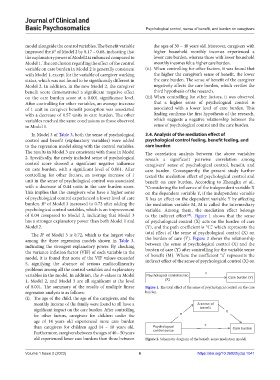
            model, it is found that none of the VIF values exceeded   of benefit (M). Where the coefficient “a” represents the
            5, signifying the absence of serious multicollinearity   indirect effect of the sense of psychological control (X) on
            problems among all the control variables and explanatory
            variables in the model. In addition, the F-values in Model   Psychological control sense  c  Care burden (Y)
            1, Model 2, and Model 3 are all significant at the level   (X)
            of 0.001. The  summary of the results of multiple linear   Figure 1. The total effect of the sense of psychological control on the care
            regression analysis is as follows:                 burden.
            (i).  The age of the child, the age of the caregivers, and the
               monthly income of the family were found to all have a                 A sense of
               significant impact on the care burden. After controlling               benefit    b
               for other factors, caregivers for children under the          a
               age of 14  years old experienced more care burden
               than caregivers for children aged 14 – 18  years old.   Psychological    c           Care burden
               Furthermore, caregivers between the ages of 40 – 50 years   control sense
               old experienced lower care burdens than those between   Figure 2. Schematic diagram of the benefit-sense mediation model.


            Volume 1 Issue 2 (2023)                         6                        https://doi.org/10.36922/jcbp.1041

