


Page 47 - JCBP-2-2
P. 47
Journal of Clinical and
            Basic Psychosomatics                                                  Alexithymia as a mediator relationship


            of SPS (moderate-SPS); and 248 participants (30.5%) had   occupation (P < 0.01). Notably, gender exhibited an effect
            a score strictly above 137, signifying a high level of SPS   on health anxiety (P < 0.05). In addition, we observed the
            (high-SPS). In terms of alexithymia scores, the range fell   effects of age (P < 0.001), education level (P < 0.001), and
            within a range between a minimum of 21 and a maximum   occupation (P < 0.001) on alexithymia. In summary, women
            of 91, with a mean score of 51.31 (SD = 11.98). Specifically,   reported significantly higher levels of sensitivity and health
            518 participants (63.64%) obtained a score below 56,   anxiety, while older participants tended to report lower
            while  296  (36.36%)  obtained a score of 56  or  higher,   levels of sensitivity and alexithymia. Participants with
            prompting consideration that they might express a form   higher educational attainment (4-year bachelor’s degree or
            of alexithymia.                                    a master’s degree and above) reported lower alexithymia
                                                               scores than those with lower levels of education. Moreover,
              On examining the distribution according to SPS   participants in managerial and intellectual professions
            degree and alexithymia scores (Table 2), it’s notable that   reported lower sensitivity and alexithymia scores than
            there is an over-representation of alexithymic participants   students, with a similar trend observed among employees
            within the high-SPS group, accounting for almost 45%   for alexithymia. Finally, participants who engaged in
            of the group. The chi-square test revealed that this   teleworking during  the  lockdown reported  lower scores
            difference  in  distribution  was  statistically  significant   of alexithymia than those who were unemployed before
            (χ  [2,  N  = 814]   = 16.282,  P  < 0.001), affirming a link   the lockdown. Regarding effect sizes, eta-squared results
              2
            between SPS  degree  and alexithymia.  Concerning  the   indicated no more than medium-sized effects, suggesting
            HAQ scores, the range spanned from a minimum of 21 to a   that these variables moderately explain the proportion of
            maximum of 105, with a mean score of 52.56 (SD = 16.00).  variance observed.

            3.2. Sociodemographic influence                    3.3. Correlational analysis
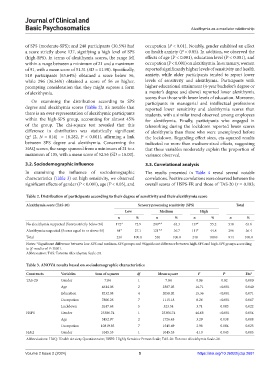
            In examining the influence of sociodemographic     The results presented in  Table  4 reveal several notable
            characteristics (Table 3) on high sensitivity, we observed   correlations. Positive correlations were observed between the
            significant effects of gender (P < 0.001), age (P < 0.05), and   overall scores of HSPS-FR and those of TAS-20 (r = 0.183;

            Table 2. Distribution of participants according to their degree of sensitivity and their alexithymia score

            Alexithymia score (TAS‑20)                      Sensory processing sensitivity (SPS)     Total
                                                      Low            Medium           High
                                                   n       %       n       %       n       %       n      %
            No alexithymia suspected (Scores strictly below 56)  172*  72.9  209* ,#  63.3  137 #  55.2  518  63.6
            Alexithymia suspected (Scores equal to or above 56)  64*  27.1  121* ,#  36.7  111 #  44.8  296  36.4
            Total                                  236    100.0    330     100.0   248    100.0   814    100.0
            Notes: *Significant difference between low-SPS and medium-SPS groups and #Significant difference between high-SPS and high-SPS groups according
               2
            to χ  results of P<0.001.
            Abbreviation: TAS: Toronto Alexithymia Scale-20.

            Table 3. ANOVA results based on sociodemographic characteristics
            Constructs     Variables      Sum of squares   df       Mean square      F          P        Eta   2
            TAS-20         Gender            7.84           1          7.84          0.06      0.82      0.000
                           Age              4614.06         2         2307.03       16.71     <0.001     0.040
                           Education        8232.08         4         2058.02       15.36     <0.001     0.071
                           Occupation       7806.26         7         1115.18        8.26     <0.001     0.067
                           Lockdown         2617.68         5          523.54        3.71      0.003     0.022
            HSPS           Gender           23306.74        1         23306.74      46.68     <0.001     0.054
                           Age              3452.97         2         1726.48        3.29      0.038     0.008
                           Occupation       10819.85        7         1545.69        2.98      0.004     0.025
            HAQ            Gender           1045.35         1         1045.35        4.10      0.043     0.005
            Abbreviations: HAQ: Health Anxiety Questionnaire; HSPS: Highly Sensitive Person Scale; TAS-20: Toronto Alexithymia Scale-20.


            Volume 2 Issue 2 (2024)                         5                        https://doi.org/10.36922/jcbp.2681

