


Page 49 - JCBP-2-2
P. 49
Journal of Clinical and
            Basic Psychosomatics                                                  Alexithymia as a mediator relationship


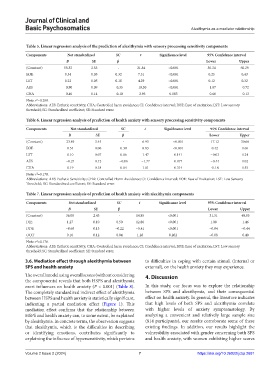
            Table 5. Linear regression analysis of the prediction of alexithymia with sensory processing sensitivity components
            Components        Not standardized    SC         t       Significance level  95% Confidence interval
                             B          SE         β                                     Lower         Upper
            (Constant)      55.32       2.53       -       21.84         <0.001          50.34         60.29
            EOE              0.34       0.05      0.32      7.51         <0.001           0.25          0.43
            LST              0.22       0.05      0.18      4.29         <0.001           0.12          0.32
            AES             −0.90       0.09      −0.35    −10.30        <0.001          −1.07         −0.72
            CHA             −0.40       0.14      −0.10    −2.93         0.003           −0.66         −0.13
            Note: r =0.208.
                 2
            Abbreviations: AES: Esthetic sensitivity; CHA: Controlled harm avoidance; CI: Confidence interval; EOE: Ease of excitation; LST: Low sensory
            threshold; SC: Standardized coefficient; SE: Standard error.
            Table 6. Linear regression analysis of prediction of health anxiety with sensory processing sensitivity components

            Components         Not standardized     SC        t        Significance level  95% Confidence interval
                              B           SE         β                                    Lower        Upper
            (Constant)       23.89       3.45        -        6.93         <0.001          17.12        30.66
            EOE               0.54       0.06       0.38      8.83         <0.001          0.42         0.66
            LST               0.10       0.07       0.06      1.47         0.141           −0.03        0.24
            AES              −0.21       0.12       −0.06    −1.77         0.077           −0.44        0.02
            CHA               0.19       0.18       0.04      1.01         0.314           -0.18        0.55
            Note: r =0.178.
                 2
            Abbreviations: AES: Esthetic Sensitivity; CHA: Controlled Harm Avoidance; CI: Confidence Interval; EOE: Ease of Excitation; LST: Low Sensory
            Threshold; SC: Standardized coefficient; SE: Standard error.
            Table 7. Linear regression analysis of prediction of health anxiety with alexithymia components
            Components        Not standardized     SC       t        Significance level  95% Confidence interval
                              B          SE        β                                      Lower        Upper
            (Constant)       36.08       2.43       -      14.85        <0.001            31.31         40.85
            DIE              1.27        0.10      0.50    12.86        <0.001             1.08         1.46
            DDE              −0.69       0.13     −0.22    −5.41        <0.001            −0.94         −0.44
            OOT              0.16        0.12      0.04    1.28          0.202            −0.08         0.40
            Note: r =0.176.
                 2
            Abbreviations: AES: Esthetic sensitivity; CHA: Controlled harm avoidance; CI: Confidence interval; EOE: Ease of excitation; LST: Low sensory
            threshold; SC: Standardized coefficient; SE: Standard error.
            3.6. Mediation effect through alexithymia between   to difficulties in coping with certain stimuli (internal or
            SPS and health anxiety                             external), on the health anxiety they may experience.
            The overall model using overall scores (without considering   4. Discussion
            the components) reveals that both HSPS and alexithymia
            exert influences on health anxiety (P < 0.001) (Table 8).   In this study,  our focus was  to explore the  relationship
            The completely standardized indirect effect of alexithymia   between SPS and alexithymia, and their consequential
            between HSPS and health anxiety is statistically significant,   effect on health anxiety. In general, the literature indicates
            indicating a partial mediation effect (Figure  1). This   that  high  levels  of  both  SPS  and  alexithymia  correlate
            mediation effect confirms that the relationship between   with  higher  levels  of  anxiety  symptomatology. By
            HSPS and health anxiety can, to some extent, be explained   analyzing a convenient and relatively large sample  size
            by alexithymia. In concrete terms, the observation suggests   (814 participants), our results corroborate some of these
            that alexithymia, which is the difficulties in describing   existing findings. In addition, our results highlight the
            or identifying emotions, contributes significantly to   vulnerability associated with gender concerning both SPS
            explaining the influence of hypersensitivity, which pertains   and health anxiety, with women exhibiting higher scores


            Volume 2 Issue 2 (2024)                         7                        https://doi.org/10.36922/jcbp.2681

