


Page 50 - JCBP-2-2
P. 50
Journal of Clinical and
            Basic Psychosomatics                                                  Alexithymia as a mediator relationship


            Table 8. Mediation effect between HSPS and health anxiety through alexithymia
            Components                  Not standardized   SC          t        Significance level  95% CI
                                          B        SE      β                                    Lower   Upper
            (Constant)                   9.54     3.29      -         2.90           0.004       3.09    15.99
            HSPS                         0.24     0.02     0.34       10.54         <0.001       0.19    0.28
            TAS-20                       0.26     0.04     0.20       6.04          <0.001       0.18    0.35
            Model of Indirect mediating effect  Effect coefficient  Boot SE  Boot lower CI  Boot Upper CI
            TAS-20 (overall)                 0.036        0.009      0.0196                 0.0546
            Notes: r =0.179; Interaction=F (1;810)=0.028; P=0.868.
                 2
            Abbreviations: AES: Esthetic sensitivity; CHA: Controlled harm avoidance; CI: Confidence interval; EOE: Ease of excitation; HSPS: Highly sensitive
            person scale; LST: Low sensory threshold; SC: Standardized coefficient; SE: Standard Error; TAS-20: Toronto Alexithymia Scale 20.
                                                               behaviors in response to potentially unpleasant stimuli.
                                Alexithymia
                                                               Consequently, highly sensitive individuals with high scores
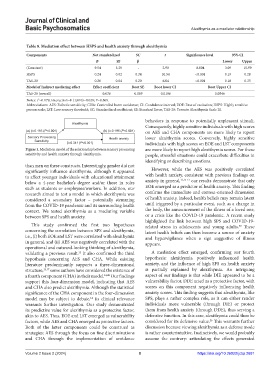
            (a) β=0.183 (P<0.001)            (b) β=0.195 (P<0.001)  on AES and CHA components are more likely to report
             Sensory Processing                Health anxiety  lower alexithymia scores. Conversely, highly sensitive
                Sensitivity
                             β=0.341 (P<0.001)                 individuals with high scores on EOE and LST components
            Figure 1. Mediation model of the relationship between sensory processing   are more likely to report high alexithymia scores. For these
            sensitivity and health anxiety through alexithymia.  people, stressful situations could exacerbate difficulties in
                                                               identifying or describing emotions.
            than men on these constructs. Interestingly, gender did not
            significantly influence alexithymia, although it appeared   However, while the AES was positively correlated
            to affect younger individuals with educational attainment   with health anxiety, consistent with previous findings on
            below a 4-year bachelor’s degree and/or those in roles   anxiety in general, 13,15-17  our results demonstrate that only
            such as students or employees/workers. In addition, our   EOE emerged as a predictor of health anxiety. This finding
            research aimed to test a model in which alexithymia was   confirms the immediate and context-oriented dimension
            considered a secondary factor – potentially stemming   of health anxiety. Indeed, health beliefs may remain latent
            from the COVID-19 pandemic and its surrounding health   until triggered by a particular event, such as a change in
            context. We tested alexithymia as a mediating variable   the body, the announcement of the illness of a loved one,
            between SPS and health anxiety.                    or a crisis like the COVID-19 pandemic. A recent study
                                                               highlighted the link between high SPS and COVID-19-
              This  study confirmed  the first two hypotheses   related stress in adolescents and young adults.  These
                                                                                                       50
            concerning the correlation between SPS and alexithymia,   latent health beliefs can then become a source of anxiety
            i.e., (i) both EOE and LST were correlated with alexithymia   and hypervigilance when a sign suggestive of illness
            in general, and (ii) AES was negatively correlated with the   appears.
            operational and outward-looking thinking of alexithymia,
            validating a previous result.  It also confirmed the third   A mediation effect emerged, confirming our fourth
                                  15
            hypothesis concerning AES and CHA. While existing   hypothesis: alexithymia positively influenced health
            literature predominantly supports a three-dimensional   anxiety, and the influence of high SPS on health anxiety
            structure, 13,17  some authors have considered the existence of   is partially explained by alexithymia. An intriguing
            a fourth component (CHA) in their model. 14,49  Our findings   aspect of our findings is that while DIE appeared to be a
            support this four-dimension model, indicating that AES   vulnerability factor, DDE acted as a protective factor, with
            and CHA also predict alexithymia. Although the statistical   scores  on this component negatively influencing  health
            significance of the CHA component in the four-dimension   anxiety scores. This finding suggests that alexithymia, like
            model  may  be  subject  to  debate,   its  clinical  relevance   SPS, plays a rather complex role, as it can either render
                                       14
            warrants further investigation. Our study demonstrated   individuals more  vulnerable  (through DIE)  or protect
            its predictive value for alexithymia as a protective factor,   them from health anxiety (through DDE), thus serving a
            akin to AES. Thus, EOE and LST emerged as vulnerability   defensive function. In this case, alexithymia could then be
                                                                                          26
            factors, while AES and CHA emerged as protective factors.   considered for its defensive value.  This warrants further
            Both  of the  latter  components  could be  construed as   discussion because viewing alexithymia as a defense mode
            strategies: AES through the focus on fine discriminations   is rather counterintuitive. Instinctively, we would probably
            and CHA through the implementation of avoidance    assume the contrary: articulating the effects generated


            Volume 2 Issue 2 (2024)                         8                        https://doi.org/10.36922/jcbp.2681

