


Page 48 - JCBP-2-2
P. 48
Journal of Clinical and
            Basic Psychosomatics                                                  Alexithymia as a mediator relationship


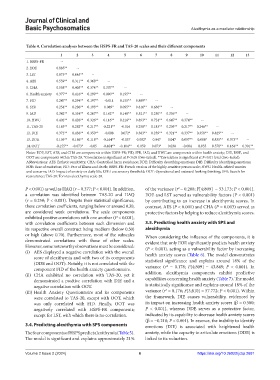
            Table 4. Correlation analyses between the HSPS‑FR and TAS‑20 scales and their different components
                           1      2     3      4      5      6     7      8     9     10     11    12    13
            1. HSPS-FR     --
            2. EOE       0.885**  --
            3. LST       0.873**  0.645**  --
            4. AES       0.559**  0.311**  0.368**  --
            5. CHA       0.558**  0.405**  0.374**  0.307**  --
            6. Health anxiety  0.377**  0.416**  0.299**  0.090**  0.195**  --
            7. FID       0.247**  0.294**  0.197**  -0.011  0.155**  0.889**  --
            8. SFR       0.254**  0.286**  0.193**  0.089*  0.095**  0.816**  0.636**  --
            9. IAD       0.342**  0.354**  0.267**  0.162**  0.148**  0.521**  0.250**  0.336**  --
            10. HWC      0.402**  0.426**  0.326**  0.116**  0.216**  0.893**  0.724**  0.647**  0.374**  --
            11. TAS-20   0.183**  0.282**  0.217**  -0.221**  -0.016  0.258**  0.183**  0.203**  0.217**  0.246**  --
            12. DIE      0.372**  0.436**  0.350**  -0.008  0.072*  0.383**  0.259**  0.321**  0.337**  0.358**  0.829**  --
            13. DDE      0.103**  0.186**  0.118**  -0.164**  -0.037  0.082*  0.047  0.047  0.097**  0.088*  0.835**  0.573**  --
            14. OOT      -0.155**  -0.073*  -0.05  -0.404**  -0.104**  0.059  0.073*  0.038  -0.004  0.055  0.578**  0.164**  0.301**
            Notes: EOE, LST, AES, and CHA are components within HSPS-FR; FID, SFR, IAD, and HWC are components within health anxiety; DIE, DDE, and
            OOT are components within TAS-20. *Correlation is significant at P<0.05 (two-tailed). **Correlation is significant at P<0.01 level (two-tailed).
            Abbreviations: AES: Esthetic sensitivity; CHA: Controlled harm avoidance; DDE: Difficulty describing emotions; DIE: Difficulty identifying emotions;
            EOE: Ease of excitation; FID: Fear of illness and death; HSPS-FR: French version of the highly sensitive person scale; HWC: Health-related worries
            and concerns; IAD: Impact of anxiety on daily life; LST: Low sensory threshold; OOT: Operational and outward-looking thinking; SFR: Search for
            reassurance; TAS-20: Toronto alexithymia scale-20.

            P < 0.001) as well as HAQ (r = 0.377; P < 0.001). In addition,   of the variance (r = 0.208; F[4;809]  = 53.173; P < 0.001).
                                                                             2
            a correlation was identified between TAS-20 and HAQ   EOE and LST served as vulnerability factors (P < 0.001)
            (r = 0.258; P < 0.001). Despite their statistical significance,   by contributing to an increase in alexithymia scores. In
            these correlation coefficients, ranging below or around 0.30,   contrast, AES (P < 0.001) and CHA (P = 0.003) served as
            are considered weak correlations. The scale components   protective factors by helping to reduce alexithymia scores.
            exhibited positive correlations with one another (P < 0.001),
            with  correlation coefficients  between  each  dimension  and   3.5. Predicting health anxiety with SPS and
            its respective overall construct being medium (below 0.50)   alexithymia
            or high (above 0.70). Furthermore, most of the subscales   When considering the influence of the components, it is
            demonstrated correlations with those of other scales.   evident that only EOE significantly predicts health anxiety
            However, some noteworthy observations must be considered:  (P < 0.001), acting as a vulnerability factor by increasing
            (i)  AES displayed a negative correlation with the overall   health anxiety scores (Table 6). The model demonstrates
               score of alexithymia and with two of its components
               (DDE and OOT). Notably, it is not correlated with the   statistical significance and explains around 18% of the
                                                                        2
               component FID of the health anxiety questionnaire.  variance  (r   = 0.178;  F[4;809]  = 43.849;  P  <  0.001). In
            (ii)  CHA exhibited no correlation with TAS-20, yet it   addition,  alexithymia components  exhibit predictive
               demonstrated a positive correlation with DIE and a   capabilities concerning health anxiety (Table 7). The model
               negative correlation with OOT.                  is statistically significance and explains around 18% of the
                                                                       2
            (iii) Health Anxiety Questionnaire and its components   variance (r  = 0.176; F[3;810] = 57.772; P < 0.001). Within
               were correlated to TAS-20, except with OOT, which   the framework, DIE causes vulnerability, evidenced by
               was only correlated with FID. Finally, OOT was   its impact on increasing health anxiety scores (β = 0.500;
               negatively  correlated with  HSPS-FR components;   P  < 0.001), whereas DDE serves as a protective factor,
               except for LST, with which there is no correlation.  indicated by its capability to decrease health anxiety scores
                                                               (β = −0.218; P < 0.001). In essence, the inability to identify
            3.4. Predicting alexithymia with SPS components    emotions  (DIE)  is associated with heightened health
            The four components of HSPS predict alexithymia (Table 5).   anxiety, while the capacity to articulate emotions (DDE) is
            The model is significant and explains approximately 21%   linked to its reduction.


            Volume 2 Issue 2 (2024)                         6                        https://doi.org/10.36922/jcbp.2681

