


Page 62 - JCBP-2-2
P. 62
Journal of Clinical and
            Basic Psychosomatics                                              Cultural coping for PTSD among amaXhosa


            can compromise the survivor’s well-being, posing a threat   Participants perceived traumatic experiences as being
            to their psychological, emotional, and physical health,    caused by spiritual factors, aligning with beliefs common
                                                          6
            prolonging the symptoms of PTSD.                   in African cultures. 16-18  Coping strategies included
                                                               Christian religious practices, consultation with a sangoma
            3.7. Key findings from interviews and FGDs         (traditional healer), and  social support. Notably,  while
            The gathered data has revealed the significant reliance of   both interviewees and FGD participants engaged in
            amaXhosa participants on culturally informed practices   culturally informed practices, Christian religious beliefs
            for addressing PTSD symptoms. Both the interview and   were more prominent among interviewees. This difference
            FGD participants understood traumatic symptoms from   could be attributed to the nature of questions asked during
            a spiritual viewpoint with emphasis on the dead spirit.   the interviews compared to FGDs.
            While some individuals explained  their symptoms  as   The study’s findings support existing literature 19-21  on
            naturally  occurring  and  expected  to  disappear  after  a   the role of Christian religious practices in treating PTSD
            period of time, they nevertheless adhered to practices   symptoms. Participants believed that prayers facilitated
            specific to their culture. A summary of the main findings   communication with a higher power and helped cope
            drawn from the interviews and FGDs is presented in   with  emotional  distress.  Similarly,  the  consultation  with
            Table 2.
                                                               a sangoma and engagement in indigenous rituals were
            4. Discussion                                      considered effective coping strategies. The high regard
                                                               for traditional healers among amaXhosa participants
            The study explored culturally informed treatment   aligns with previous research indicating a preference for
            strategies for PTSD adopted by amaXhosa participants in   traditional healing over biomedical treatments in African
            the Eastern Cape Province of South Africa. The research   contexts. 10,22
            question addressed in this study is “How do culturally
            informed coping strategies influence the treatment of   Social support emerged as another culturally informed
            PTSD symptoms amongst members of the amaXhosa      treatment strategy, consistent with universal practices.
            culture in Gqeberha, South Africa?” The findings from   Family  and friends  provided care, financial support,
            interviews and FGDs revealed common interpretations of   encouragement, and advice, facilitating the healing
                                                                     23
            PTSD symptoms and demonstrated culturally informed   process.  Importantly, participants combined multiple
            coping strategies.                                 beliefs and practices, considering them a holistic approach
                                                               to treatment. This integration of beliefs and practices
                                                               reflects  the  cultural  influence  on  coping  strategies  for
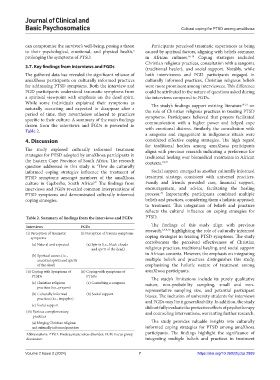
            Table 2. Summary of findings from the interviews and FGDs  PTSD.

            Interviews             FGDs                          The findings of this study align with previous
                                                               research, 3,4,9,10  highlighting the role of culturally informed
            (i)  Perception of traumatic   (i) Perception of trauma symptoms
              symptoms                                         coping strategies in treating PTSD symptoms. The study
               (a) Natural and expected  (a)  Spirits (i.e., black clouds   corroborates the perceived effectiveness of Christian
                                        and spirit of the dead)  religious practices, traditional healing, and social support
               (b)  Spiritual causes (i.e.,                    in African contexts. However, the emphasis on integrating
                 ancestral spirits and spirits                 multiple beliefs and practices distinguishes this study,
                 of the dead)                                  emphasizing the holistic nature of treatment among
            (ii)  Coping with Symptoms of   (ii)  Coping with symptoms of   amaXhosa participants.
               PTSDs                  PTSDs                      The  study’s limitations  include  its  purely  qualitative
               (a)  Christian religious   (a) Consulting a sangoma  nature, non-probability sampling, small and non-
                 practices (i.e., prayers)                     representative sampling size, and potential participant
               (b)  Culturally informed   (b) Social support   biases. The inclusion of university students for interviews
                 practices (i.e., impepho)
               (c) Social support                              and FGDs may limit generalizability. In addition, the study
                                                               did not fully evaluate the protective effects of psychotherapy
            (iii)  Various complementary                       and counseling interventions, warranting further research.
               practices
               (a) Merging Christian religious                   The study provides valuable insights into culturally
               and culturally informed practices               informed coping strategies for PTSD among amaXhosa
            Abbreviations: PTSD: Posttraumatic stress disorder; FGD: Focus group   participants. The  findings highlight  the significance of
            discussion.                                        integrating multiple beliefs and practices in treatment


            Volume 2 Issue 2 (2024)                         7                        https://doi.org/10.36922/jcbp.2889

