


Page 63 - JCBP-2-2
P. 63
Journal of Clinical and
            Basic Psychosomatics                                              Cultural coping for PTSD among amaXhosa


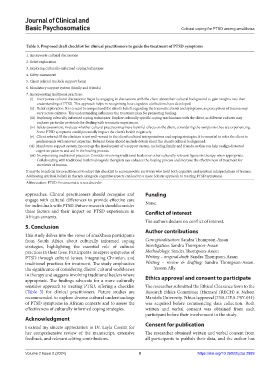
            Table 3. Proposed draft checklist for clinical practitioners to guide the treatment of PTSD symptoms
            1. Incorporate cultural discussions
            2. Belief exploration
            3. Exploring culturally-informed coping techniques
            4. Safety assessment
            5. Client referral (include support form)
            6. Mandatory support system (family and friends)
            7. Incorporating traditional practices:
                (i)     Incorporate cultural discussions: Begin by engaging in discussions with the client about their cultural background to gain insights into their
                 understanding of PTSD. This approach helps in recognizing how cognitive attributions have developed.
                (ii)    Belief exploration: It is crucial to comprehend the client’s beliefs regarding the traumatic events and symptoms, as perceptions of trauma may
                 vary across cultures. This understanding influences the treatment plan for promoting healing.
                (iii)   Exploring culturally informed coping techniques: Explore culturally specific coping mechanisms with the client, as different cultures may
                 endorse particular protocols for dealing with traumatic experiences.
                (iv)   Safety assessment: Evaluate whether cultural practices may have harmful effects on the client, considering the symptoms they are experiencing.
                 Some PTSD symptoms could potentially impact the client’s health negatively.
                (v)    Client referral: If the clinician is not well-versed in the client’s cultural interpretations and coping strategies, it is essential to refer the client to
                 professionals with relevant expertise. Referral forms should include details about the client’s cultural background.
                (vi)   Mandatory support system: Encourage the involvement of a support system, including family and friends, as this can help realign distorted
                cognitive patterns and aid in the healing process.
                 (vii)   Incorporating traditional practices: Consider involving traditional healers or other culturally relevant figures in therapy when appropriate.
                 Collaborating with traditional healers alongside therapists can enhance the healing process and increase the effectiveness of treatment for
                 survivors of trauma.
            It may be beneficial for practitioners to adapt this checklist to accommodate survivors who hold both cognitive and spiritual interpretations of trauma.
            Addressing spiritual beliefs in therapy alongside cognitive aspects can lead to a more holistic approach to treating PTSD symptoms.
            Abbreviation: PTSD: Posttraumatic stress disorder.

            approaches. Clinical practitioners should recognize and   Funding
            engage with cultural differences to provide effective care
            for individuals with PTSD. Future research should consider   None.
            these factors and their impact on PTSD experiences in   Conflict of interest
            African contexts.
                                                               The authors declare no conflict of interest.
            5. Conclusion

            This study delves into the views of amaXhosa participants   Author contributions
            from  South Africa about culturally  informed  coping   Conceptualization: Sandra Thompson-Assan
            strategies, highlighting the essential role of cultural   Investigation: Sandra Thompson-Assan
            practices in their lives. Participants interpret symptoms of   Methodology: Sandra Thompson-Assan
            PTSD through cultural lenses, integrating Christian, and   Writing – original draft: Sandra Thompson-Assan
            traditional practices for treatment. The study emphasizes   Writing – review & drafting: Sandra Thompson-Assan,
            the significance of considering clients’ cultural worldviews   Yaseen Ally
            in therapy and suggests involving traditional healers where
            appropriate. The findings advocate for a more culturally   Ethics approval and consent to participate
            sensitive approach to treating PTSD, offering a checklist   The researcher submitted the Ethical Clearance form to the
            (Table 3) for clinical practitioners. Future studies are   Research Ethics Committee (Human) (RECH) at Nelson
            recommended to explore diverse cultural understandings   Mandela University. Ethical approval (H18-HEA-PSY-011)
            of PTSD symptoms in African contexts and to assess the   was acquired before commencing data collection. Both
            effectiveness of culturally informed coping strategies.  written  and  verbal  consent  was  obtained  from  each
                                                               participant before their involvement in the study.
            Acknowledgment
            I extend my sincere appreciation to Dr. Layla Cassim for   Consent for publication
            her comprehensive review of the manuscript, extensive   The researcher obtained written and verbal consent from
            feedback, and relevant editing contributions.      all participants to publish their data, and the author has


            Volume 2 Issue 2 (2024)                         8                        https://doi.org/10.36922/jcbp.2889

