


Page 59 - JCBP-2-2
P. 59
Journal of Clinical and
            Basic Psychosomatics                                              Cultural coping for PTSD among amaXhosa


            reflecting on the information to formulate initial codes.   completed their matriculation, and two had informal
            Subsequently, related codes were identified, merged, and   education. The university students’ ages ranged between
            subjected to peer-reviewed for credibility. The refinement   19 and 21  years old, while the matriculation holders
            of codes and generation of themes involved comparing   were between 27 and 40 years old. The individuals with
            codes across interviews and FGDs to discern similarities   informal education were aged 24, 39, and 59 years old. Ten
            and differences.                                   participants identified themselves as Christians, while the
              To address validity concerns, the study focused on   remaining five associated more with traditional religion.
            credibility, applicability, consistency, and neutrality, thus   Besides the university students, the remaining participants
            promoting trustworthiness. Triangulation of qualitative   worked as shop attendants and informal traders.
            methods, separate analysis of interviews and FGDs,   The focus group comprised eight culturally informed
            and  comparison  of  responses  were  employed  to  ensure   participants, evenly split between four men and four
            credibility. Two transcribers and independent coders   women. Among them, five participants were university
            were engaged to maintain consistency, with regular   graduates, while three had informal education, with ages
            cross-checking by a supervisor. The author’s awareness of   ranging  from 18  to 62.  Four participants identified with
            potential biases and mitigation measures further enhanced   the  Christian  religion,  while  the  others  leaned  toward
            the study’s neutrality. The comprehensive approach to data   traditional worship. All focus group participants engaged
            collection and analysis yielded findings with potential   in  small-scale  selling  of  goods.  Participants  were  chosen
            applicability to other populations.                based on their cultural understanding, defined as having
                                                               received formal or informal training from a cultural leader.
            3. Results                                         Three gatekeepers representing the respective towns guided
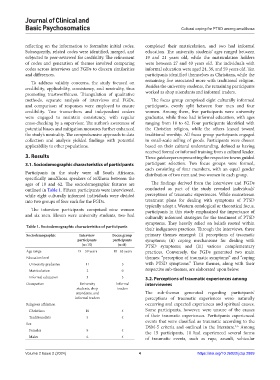
            3.1. Sociodemographic characteristics of participants  participant selection. Two focus groups were formed,
                                                               each consisting of four members, with an equal gender
            Participants in the study were all South Africans,   distribution of two men and two women in each group.
            specifically amaXhosa speakers of isiXhosa between the
            ages  of  18 and  62.  The  sociodemographic  features  are   The findings derived from the interviews and FGDs
            outlined in Table 1. Fifteen participants were interviewed,   conducted as part of the study revealed individuals’
            while eight culturally informed individuals were divided   perceptions of traumatic experiences. While mainstream
            into two groups of four each for the FGDs.         treatment plans for dealing with symptoms of PTSD
                                                               typically adopt a Western ontological or theoretical focus,
              The  interview  participants  comprised  nine  women   participants in this study emphasized the importance of
            and six men. Eleven were university students, two had   culturally informed strategies for the treatment of PTSD
                                                               symptoms. They heavily relied on beliefs rooted within
            Table 1. Sociodemographic characteristics of participants
                                                               their indigenous practices. Through the interviews, three
            Sociodemographic       Interview     Focus group   primary  themes  emerged:  (i) perceptions  of traumatic
                                  participants   participants   symptoms; (ii) coping mechanisms for dealing with
                                    (n=15)         (n=8)       PTSD symptoms; and (iii) various complementary
            Age range             19 – 59 years  18 –62 years  practices. Conversely, the FGDs generated two main
            Education level                                    themes: “perception of traumatic symptoms” and “coping
             University graduates    11              5         with PTSD symptoms.” These themes, along with their
             Matriculation            2              0         respective sub-themes, are elaborated upon below.
             Informal education       3              3         3.2. Perceptions of traumatic experiences among
            Occupation             University     Informal     interviewees
                                  students, shop   traders
                                 attendants, and               The sub-themes generated regarding participants’
                                 informal traders              perceptions of traumatic experiences were: naturally
            Religious affiliation                              occurring and expected experiences and spiritual causes.
             Christians              10              4         Some participants, however, were unsure of the causes
             Traditionalists          5              4         of their traumatic experiences. Participants experienced
            Sex                                                events that were classified as traumatic according to the
                                                               DSM-5 criteria and outlined in the literature.  Among
                                                                                                     1,6
             Females                  9              4         the 15 participants, 10 had experienced several forms
             Males                    6              4         of traumatic events, such as rape, assault, vehicular


            Volume 2 Issue 2 (2024)                         4                        https://doi.org/10.36922/jcbp.2889

