


Page 20 - JCBP-2-3
P. 20
Journal of Clinical and
            Basic Psychosomatics                                                   The antidepressant effect of ketamine


              The kynurenine  (KYN)  pathway plays  an  important   has significantly influenced awareness of antidepressant
            role in depression, according to many investigations.    treatments and greatly expanded the medication options
                                                         84
            KYN is a major regulator of glutamate and 5-HT. Both   for patients with TRD and depression at risk of suicide.
            the metabolic enzymes and metabolites of KYN are   Investigating biomarkers related to the rapid-acting
            involved in the antidepressant mechanism of ketamine.   antidepressant effects of ketamine will be extremely
            Moaddel  et al.  applied ketamine to TRD patients   beneficial for early intervention, rapid onset of therapeutic
                         85
            and found that plasma KYN levels decreased 4  h after   effects, and predicting treatment outcomes in depression.
            ketamine infusion in the remission group. Kadriu et al.    In this review, we summarize a number of biomarkers
                                                         86
            reported that ketamine could reduce the levels of KYN,   (Table 1) that can predict and modulate ketamine efficacy.
            a metabolizing enzyme, and a toxic metabolite of KYN,   Although research in this area is still in its infancy, it
            quinolinic acid, but increase the levels of a protective   is helpful for clinicians to identify TRD patients who
            metabolite, kynureric acid, in depressed patients. They   are suitable candidates for ketamine treatment, thereby
            also found that proinflammatory cytokines at baseline   alleviating the burden on these patients and society.
            were associated with alterations in the KYN pathway   To  date,  the  majority  of  biomarkers  are  still  in  the
            after ketamine treatment, suggesting that KYN might   preclinical exploratory stage, and existing findings
            be  involved  in the  immune  inflammatory response   are limited. To realize the clinical application of these
            to depression. A  recent study also confirmed that   biomarkers,  future  studies  should  combine  different
            ketamine could rapidly increase the serum kynurenic   types of biomarkers to investigate their relationships
            acid concentration in depressed patients, and the level of   and interactions. This approach could optimize clinical
            kynurenic uric acid at 24 h could predict the sustained   outcomes by enhancing the involvement of biological
            antidepressant effects of ketamine at 13 and 26 days.  The   targets in new models. Cross-modal research on
                                                      87
            above evidence suggests that the KYN pathway is involved   biomarkers  has  been  carried  out  consecutively  and  is
            in the immunological, monoaminergic, and glutamatergic   extremely valuable for optimizing neurobiological signals-
            mechanisms of depression. The key neuroactive factors   assisted diagnosis and treatment.
            in the KYN pathway, including metabolic enzymes and
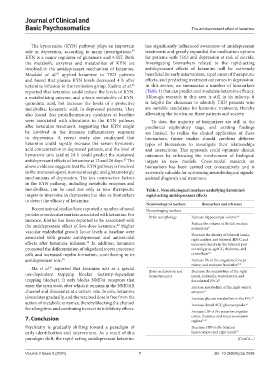
            metabolites, can be used not only as new therapeutic   Table 1. Neurobiological markers underlying ketamine’s
            targets to intervene in depression but also as biomarkers   rapid-acting antidepressant effects
            to detect the efficacy of ketamine.
                                                               Neurobiological markers  Biomarkers and reference
              Recent animal studies have reported a number of novel   Neuroimaging markers
            protein or molecular markers associated with ketamine. For   Brain morphology  Increase hippocampal volume 5,6
            instance, Klotho has been reported to be associated with
                                                   88
            the antidepressant effect of low-dose ketamine.  Higher               Reduce the volume of the left nucleus
                                                                                  accumbens
                                                                                          6
            vascular endothelial growth factor levels at baseline were
            associated with greater antidepressant and antisuicidal               Decrease the density of bilateral insula,
                                                                                  right caudate, and bilateral dlPFC and
            effects after ketamine infusion.  In addition, ketamine               increased density in the bilateral post-
                                      89
            promoted the differentiation of oligodendrocyte precursor             central gyrus, sgACC, thalamus, and
            cells and increased myelin formation, contributing to its             cerebellum 7,8
            antidepressant role. 90                                               Increase FA of the cingulum, forceps
                                                                                  minor, and uncinate fasciculus 9,10
              Ma  et  al.  reported that ketamine acts as a special
                      91
            use-dependent trapping blocker (activity-dependent   Brain metabolism and   Decrease the metabolism of the right
                                                                                  insula, habenula, ventrolateral, and
                                                                hemodynamics
            trapping blocker). It only blocks NMDA receptors that                 dorsolateral PFCs 11
            enter the open state, after which it remains in the NMDAR             Increase metabolism of the right ventral
            channel and dissociates at a certain rate. In vivo, ketamine          striatum 12
            dissociates gradually, and the retained dose is free from the         Increase glucose metabolism in the PFC 13
            action of metabolic enzymes, thereby blocking the channel             Increase dorsal ACC glucose uptake 14
            for a long time and continuing to exert its inhibitory effects.
                                                                                  Increase CBF of the posterior cingulate
            7. Conclusion                                                         cortex, thalamus and visual association
                                                                                  regions
                                                                                       15,16
            Psychiatry is gradually shifting toward a paradigm of                 Decrease CBF in the bilateral
            early identification and intervention. As a result of this            hippocampus and right insula 15
            paradigm shift, the rapid-acting antidepressant ketamine                                  (Cont'd...)


            Volume 2 Issue 3 (2024)                         7                               doi: 10.36922/jcbp.2596

