


Page 83 - JCBP-3-1
P. 83
Journal of Clinical and
            Basic Psychosomatics                                                     HDL markers and suicidal ideation


            between the pathogenesis of SI and various biomarkers,
            including high-sensitivity C-reactive protein (hs-CRP),
                                                          5
            monocytes,  and high-density lipoprotein cholesterol
                     6
            (HDL-C).  Recent research has further underscored the
                    7
            complex  interplay  among  inflammatory,  immune,  and
            lipid biomarkers. 8-12
              High-density lipoprotein (HDL), among lipid
            biomarkers, has attracted significant attention due to
            its multifunctional roles, including anti-inflammatory,
            antioxidant,  immune-regulating,  and reverse  cholesterol
            transport functions. 13,14  In recent years, novel HDL-
            related inflammatory indicators have been developed by
            combining HDL-C levels with other blood components,
            such as white blood cell (WBC), lymphocyte (LYM),
            monocyte  (MONO),  and  neutrophil  (NEU)  counts  as
            well as hs-CRP and platelet (PLT) levels. 15-17  These HDL-
            associated markers simultaneously reflect inflammation,
            immune responses, and metabolic states, allowing for a
            more comprehensive evaluation of how these risk factors
            collectively influence health. However, research on the
            relationship between HDL-associated markers and SI
            remains extremely limited.
              The Centers for Disease Control and Prevention
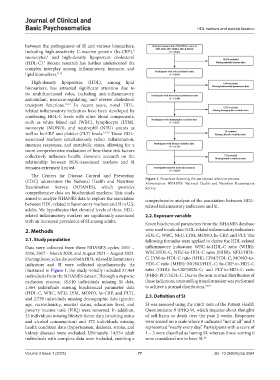
            (CDC)  administers the National  Health and  Nutrition   Figure 1. Flowchart depicting the participant selection process
                                                               Abbreviation: NHANES: National Health and Nutrition Examination
            Examination Survey  (NHANES),  which provides      Survey.
            comprehensive data on biochemical markers. This study
            aimed to analyze NHANES data to explore the association   comprehensive analysis of the association between HDL-
            between HDL-related inflammatory markers and SI in U.S.   related inflammatory indicators and SI.
            adults. We hypothesize that elevated levels of these HDL-
            related inflammatory markers are significantly associated   2.2. Exposure variable
            with an increased prevalence of SI among adults.
                                                               Seven biochemical parameters from the NHANES database
            2. Methods                                         were used to calculate HDL-related inflammatory indicators:
                                                               HDL-C, WBC, NEU, LYM, MONO, hs-CRP, and PLT. The
            2.1. Study population                              following formulas were applied to derive the HDL-related
            Data were collected from three NHANES cycles: 2015 –   inflammatory indicators: WBC-to-HDL-C ratio (WHR):
            2016, 2017 – March 2020, and August 2021 – August 2023.   WBC/HDL-C; NEU-to-HDL-C ratio (NHR): NEU/HDL-
            During these cycles, data on both HDL-related inflammatory   C; LYM-to-HDL-C ratio (LHR): LYM/HDL-C; MONO-to-
            indicators and SI were collected simultaneously. As   HDL-C ratio (MHR): MONO/HDL-C; hs-CRP-to-HDL-C
            illustrated in Figure 1, the study initially included 37,464   ratio (CHR): hs-CRP/HDL-C; and PLT-to-HDL-C ratio
            individuals from the NHANES dataset. Through a stepwise   (PHR): PLT/HDL-C. Due to the non-normal distribution of
            exclusion process, 18,510 individuals missing SI data,   these indicators, a natural log transformation was performed
            1,464 individuals missing biochemical parameter data   to achieve a normal distribution. 18,19
            (HDL-C, WBC, NEU, LYM, MONO, hs-CRP, and PLT),
            and 2,729 individuals missing demographic data (gender,   2.3. Definition of SI
            age, race/ethnicity, marital status, education level, and   SI was assessed using the ninth item of the Patient Health
            poverty income ratio [PIR]) were removed. In addition,   Questionnaire-9 (PHQ-9), which inquires about thoughts
            35 individuals missing lifestyle factor data (smoking status   of self-harm or death over the past 2  weeks. Responses
            and alcohol consumption) and 172 individuals missing   were scored on a scale where 0 indicated “not at all” and 3
            health condition data (hypertension, diabetes, stroke, and   represented “nearly every day.” Participants with a score of
            kidney  disease)  were  excluded.  Ultimately,  14,554 adult   1 – 3 were classified as having SI, whereas those scoring 0
            individuals with complete data were included, enabling a   were considered not to have SI. 20


            Volume 3 Issue 1 (2025)                         77                              doi: 10.36922/jcbp.5084

