


Page 36 - JCBP-3-3
P. 36
Journal of Clinical and
            Basic Psychosomatics                                                  Microbiota in psychosomatic disorders


            and metabolic profiles (Table  1), affecting mood and   anxiety and stress responses 57,58  (Table  1). Tryptophan
            cognitive functions. For example, alterations in bile acid   metabolites produced by gut microbiota also play a
            metabolism are associated with changes in serotonin and   crucial role in brain function and mood regulation.
                                                                                                            59
            dopamine signaling pathways, both critical for regulating   Tryptophan is an essential amino  acid that  serves as a
            mood. Dysregulation of bile acid metabolism has been   pre-cursor for several bioactive compounds, including
            linked to neurodegenerative diseases and mood disorders,   serotonin and kynurenine. Approximately 90% of
            further highlighting their role in maintaining neurological   serotonin is synthesized in the gut, where gut bacteria
            health.  Furthermore, bile acids are also associated with   modulate the availability of tryptophan for serotonin
                 64
            metabolic diseases as they regulate hormone secretion,   production by enterochromaffin cells. Serotonin is a key
            such as glucagon-like peptide-1 and peptide YY, which   neurotransmitter in regulating mood, appetite, and sleep,
            regulate appetite and energy balance. 41,42  Emerging   and alterations in tryptophan metabolism can directly
            evidence also links dysbiosis to cardiovascular diseases,   influence its availability. Reduced levels of serotonin
            such as atherosclerosis and hypertension. Certain gut   are strongly associated with depression and anxiety,
            bacteria  metabolize  dietary  nutrients  into  compounds   underscoring the importance of tryptophan metabolism
            like trimethylamine-N-oxide, which is associated with a   in mental health. In addition to serotonin, tryptophan is
            higher risk of cardiovascular events. In addition, dysbiosis-  metabolized along the kynurenine pathway, which is also
            induced inflammation also plays a role in the development   influenced by gut bacteria. Kynurenine and its downstream
            of atherosclerosis and other cardiovascular conditions. 47,48  metabolites  have  neuroactive  properties  and can either
                                                               be neuroprotective or neurotoxic, depending on the
            2.3. Neurotransmitter synthesis                    balance between metabolites. 60,61  For example, kynurenic

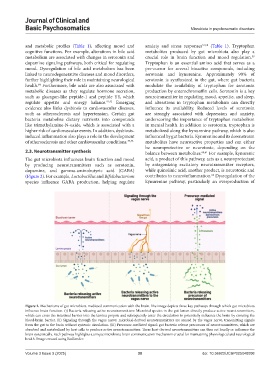
            The gut microbiota influences brain function and mood   acid, a product of this pathway, acts as a neuroprotectant
            by producing neurotransmitters such as serotonin,   by antagonizing  excitatory  neurotransmitter  receptors,
            dopamine, and gamma-aminobutyric acid (GABA)       while quinolinic acid, another product, is neurotoxic and
                                                                                           62
            (Figure 2). For example, Lactobacillus and Bifidobacterium   contributes to neuroinflammation.  Dysregulation of the
            species influence GABA production, helping regulate   kynurenine pathway, particularly an overproduction of


            Figure 2. Mechanisms of gut microbiota-mediated communication with the brain. The image depicts three key pathways through which gut microbiota
            influence brain function. (i) Bacteria releasing active neurotransmitters: Microbial species in the gut lumen directly produce active neurotransmitters,
            which can cross the intestinal barrier into the lamina propria and subsequently enter the circulation to potentially influence the brain by crossing the
            blood‑brain barrier. (ii) Signaling through the vagus nerve: microbial‑derived neurotransmitters are sensed by the vagus nerve, transmitting signals
            from the gut to the brain without systemic circulation. (iii) Precursor‑mediated signal: gut bacteria release precursors of neurotransmitters, which are
            absorbed and metabolized by host cells to produce active neurotransmitters. These host-derived neurotransmitters can then act locally or influence the
            brain systemically. Each pathway highlights a unique microbiota-brain communication mechanism crucial for maintaining physiological and neurological
            health. Image created using BioRender.


            Volume 3 Issue 3 (2025)                         30                         doi: 10.36922/JCBP025040008

