


Page 100 - JCTR-10-1
P. 100
96                        Mardany et al. | Journal of Clinical and Translational Research 2024; 10(1): 93-98
        higher in Class  III malocclusion  compared  to Class  I and II   posture and head inclination  [14,15]. The mean  volume  of the
        malocclusions (P < 0.001; Table 2).                     pharyngeal, velopharynx, oropharynx, and glossopharynx and the
          A significant difference in volume was observed in all pharyngeal   mean area of the narrowest region airway in patients with skeletal
        space pairs between the two malocclusions, except glossopharyngeal   Class III malocclusion were significantly larger than in patients
        volume in Class I versus II and Class I versus III. Furthermore, there   with skeletal Class I and II malocclusions. Class III patients have
        were no significant differences in the most constricted area between   a more protruding mandible and the tongue is positioned more
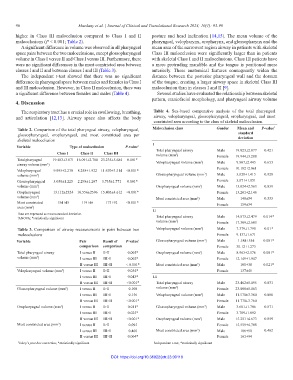
        classes I and II and between classes I and III (Table 3).  anteriorly.  These anatomical  features consequently  widen the
          The independent  t-test  showed  that  there  was  no  significant   distance between the posterior pharyngeal wall and the dorsum
        difference in pharyngeal space between males and females in Class I   of the tongue, creating a larger airway space in skeletal Class III
        and III malocclusion. However, in Class II malocclusion, there was   malocclusion than in classes I and II [9].
        a significant difference between females and males (Table 4).  Several studies have evaluated the relationship between skeletal
                                                                pattern, craniofacial morphology, and pharyngeal airway volume
        4. Discussion
          The respiratory tract has a crucial role in swallowing, breathing,   Table  4. Sex-based comparative  analysis of the total pharyngeal
        and  articulation  [12,13].  Airway  space  also  affects  the  body   airway, velopharyngeal,  glossopharyngeal,  oropharyngeal,  and most
                                                                 constricted area according to the class of skeletal malocclusion.
        Table 2. Comparison of the total pharyngeal airway, velopharyngeal,   Malocclusion class  Gender  Mean and   P‑value ˦
        glossopharyngeal, oropharyngeal, and most constricted  area per                              standard
        skeletal malocclusion                                                                       deviation
        Variable              Type of malocclusion   P‑value ˦   I  Total pharyngeal airway    Male  19.023±2.877  0.421
                         Class I   Class II  Class III            volume (mm )              Female  19.944±3.288
                                                                          3
        Total pharyngeal   19.483±3.071 16.091±2.788 23.235±5.684  0.001*            3
        airway volume (mm )                                       Velopharyngeal volume (mm )  Male  9.807±2.445  0.653
                     3
        Velopharyngeal   9.995±2.230  8.258±1.922  11.670±3.514  <0.001*                    Female  10.182±2.061
                                                                                      3
        volume (mm )                                              Glossopharyngeal volume (mm )  Male  3.029±1.415  0.928
                3
        Glossopharyngeal   3.050±1.225  2.298±1.207  3.735±1.771  0.001*                    Female  3.071±1.051
        volume (mm )                                              Oropharyngeal volume (mm )  Male  13.024±2.563  0.839
                3
                                                                                    3
        Oropharyngeal   13.112±2324  10.556±2596 15.405±4.612  <0.001*                      Female  13.201±2.146
        volume (mm )                                              Most constricted area (mm )  Male  148±54    0.533
                3
                                                                                   2
        Most constricted   154±45  119±46    173±92   <0.001*                               Female   159±34
        area (mm )
              2
                                                                 II
        Data are expressed as mean±standard deviation.
        ˦ ANOVA; *statistically significant                       Total pharyngeal airway    Male  14.873±2.479  0.014*
                                                                  volume (mm )              Female  17.309±2.603
                                                                          3
                                                                                     3
        Table 3. Comparison of airway measurements in pairs between two   Velopharyngeal volume (mm )  Male  7.379±1.790  0.01*
        malocclusions                                                                       Female  9.137±1.671
                                                                                      3
        Variable                  Pair      Result of   P‑value ˦  Glossopharyngeal volume (mm )  Male  1.584±554  0.001*
                                  comparison  comparison                                    Female  30.12±1.273
        Total pharyngeal airway    I versus II  I>II  0.005*      Oropharyngeal volume (mm )  Male  8.963±2.176  0.001*
                                                                                    3
        volume (mm )              I versus III  III>I  0.002*                               Female  12.149±1.947
                3
                                  II versus III  III>II  < 0.001*  Most constricted area (mm )  Male  100±38   0.021*
                                                                                   2
        Velopharyngeal volume (mm )  I versus II  I>II  0.034*                              Female   137±46
                           3
                                  I versus III  III>I  0.043*    III
                                  II versus III  III>II  <0.001*  Total pharyngeal airway    Male  23.462±5.695  0.831
                                                                          3
        Glossopharyngeal volume (mm )  I versus II  I>II  0.108   volume (mm )              Female  23.008±5.863
                            3
                                  I versus III  III>I  0.156      Velopharyngeal volume (mm )  Male  11.570±3.380  0.880
                                                                                     3
                                  II versus III  III>II  <0.001*                            Female  11.770±3.760
        Oropharyngeal volume (mm )  I versus II  I>II  0.011*     Glossopharyngeal volume (mm )  Male  3.681±1.706  0.871
                                                                                      3
                          3
                                  I versus III  III>I  0.025*                               Female  3.789±1.892
                                  II versus III  III>II  <0.001*  Oropharyngeal volume (mm )  Male  15.251±4.673  0.859
                                                                                    3
        Most constricted area (mm )  I versus II  I>II  0.095                               Female  15.559±4.708
                         2
                                  I versus III  III>I  0.460      Most constricted area (mm )  Male  186±90    0.462
                                                                                   2
                                  II versus III  III>II  0.004*                             Female   161±94
        ˦ Tukey’s post-hoc correction; *statistically significant  ˦ Independent t-test; *statistically significant
                                                DOI: https://doi.org/10.36922/jctr.23.00110

