


Page 98 - JCTR-10-1
P. 98
94                        Mardany et al. | Journal of Clinical and Translational Research 2024; 10(1): 93-98
          Some studies supported the association between skeletal pattern   the sella turcica), N (the intersection points of the nasion and the
        and the  airway, while  others did not show such a relationship.   frontal bone in the sagittal view), A (the innermost point on the
        A  study by Jadhav  et  al.  [6] demonstrated  that  there  was no   anterior contour of the maxilla below the maxillary plane), and B
        significant correlation between the total airway volume and three   (the innermost point on the anterior mandibular shape above the
        sagittal  skeletal  groups. Alhammadi  et  al.  [7] reported  that  the   pogonion). The Wits appraisal is the measured distance between A
        volume of the palatopharyngeal  and glossopharyngeal airways   and B along the mid-sagittal reference line. GoGn-SN angle was
        and  the  narrowest  point  of  the  palatopharyngeal  airway  were   measured between the line of the gonion (Go) and gnathion (Gn)
        greater in Class II skeletal than in other skeletal groups. Alves   and the sella-nasion (SN) line. All patients were middle easterners
        et al. [8] found that the type of malocclusion did not influence   and had normal growth patterns.
        the dimensions and volumes  of  the  airway  in  most  cases.  On   All CBCT images were selected from patients with a mandibular
        the other hand, Tseng et al. [9] showed that individuals with   plane angle of 32 ± 5 = GoGn-SN.
        Class  II skeletal malocclusion have smaller airway volumes   ●  Class I: 0° < ANB < 4°; −1 mm < Wits < 0 mm
        than individuals with Class I and III malocclusion. In a study   ●  Class II: ANB > 4°; 0 mm < Wits
        by Shokri et al. [10], it was shown that the volume and area of   ●  Class III: ANB < 0°; Wits < −1 mm
        the airway were significantly greater in Class III patients than   Exclusion criteria of this study are as follows:
        in Class I or II. Zeng et al. [11] demonstrated that the volume   The  patients  who  had  no  history  of orthognathic  surgery,
        of the pharyngeal airway was significantly greater in Class III   nasal surgery, syndromes, trauma, or pathology in the airway and
        and Class  I patients compared to Class  II patients. Due to   pharynx.
        the  significant  discrepancies  in  the  results  among  the  studies   CBCT images that lacked diagnostic value.
        mentioned above and the lack of research regarding different   CBCT images were converted to DICOM format and transferred
        sagittal malocclusion with normal growth patterns in the Middle   to 3D Dolphin software (Management  & Imaging  Solutions,
        Eastern population, the necessity of conducting this research   Chatsworth, CA, USA). The overall volume of the pharyngeal
        became evident.  Therefore, this study aimed to measure the   airway and the most constricted area (mm ) were assessed and
                                                                                                    2
        relationship between the airway volume and skeletal Class I,   determined (Figures 1 and 2). The measurements were performed
        Class  II, and Class  III malocclusions with normal growth   by two researchers, and the intraclass correlation coefficient (ICC)
        patterns in individuals aged 17 – 39 years using CBCT.  was calculated to determine the reliability of the two researchers.

        2. Patients and Methods                                 In this study, the ICC was above 80%, indicating the reliability of
                                                                the two researchers.
          In this study, we conducted a comprehensive  analysis of   The definitions used throughout this study are as follows:
        CBCT obtained from the Department of Oral and Maxillofacial
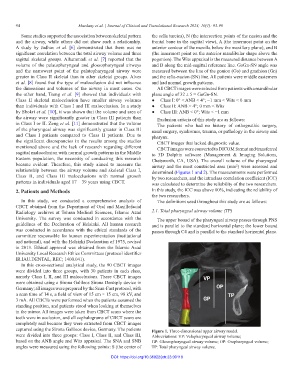
        Radiology archives at  Tehran Medical  Sciences, Islamic  Azad   2.1. Total pharyngeal airway volume (TP)
        University.  The  survey was conducted  in  accordance  with  the   The upper bound of the pharyngeal airway passes through PNS
        guidelines  of the Declaration  of Helsinki. All human research   and is parallel to the standard horizontal plane; the lower bound
        was  conducted in accordance  with the ethical  standards of the   passes through C4 and is parallel to the standard horizontal plane.
        committee responsible for human experimentation (institutional
        and national), and with the Helsinki Declaration of 1975, revised
        in  2013.  Ethical  approval  was  obtained  from  the  Islamic Azad
        University Local Research Ethics Committees (protocol identifier
        IR.IAU.DENTAL, REC; 1400.041).
          In this cross-sectional analytical study, the 90 CBCT images
        were divided  into three  groups, with 30  patients  in each  class,
        namely Class I, II, and III malocclusions. These CBCT images
        were obtained using a Sirona Galileos Sirona Dentsply device in
        Germany; all images were prepared by the Scan-Fast protocol, with
        a scan time of 14 s, a field of view of 15 cm × 15 cm, 98 kV, and
        3 mA. All CBCTs were performed when the patients assumed the
        standing position, and patients stood when looking at themselves
        in the mirror. All images were taken from CBCT scans where the
        teeth were in occlusion, and all cephalograms of CBCT scans are
        completely real because they were extracted from CBCT images
        captured using the Sirona Galileos device, Germany. The patients   Figure 1. Three-dimensional upper airway model.
        were divided into three groups: Class I, Class II, and Class III,   Abbreviations: VP: Velopharyngeal airway volume;
        based on the ANB angle and Wits appraisal. The SNA and SNB   GP: Glossopharyngeal airway volume; OP: Oropharyngeal volume;
        angles were measured using the following points: S (the center of   TP: Total pharyngeal airway volume.
                                                DOI: https://doi.org/10.36922/jctr.23.00110

