


Page 99 - JCTR-10-1
P. 99
Mardany et al. | Journal of Clinical and Translational Research 2024; 10(1): 93-98   95
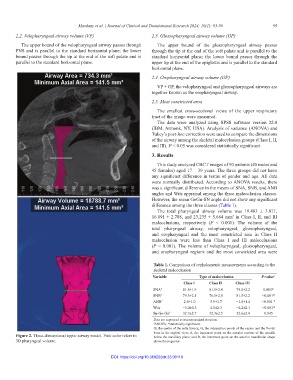
        2.2. Velopharyngeal airway volume (VP)                  2.3. Glossopharyngeal airway volume (GP)

          The upper bound of the velopharyngeal airway passes through   The upper bound of the glossopharyngeal airway passes
        PNS and is parallel to the standard horizontal plane; the lower   through the tip at the end of the soft palate and is parallel to the
        bound passes through the tip at the end of the soft palate and is   standard  horizontal  plane;  the  lower  bound passes through  the
        parallel to the standard horizontal plane.              upper tip at the end of the epiglottis and is parallel to the standard
                                                                horizontal plane.
                                                                2.4. Oropharyngeal airway volume (OP)

                                                                   VP + GP, the velopharyngeal and glossopharyngeal airways are
                                                                together known as the oropharyngeal airway.

                                                                2.5. Most constricted area
                                                                   The  smallest  cross-sectional  views of the  upper respiratory
                                                                tract of the image were measured.
                                                                   The  data  were analyzed  using SPSS software  version  22.0
                                                                (IBM, Armonk, NY, USA). Analysis of variance (ANOVA) and
                                                                Tukey’s post-hoc correction were used to compare the dimensions
                                                                of the airway among the skeletal malocclusion groups (Class I, II,
                                                                and III). P < 0.05 was considered statistically significant.
                                                                3. Results

                                                                   This study analyzed CBCT images of 90 patients (45 males and
                                                                45 females) aged 17 – 39 years. The three groups did not have
                                                                any  significant  difference  in  terms  of  gender  and  age. All  data
                                                                were normally  distributed. According  to ANOVA results,  there
                                                                was a significant difference in the means of SNA, SNB, and ANB
                                                                angles and Wits appraisal among the three malocclusion classes.
                                                                However, the mean GoGn-SN angle did not show any significant
                                                                difference among the three classes (Table 1).
                                                                   The  total  pharyngeal  airway  volume  was  19.483  ±  3.071,
                                                                16.091 ± 2.788, and 23.235 ± 5.684 mm  in Class I, II, and III
                                                                                                  3
                                                                malocclusions,  respectively  (P  <  0.001).  The  volume  of  the
                                                                total  pharyngeal  airway, velopharyngeal,  glossopharyngeal,
                                                                and oropharyngeal  and the most constricted  area in Class  II
                                                                malocclusion  were less than  Class  I and III malocclusions
                                                                (P  <  0.001). The  volume  of  velopharyngeal,  glossopharyngeal,
                                                                and oropharyngeal  regions and the most constricted  area  were

                                                                 Table 1. Comparison of cephalometric measurements according to the
                                                                 skeletal malocclusion
                                                                 Variable           Type of malocclusion      P‑value ˦
                                                                              Class I   Class II   Class III
                                                                 SNA 2       81.8±1.9   81.5±2.0    79.8±2.2   0.005*
                                                                 SNB 2       79.3±2.1   76.1±2.8    81.5±2.2   <0.001*
                                                                 ANB 2        2.6±1.0    5.9±1.7    −1.8±1.4  <0.001 *
                                                                 Wits        −3.0±0.3    4.0±2.3    −4.2±2.1   <0.001*
                                                                 Sn-Go-Gn 2  32.7±2.7   32.3±2.5    32.6±2.4   0.845
                                                                 Data are expressed as mean±standard deviation.
                                                                 ˦ ANOVA; *statistically significant.
                                                                 2 S, the center of the sella turcica; N, the intersection points of the nasion and the frontal
                                                                 bone in the sagittal view; A, the innermost point on the anterior contour of the maxilla
        Figure 2. Three-dimensional upper airway model. Pink color refers to   below the maxillary plane; and B, the innermost point on the anterior mandibular shape
        3D pharyngeal volume.                                    above the pogonion


                                                DOI: https://doi.org/10.36922/jctr.23.00110

