


Page 15 - JCTR-10-1
P. 15
Lunevicius et al. | Journal of Clinical and Translational Research 2024; 10(1): 9-17   11
        of the liver were other features of the case’s surgical anatomy. Also,   hospital. Histopathological  investigation  of the excised part of
        it was the first time an experienced consultant surgeon operated on   the gallbladder of 60 × 33 × 24 mm dimensions revealed a 6-mm
        a patient with a true left-sided gallbladder. An additional 5-mm   wall thickness, necrotic mucosa, and signs  of diffuse chronic
        diameter  port was inserted into the peritoneal  cavity  through   inflammation.
        the left upper quadrant of the abdominal wall. An attempt was   No other side effects and readmissions to the hospital occurred
        made to detach the gallbladder’s fundus from the visceral surface   within  90 post-operative  days.  The  patient  underwent  three-
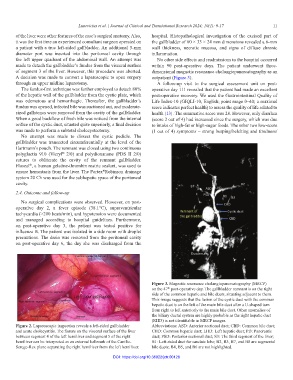
        of segment 3 of the liver. However, this procedure was aborted.   dimensional magnetic resonance cholangiopancreatography as an
        A decision was made to convert a laparoscopic to open surgery   outpatient (Figure 3).
        through an upper midline laparotomy.                       A follow-up visit  to  the  surgical  assessment  unit  on post-
          The fundus-first technique was further employed to detach 80%   operative day 111 revealed that the patient had made an excellent
        of the hepatic wall of the gallbladder from the cystic plate, which   post-operative recovery. We used the Gastrointestinal Quality of
        was edematous  and hemorrhagic.  Thereafter, the  gallbladder’s   Life Index-10 (GIQLI-10, English; point range 0–40; a maximal
        fundus was opened, infected bile was suctioned out, and moderate-  score indicates perfect health) to assess the quality of life related to
        sized gallstones were removed from the cavity of the gallbladder.   health [13]. The summative score was 28. However, only diarrhea
        When a good backflow of fresh bile was noticed from the internal   (score 2 out of 4) had increased since the surgery, which was due
        orifice of the cystic duct, situated quite superiorly, a final decision   to intake of high-fat or high-sugar foods. The other two low-score
        was made to perform a subtotal cholecystectomy.         (1 out of 4) symptoms – strong burping/belching and tiredness/
          No attempt  was made  to  dissect  the  cystic  pedicle.  The
        gallbladder  was transected circumferentially  at the level of the
        Hartmann’s pouch. The remnant was closed using two continuous
        polyglactin  910 (Vicryl  2/0) and polydioxanone  (PDS II 2/0)
                           ®
        sutures  to  obliterate  the  cavity  of the  remnant  gallbladder.
        Floseal , a human gelatine-thrombin matric sealant, was used to
             ®
        ensure hemostasis from the liver. The Portex Robinson drainage
                                            ®
        system 20 Ch was used for the subhepatic space of the peritoneal
        cavity.
        2.4. Outcome and follow-up

          No surgical complications were observed. However, on post-
        operative day 2, a fever episode (38.1°C), supraventricular
        tachycardia (>200 beats/min), and hypotension were documented
        and  managed  according  to  hospital  guidelines.  Furthermore,
        on post-operative day 3, the patient  was tested positive for
        influenza B. The patient was isolated in a side room with droplet
        precautions. The drain was removed from the peritoneal cavity
        on post-operative day 6, the day she was discharged from the


                                                                Figure 3. Magnetic resonance cholangiopancreatography (MRCP)
                                                                on the 47  post-operative day. The gallbladder remnant is on the right
                                                                       th
                                                                side of the common hepatic and bile ducts, situating adjacent to them.
                                                                This image suggests that the fusion of the cystic duct with the common
                                                                hepatic duct is on the left of the main bile duct after a U-shaped turn
                                                                from right to left anteriorly to the main bile duct. Other anomalies of
                                                                the biliary ductal system are highly probable as the right hepatic duct
                                                                (RHD) is not identifiable in MRCP images.
        Figure 2. Laparoscopic inspection reveals a left-sided gallbladder   Abbreviations: ASD: Anterior sectional duct; CBD: Common bile duct;
        and acute cholecystitis. The fissure on the visceral surface of the liver   CHD: Common hepatic duct; LHD: Left hepatic duct; PD: Pancreatic
        between segment 4 of the left hemiliver and segment 5 of the right   duct; PSD: Posterior sectional duct; S3: The third segment of the liver;
        hemiliver can be interpreted as an external hallmark of the Cantlie-  B1: Left-sided duct for caudate lobe; B2, B3, B7, and B8 are segmental
        Serege-Rex plane separating the right hemiliver from the left hemiliver.  bile ducts; B4, B5, and B6 are not highlighted.
                                                DOI: https://doi.org/10.36922/jctr.00128

