


Page 14 - JCTR-10-1
P. 14
10                        Lunevicius et al. | Journal of Clinical and Translational Research 2024;10(1) 9-17
        2. Materials and Methods                                2.2. Differential diagnosis

        2.1. Case presentation                                     A working diagnosis  of acute  calculous  cholecystitis  was
                                                                apparent; however, four diagnostic detail points should be briefly
          A right-handed female patient in her 40s with severe   overviewed. First, according to Tokyo Guidelines 2007 (TG07),
        central epigastric and right-sided hypochondrium pain was   2013 (TG13), and 2018 (TG18), grading the acute cholecystitis
        admitted to  the  emergency  general  surgery  ward  of  the   severity should be emphasized during admission and pre-operative
        acute  care  hospital. The  pain  was  associated  with  vomiting   diagnosis. Our case should have been classified as acute moderate
        and diarrhea. Her only concomitant diseases were essential   cholecystitis – grade 2 – as it was associated with a duration of
        hypertension, which was controlled using 5 mg ramipril daily,   acute symptoms of >72 h [10].
        and constipation. Her body mass index was 35.8  kg/m  on   Second, precise radiological characterization of the gallbladder
                                                        2
        admission.                                              and its site is crucial in managing acute cholecystitis. However,
          The patient was afebrile (37.1°C), with a satisfactory oxygen   detecting an atypical gallbladder anatomical location is difficult
        saturation level at 98%, sinus heart rhythm at 81 beats/min, and   (although  possible) when performing  an urgent  transabdominal
        high arterial blood pressure at 179/98 mmHg. Further objective   ultrasound scan (further details are provided in the discussion).
        examination  revealed  severely  tender  right hypochondrium,   Therefore, the left-sided gallbladder is identified during surgery
        central epigastrium, and positive Murphy’s sign.        in over 80% of cases [5].
          Her white blood cell count was 16.1 × 10 /L. Her neutrophils   Third,  intraoperative  characterization  of  the  anatomy  of the
                                            9
        comprised  89.4% leukocytes  (14.4 × 10 /L).  The total  serum   gallbladder, liver, and its ligaments  facilitates  decision-making
                                          9
        bilirubin concentration was within the standard range (9 µmol/L;   during laparoscopic  or open surgery.  Also, it  is essential  in
        0.53  mg/dL). However, her serum  γ-glutamyl  transferase   education and academic surgery. In the absence of situs viscerum
        concentration  was 3.8  times  above  the  standard  level  of   inversus, the sinistroposition, a true left-sided  gallbladder  (our
        <40 U/L. Her serum C-reactive protein concentration was within   patient), usually with hypoplastic segment 4 of the liver, should
        the standard range (4  mg/L).  Hyperlactatemia  of 3.8 mmol/L   be differentiated from the medioposition of the gallbladder [11],
        was also detected in the patient. The radiographs did not reveal   when it is medially displaced to lie on the undersurface of the
        pneumoperitoneum or chest infection.                    quadrate lobe (i.e., inferior subsegment of segment 4) of the left
          The  radiologist performed  a transabdominal  ultrasound   hemiliver.
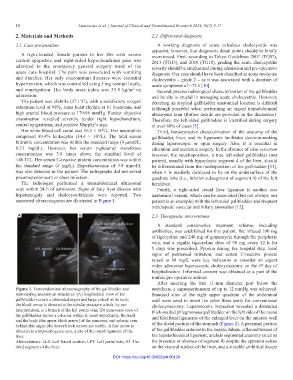
        scan within 24 h of admission. Signs of fatty liver disease with   Fourth, a right-sided round liver ligament  is another rare
        hepatomegaly  and cholecystolithiasis  were reported.  Two   anatomical variant, which can be associated (but not always; our
        annotated ultrasonograms are illustrated in Figure 1.   patient is an example) with the left-sided gallbladder and frequent
                                                                intrahepatic vascular and biliary anomalies [12].
         A                        B                             2.3. Therapeutic interventions

                                                                   A standard conservative treatment  scheme, including
                                                                antibiotics, was established for this patient. We infused 100 mg
                                                                of tigecycline and 240 mg of gentamycin through the peripheric
                                                                vein, and a regular tigecycline dose of 50  mg every 12  h for
                                                                5  days was prescribed. Pyrexia during the hospital stay, local
                                                                signs of peritoneal  irritation,  and  serum  C-reactive  protein
                                                                raised to 88  mg/L were key indicators  to consider an urgent
                                                                index admission laparoscopic cholecystectomy on the 4  day of
                                                                                                              th
                                                                hospitalization. Informed consent was obtained as a part of the
                                                                routine pre-operative actions.
                                                                   After  inserting  the  first  11-mm  diameter  port  below  the
        Figure 1. Transabdominal ultrasonography of the gallbladder and   umbilicus, a capnoperitoneum of up to 12 mmHg was achieved.
        surrounding anatomical structures: (A) longitudinal view of the   Standard sites of the right upper quadrant of the abdominal
        gallbladder reveals a distended organ and large calculi in its neck;   wall  were  used to insert  the  other  three  ports for conventional
        the block arrow is directed at the tubular structure which, by our   cholecystectomy. Laparoscopic  inspection revealed  a distended
        interpretation, is a branch of the left portal vein; (B) transverse view of   thick-walled phlegmonous gallbladder on the left side of the round
        the gallbladder shows a calculus within it; most importantly, the head
        and the body (the upper block arrow) of the pancreas, and splenic vein   and falciform ligaments of the enlarged liver on the anterior wall
        behind this organ (the lower block arrow) are visible. A line arrow is   of the distal portion of the stomach (Figure 2). A proximal portion
        directed at a hypoechogenic area, a site of the round ligament of the   of the gallbladder anterior to the hepatic hilum, inflamed tissues of
        liver.                                                  the hepatoduodenal ligament, unclear segmental anatomy (such as
        Abbreviations: LLS: Left lateral section; LPT: Left portal vein; S3: The   the presence or absence of segment 4) despite the apparent sulcus
        third segment of the liver.                             on the visceral surface of the liver, and a sizeable umbilical fissure
                                                DOI: https://doi.org/10.36922/jctr.00128

