


Page 9 - JCTR-10-1
P. 9
Lv et al. | Journal of Clinical and Translational Research 2024; 10(1): 1-8       5
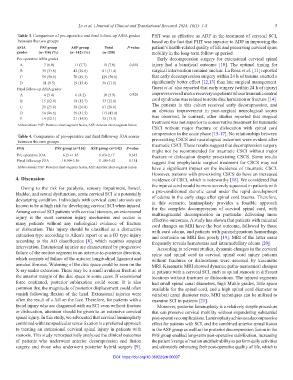
        Table 3. Comparison of pre-operative and final follow-up ASIA grades   PHT was as effective as ADF in the treatment of cervical SCI,
        between the two groups                                  based on the fact that PHT was superior to ADF in improving the
        ASIA      PSF group    ASF group     Total    P‑value   patient’s health-related quality of life and preserving cervical spine
        grades   (n=116) (%)  (n=142) (%)   (n=258)             mobility in the long-term follow-up period.
        Pre-operative ASIA grades                                  Early decompression surgery for extensional cervical  spinal
         A         7 (6.0)      11 (7.7)    18 (7.0)   0.690    injury  had  a  beneficial  outcome  [10].  The  optimal  timing  for
         B         39 (33.6)    42 (29.6)   81 (31.4)           surgical intervention remains unclear. La Rosa et al. [11] reported
         C         59 (50.9)    70 (49.3)  129 (50.0)           that early decompression surgery within 24 h of trauma exerted a
         D         11 (9.5)     19 (13.4)   30 (11.6)           significantly better effect [12,13] than late surgical management.
        Final follow-up ASIA grades                             Guest et al. also reported that early surgery (within 24 h of injury)
         A         4 (3.4)       6 (4.2)    10 (3.9)   0.926    improves overall motor recovery in patients whose traumatic central
         B         15 (12.9)    18 (12.7)   33 (12.8)           cord syndrome was related to acute disc herniation or fracture  [14].
         C         29 (25.0)    38 (26.8)   67 (26.0)           The patients  in this cohort received  early decompression, and
         D         54 (46.6)    59 (41.5)  113 (43.8)           an obvious improvement  in post-surgical  neurological  scores
         E         14 (12.1)    21 (14.8)   35 (13.5)           was observed. In contrast,  other  studies  reported  that  surgical
        Abbreviations: PSF: Posterior short-segment fusion, ASF: Anterior short-segment fusion  treatment was not superior to conservative treatment for traumatic
                                                                CSCI without  major  fracture  or  dislocation  with  spinal  cord
                                                                compression in the acute phase [15-17]. No relationships between
        Table 4. Comparison of pre-operative and final follow-up JOA scores
        between the two groups                                  pre-existing CSCS and neurological outcomes were evident after
        JOA             PSF group (n=116)  ASF group (n=142)  P‑value  traumatic CSCI. These results suggest that decompression surgery
                                                                might not be recommended  for traumatic  CSCI  without major
        Pre-operative JOA  6.21±1.85      6.45±2.17    0.345    fracture or dislocation despite pre-existing CSCS. Some results
        Final follow-up JOA  10.90±3.56   11.48±3.62   0.134    suggest that prophylactic surgical treatment for CSCS may not
        Abbreviations: PSF: Posterior short-segment fusion, ASF: Anterior short-segment fusion  have  a  significant  impact  on  the  incidence  of  traumatic  CSCI.
                                                                However, patients with pre-existing CSCS do have an increased
        4. Discussion                                           incidence of CSCI, which is noteworthy [18]. We considered that
          Owing  to  the  risk  for  paralysis,  sensory  impairment,  bowel,   the injured cord would be more severely squeezed in patients with
        bladder, and sexual dysfunction, acute cervical SCI is a potentially   a pre-conditioned stenotic  canal under the rapid development
        devastating condition. Individuals with cervical canal stenosis are   of edema in the early stage after spinal cord trauma. Therefore,
                                                                in  this  scenario, laminoplasty provides  a  feasible  approach
        known to be at high risk for developing cervical SCI when injured.   for the  complete  decompression  of cervical  spinal  cord, with
        Among cervical SCI patients with cervical stenosis, an extensional   multisegmental  decompression in  particular  delivering  more
        injury is the most common injury mechanism and occurs in   effective outcomes. A study has shown that patients with minimal
        many patients without any radiological evidence of fracture   cord changes on MRI have the best outcome, followed by those
        or  dislocation.  This  injury  should  be  classified  as  a  distractive   with cord edema, and patients with parenchymatous hemorrhage
        extension type according to Allen’s report or as a B3 type injury   and contusion on MRI fare poorly [19]. MRI of the latter cases
        according  to  the  AO  classification  [8], which requires surgical   frequently reveals hematomas and intramedullary edema [20].
        intervention. Extensional injuries are characterized by progressive   According to relevant studies, dynamic changes in the cervical
        failure of the motion segment in an anterior-to-posterior direction,   spine  and  spinal  cord  in  cervical  spinal  cord  injury  patients
        which consists of failure of the anterior longitudinal ligament and   without  fractures  or  dislocations  were  assessed by  kinematic
        annulus fibrosus. Widening of the disc space could be seen on the   MRI. Kinematic MRI showed dynamic patho-anatomical changes
        X-ray under extension. There may be a small avulsion fracture at   in patients with a cervical SCI, such as spinal stenosis in different
        the anterior margin of the disc space in some cases. If extensional   locations without fractures or dislocations. The injured segments
        force continued, posterior subluxation could occur. It is also   had small spinal canal diameters, high Muhle grades, little space
        common that the magnitude of posterior displacement could often   available for the spinal cord, and a high spinal cord diameter to
        vanish  following  flexion  of  the  head.  Extensional  injuries  were   vertebral canal diameter ratio. MRI techniques can be utilized to
        often the result of a fall on the face. Therefore, for patients with a   examine SCI in patients [21].
        facial injury who are diagnosed with an SCI even without fracture   Moreover, posterior laminoplasty is a relatively simple procedure
        or dislocation, attention should be given to an extensive cervical   that can preserve cervical mobility without engendering substantial
        spinal injury. In this study, we advocated that cervical laminoplasty   post-operative complications. Laminoplasty achieves a decompressive
        combined with transpedicular screw fixation is a preferred approach   effect for patients with SCI, and the combined anterior spinal fusion
        to treating an extensional cervical spinal injury in patients with   in the ASF group as well as the posterior decompression fusion in the
        stenosis. This study retrospectively analyzed the clinical outcomes   PFS group enabled long-term post-operative stabilization, increasing
        of patients who underwent anterior decompression and fusion   the patient’s range of motion and their ability to perform daily activities
        surgery and those who underwent posterior hybrid surgery [9].   and ultimately enhancing their post-operative quality of life, which is
                                                DOI: https://doi.org/10.36922/jctr.00037

