


Page 16 - JCTR-10-1
P. 16
12                        Lunevicius et al. | Journal of Clinical and Translational Research 2024;10(1) 9-17
        fatigue – were regarded as regular occurrences suffered similarly   radiological investigations are restricted to a real-time ultrasound
        before subtotal cholecystectomy.                        scan of the gallbladder [17]. Table 1 describes why it is difficult
                                                                to reveal a left-sided gallbladder through standard  examination
        3. Discussion                                           and imaging techniques before surgery  [3,18-22]. On  the
          The primarily aims of surgical care are to save the patient’s   contrary, a left-sided gallbladder and the variations of the biliary
        life, prevent the patient from further disease complications or   tract  – a frequent  combination  of biliary  anomalies  – can be
        reduce the risk of sustaining them, improve the patient’s quality   diagnosed preoperatively  using intravenous  contrast-enhanced
        of life, and eliminate the possibility of iatrogenic injury associated   reconstructive  three-dimensional  computed  tomography
        with surgery. Gallbladder surgery for benign biliary disease is an   (CT)-cholangiography  [23-25]. However, a three-dimensional
                                                                CT-cholangiography is not a routine  investigation  in an acute
        excellent example of this concept because injury to any classified   care surgery environment. It can be considered when a congenital
        bile duct is considered avoidable  [14-16].  This paper highlights   anomaly of the gallbladder is suspected during an ultrasound scan
        the decision-making during and the technical details of gallbladder   examination. The same logic is relevant for applying an urgent
        surgery related to double conversion in an acute surgery setting   magnetic resonance cholangiopancreatography.
        with atypical gallbladder anatomy. Conversions from laparoscopic   Second,  a  targeted  laparoscopic  inspection  of  the  liver  and
        to open surgery and pre-planned total to subtotal cholecystectomy   gallbladder  through  a  first  port  and  the  rationale  for  correctly
        with the closure of the gallbladder remnant guaranteed no   using other laparoscopic ports and instruments are fundamental
        intraoperative risks, satisfactory surgical outcomes, and effective   principles of safe laparoscopic surgery for all, as an element
        physical rehabilitation following the arduous gallbladder surgery.   of uncertainty is a satellite of every surgery. Unfortunately, the
        Seven other themes related to the left-sided gallbladder –precision in   gallbladder  anatomy-related  intraoperative  problem was not
        radiological diagnostics, the importance of laparoscopic inspection,   identified and acknowledged during the primary inspection of the
        detailed informed consenting, extraordinarily high bile duct injury   hepatobiliary area. This determined the standard insertion of the
        rates,  variations  of  ductal  anatomy,  intraoperative  fluorescent   other three laparoscopic ports through the right upper quadrant of
        cholangiography, and decision-making to perform a less-than-total   the abdominal wall. If the problem had been identified during the
        gallbladder removal – emerged from the details of this case report.  primary inspection, the second port would have been inserted into
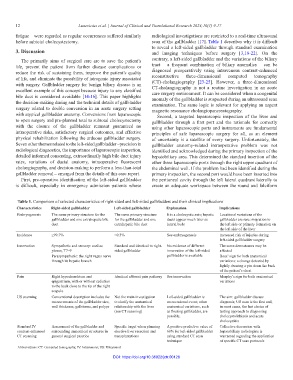
          First, pre-operative identification of the left-sided gallbladder   the peritoneal cavity through the left lateral quadrant laterally to
        is  difficult,  especially  in  emergency  admission  patients  whose   create an adequate workspace between the round and falciform


        Table 1. Comparison of selected characteristics of right-sided and left-sided gallbladders and their clinical implications
        Characteristics  Right-sided gallbladder  Left-sided gallbladder  Explanation        Implications
        Embryogenesis  The same primary structure for the   The same primary structure   It is a cholecystic axis; hepatic   Locational variations of the
                       gallbladder and one extrahepatic bile   for the gallbladder and one   ducts appear much later as   gallbladder are rare: migration to
                       duct                      extrahepatic bile duct  lateral buds        the left side or primary formation on
                                                                                             the left side of the liver
        Incidence      ≥99.7%                    <0.3%                 See embryogenesis     Increased risk of injuries during
                                                                                             left-sided gallbladder surgery
        Innervation    Sympathetic and sensory: coeliac   Standard and identical to right-  No evidence of different   The same dermatomes may be
                       plexus, T7–9              sided gallbladder     innervation of the left-sided   affected
                       Parasympathetic: the right vagus nerve          gallbladder is available  Boas’ sign for both anatomical
                       through its hepatic branch                                            variations: a change detected by
                                                                                             lightly drawing a pin down the back
                                                                                             of the patient’s chest
        Pain           Right hypochondrium and   Identical afferent pain pathway  See innervation  Murphy’s sign for both anatomical
                       epigastrium, with or without radiation                                variations
                       to the back close to the tip of the right
                       scapula
        US scanning    Conventional description includes the   Not the main investigation   Left-sided gallbladder is   The aim: gallbladder disease
                       measurements of the gallbladder size,   to clarify the anatomical   an occasional event; other   diagnosis; US scan is the first and,
                       wall thickness, gallstones, and polyps  relationship with the liver    anatomical variations, such   in most cases, the last choice of
                                                 (see CT scanning)     as floating gallbladder, are   testing approach to diagnosing
                                                                       possible.             cholecystolithiasis and acute
                                                                                             cholecystitis
        Standard IV    Assessment of the gallbladder and   Specific target when planning   A positive predictive value of   Collective discussion with
        contrast-enhanced   surrounding anatomical structures in   elective liver resection and   60% for left-sided gallbladder   hepatobiliary radiologists is
        CT scanning    general surgical practice  transplantations     using standard CT scan   warranted regarding the application
                                                                       technique             of specific CT scan protocols
        Abbreviations: CT: Computed tomography; IV: Intravenous; US: Ultrasound
                                                DOI: https://doi.org/10.36922/jctr.00128

