


Page 32 - JCTR-10-1
P. 32
28                        Shah et al. | Journal of Clinical and Translational Research 2024; 10(1): 25-32
                                                                7.3 mg/dL (direct – 5.8 mL/dL), ALT – 88 IU/L, AST – 65 IU/L,
                                                                ALP – 104 IU/L, and GGTP – 92 IU/L. Prednisolone was tapered
                                                                over the next 10 weeks and stopped after complete normalization
                                                                of  liver  function.  He  was  further  followed  for  10  weeks  after
                                                                steroid discontinuation, during which recurrence did not occur.

                                                                3.2.3. Case 3 - Dapsone-induced liver injury
                                                                   A 52-year-old male patient presented with worsening jaundice
                                                                and pruritus for the 1.5 months before seeking medical consultation
                                                                at our hospital. He had been taking dapsone 100 mg daily as anti-
                                                                leprosy treatment in the past 3 months. He was not taking any other
                                                                medications, was a non-addict, and had no comorbidities, except
                                                                leprosy. On physical examination, madarosis, contracture of upper
                                                                limb fingers, and large hypopigmented hypoesthetic patches at the
                                                                trunk and back were present. Features of hypersensitivity were
                                                                absent. He had deep icterus but there were no clinical signs of liver
                                                                failure. TB and DB were 49 and 40 mg/dL, respectively. KF rings
                                                                were present in both eyes, and 24-h urinary copper was slightly
                                                                elevated (Table 3). Serum ceruloplasmin was normal. His RUCAM
                                                                score was 6 points, and his R-value was 2.4, suggesting a mixed
                                                                pattern of DILI. Based on these results, dapsone was discontinued,
                                                                and a liver biopsy was performed, demonstrating prominent acinar
                                                                disarray,  mild-to-moderate  inflammatory  infiltrates  in  the  portal
                                                                tract,  and  ductular  reactions  with  focal  neutrophilic  cholangitis.
                                                                Giant hepatocytes, zone 3 canalicular and intrahepatic cholestasis,
                                                                and prominent zone 3 perivenulitis were also noted. Copper staining
                                                                was negative. The overall picture suggested mixed hepatitis and
                                                                cholestatic pattern, which was possibly drug-induced (Figure  3,
                                                                Case  3).  Emollients,  anti-histaminic,  and  UDCA  were  given
                                                                but liver functions continued to worsen, and oral prednisolone
                                                                (40 mg/day) was started as rescue therapy. At 2 weeks of follow-
                                                                up, his TB was 8.3 mg/dL (direct – 6.6 mL/dL). Other liver function
                                                                parameters were ALT – 65 IU/L, AST – 98 IU/L, ALP – 154 IU/L,
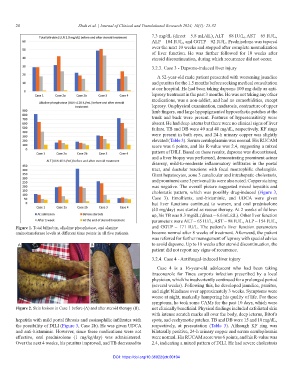
        Figure 1. Total bilirubin, alkaline phosphatase, and alanine   and  GGTP  –  171  IU/L. The  patient’s  liver  function  parameters
        aminotransferase levels at different time points in all five patients.  became normal after 8 weeks of treatment. Afterward, the patient
                                                                was referred for further management of leprosy with special advice
         A                             B                        to avoid dapsone. Up to 18 weeks after steroid discontinuation, the
                                                                patient did not report any signs of recurrence.

                                                                3.2.4. Case 4 - Antifungal-induced liver injury
                                                                   Case  4  is  a  16-year-old  adolescent  who  had  been  taking
                                                                itraconazole  for  Tinea  corporis  infection  prescribed  by  a  local
                                                                physician, which he inadvertently continued for a prolonged period
                                                                (several weeks). Following this, he developed jaundice, pruritus,
                                                                and night blindness over approximately 3 weeks. Symptoms were
                                                                worse at night, markedly hampering his quality of life. For these
                                                                symptoms, he took some CAMs for the past 10 days, which were
        Figure 2. Skin lesions in Case 1 before (A) and after steroid therapy (B).  not clinically beneficial. Physical findings included exfoliated skin
                                                                with intense scratch marks all over the body, deep icterus, Bitot’s
        hepatitis with mild portal fibrosis and eosinophilic infiltrates with   spots, and ecchymotic patches. TB and DB were 15 and 10 mg/dL,
        the possibility of DILI (Figure 3, Case 2b). He was given UDCA   respectively, at presentation  (Table  3).  Although KF ring was
        and anti-histaminic. However, since these medications were not   bilaterally positive, 24-h urinary copper and serum ceruloplasmin
        effective,  oral  prednisolone  (1  mg/kg/day)  was  administered.   were normal. His RUCAM score was 6 points, and his R-value was
        Over the next 4 weeks, his pruritus improved, and TB decreased to   2.4, indicating a mixed pattern of DILI. He had severe cholestasis


                                                DOI: https://doi.org/10.36922/jctr.00104

