


Page 34 - JCTR-10-1
P. 34
30                        Shah et al. | Journal of Clinical and Translational Research 2024; 10(1): 25-32
                                                                patients  without autoimmune  features  [21]. Contrary  to  these
                                                                findings, two studies reported that corticosteroid administration
                                                                was not found to be beneficial, but instead, was harmful to patients
                                                                with severe DILI [22] and DILI-related acute liver failure [23].
                                                                A recent report from prospective DILI registries concluded that
                                                                corticosteroid therapy did not worsen outcomes in DILI patients,
                                                                and its administration led to a greater rate of normalization of liver
                                                                enzymes in patients with severe DILI [24]. Amidst these mixed
                                                                results on the role of corticosteroids in DILI/HILI, a recent open-
                                                                label  randomized  controlled  study  concluded  that  steroids  may
                                                                accelerate the recovery of patients with severe DILI [25].
                                                                   Despite a very limited number of patients, the present study
                                                                demonstrates the beneficial role of corticosteroids in the treatment
                                                                of DILI. In the present study, four patients had mixed patterns
                                                                of liver injury with predominant  cholestasis, leading  to severe
                                                                pruritus  that  significantly  hampered  quality  of  life  in  three
                                                                patients (cases 1, 2a, and 4). The severity of pruritus in Case 1 was
                                                                characterized by intense itching, which led to skin excoriations
                                                                and bleeding. Case 2b had a hepatocellular pattern of liver injury
                                                                (R-value = 7) with cholestatic symptoms, which can be explained
                                                                by cholestatic pattern of liver injury by histopathologic means.
                                                                Most patients with DILI recovered following the cessation of
                                                                culprit agents, without showing signs of progression. Typically,
                                                                patients with progressive liver injury may have severe DILI or end
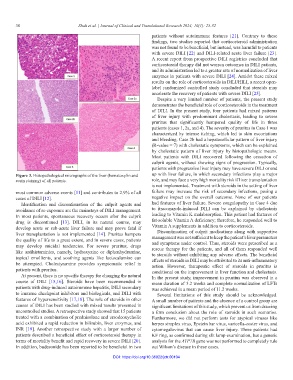
        Figure 3. Histopathological micrographs of the liver (hematoxylin and   up with liver failure, in which secondary infections play a major
        eosin staining) of all patients.                        role, and may face a very high mortality risk if liver transplantation
                                                                is not implemented. Treatment with steroids in the setting of liver
        most common adverse events [11] and contributes to 2.9% of all   failure  may increase the risk of secondary infections,  posing a
        cases of DILI [12].                                     negative  impact  on the  overall outcome.  None of our patients
          Identification  and  discontinuation  of  the  culprit  agents  and   had features of liver failure. Severe coagulopathy in Case 4 due
        avoidance of re-exposure are the mainstays of DILI management.   to  itraconazole-induced  DILI  can  be  explained  by  cholestasis
        In most patients, spontaneous recovery occurs after the culprit   leading to Vitamin K malabsorption. This patient had features of
        drug is discontinued  [13]. DILI, in its natural  course, may   fat-soluble Vitamin A deficiency; therefore, he responded well to
        develop acute or sub-acute liver failure and may prove fatal if   Vitamin A supplements in addition to corticosteroids.
        liver transplantation is not implemented [14]. Pruritus hampers   Discontinuation of culprit medications along with supportive
        the quality of life to a great extent, and in severe cases, patients   management was not sufficient to keep the patient’s liver parameters
        may develop  suicidal  tendencies.  For severe pruritus, drugs   and symptoms under control. Thus, steroids were prescribed as a
                                                                rescue therapy for the patients, and all of them responded well
        like  antihistaminics,  namely,  hydroxyzine  or  diphenhydramine,   to steroids without exhibiting any adverse effects. The beneficial
        topical  emollients, and soothing agents like lactocalamine  can   effects of steroids in DILI may be attributed to its anti-inflammatory
        be attempted. Cholestyramine  provides symptomatic  relief  in   action.  However,  therapeutic  effect  of  steroids  in  pruritus  is
        patients with pruritus.                                 conditional on the improvement in liver function and cholestasis.
          At present, there is no specific therapy for changing the natural   In the present study, improvement in pruritus was observed in a
        course of DILI  [15,16]. Steroids have been recommended  in   mean duration of 3.2 weeks and complete normalization of LFTs
        patients with drug-induced autoimmune hepatitis, DILI secondary   was achieved in a mean period of 11.2 weeks.
        to immune checkpoint inhibitors and biologicals, and DILI with   Several  limitations  of this study should be acknowledged.
        features of hypersensitivity [17,18]. The role of steroids in other   A small number of patients and the absence of a control group are
        causes of DILI has been studied with mixed results presented in   significant limitations of this study, which prevent us from drawing
        uncontrolled studies. A retrospective study showed that 15 patients   a  firm  conclusion  about  the  role  of  steroids  in  such  scenarios.
        treated with a combination of prednisolone and ursodeoxycholic   Furthermore, we did not perform tests for atypical viruses like
        acid exhibited a rapid reduction in bilirubin, liver enzymes, and   herpes simplex virus, Epstein bar virus, varicella-zoster virus, and
        INR [19]. Another retrospective study with a larger number of   cytomegalovirus that can cause liver injury. Three patients had
        patients described a beneficial effect of corticosteroid therapy in   KF ring, as confirmed during slit lamp examination, but a genetic
        terms of mortality benefit and rapid recovery in severe DILI [20].   analysis for the ATP7B gene was not performed to completely rule
        In addition, budesonide has been reported to be beneficial in two   out Wilson’s disease in these cases.
                                                DOI: https://doi.org/10.36922/jctr.00104

