


Page 33 - JCTR-10-1
P. 33
Shah et al. | Journal of Clinical and Translational Research 2024; 10(1): 25-32   29
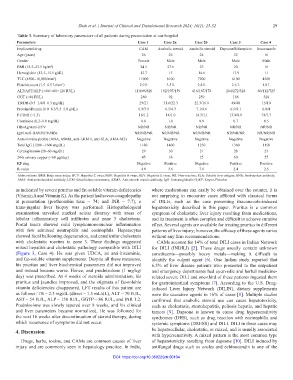
        Table 3. Summary of laboratory parameters of all patients during presentation at our hospital
        Parameters                                         Case 1    Case 2a      Case 2b        Case 3       Case 4
        Implicated drug                                    CAM     Anabolic steroid   Anabolic steroid  Dapsone/Rifampicin  Itraconazole
        Age (years)                                         26         26           24             52          16
        Gender                                             Female      Male         Male          Male         Male
        BMI (18.5–23.5 kg/m )                               24.5       27.6         25             20          16
                      2
        Hemoglobin (12.5–15.5 g/dL)                         12.7       15           14.6          13.9         11
        TLC (4500–10,000/mm )                              11000       8100         7200          6100         4500
                       3
        Platelet count (1.5–4.5 L/mm )                     2.9 L       3.5 L        2.8 L         2.6 L        1.8 L
                           3
        ALT/AST/ALP (<40/<40/<120 IU/L)                  110/96/820  192/107/159  416/187/178  264/272/324   60/112/725
        GGT (<40 IU/L)                                      280        92           259           168          320
        TB/DB (0.3–1.0/0–0.3 mg/dL)                        29/21     31.6/22.3    22.3/16.8       49/40       15/10
        Protein/albumin (6.0–8.3/3.5–5.0 g/dL)             6.9/3.9    6.5/4.3      7.1/4.6       6.5/4.1       6.0/4
        PT/INR (<1.5)                                      16/1.2     14/1.0       14.3/1.1      13.9/0.9     74/7.7
        Creatinine (0.2–1.0 mg/dL)                          0.8        1.0          0.9           0.7          0.5
        HBsAg/Anti-HCV                                     NR/NR      NR/NR        NR/NR         NR/NR        NR/NR
        IgM Anti-HAV/HEV/HBc                             NR/NR/NR    NR/NR/NR    NR/NR/NR       NR/NR/NR    NR/NR/NR
        Autoimmune profile (ANA, ASMA, anti-LKM 1, anti-SLA, AMA-M2)  Negative  Negative  Negative  Negative  Negative
        Total IgG (1200 –1600 mg/dL)                       1180        1400         1250          1360         1150
        Ceruloplasmin (20–60 mg/dL)                         29         30           21             28          23
        24-h urinary copper (<60 µg/day)                    45         38           25             60          55
        KF ring                                           Negative    Positive    Negative       Positive     Positive
        R-value                                             4.0        3.6          7.0           2.4          2.5
        Abbreviations: BMI: Body mass index; HCV: Hepatitis C virus; HAV: Hepatitis A virus; HEV: Hepatitis E virus; NR: Non-reactive; SLA: Soluble liver antigen; ANA: Anti-nuclear antibody;
        AMA: Anti-mitochondrial antibody; LKM: Liver kidney microsome; ASMA: Anti-smooth muscle antibody; IgG: Immunoglobulin G; KF: Kayser-Fleischer

        as indicated by severe pruritus and fat-soluble vitamin deficiencies   where medications can easily be obtained over the counter, it is
        (Vitamin A and Vitamin K). As the patient had severe coagulopathy   not  surprising  to  encounter  cases  afflicted  with  classical  forms
        at  presentation  (prothrombin  time  –  74;  and  INR  –  7.7),  a   of  DILIs,  such  as  the  case  presenting  itraconazole-induced
        trans-jugular liver biopsy was performed. Histopathological   hepatotoxicity  described in this paper. Pruritus is a common
        examination  unveiled  marked acinar  disarray with areas of   symptom of cholestatic liver injury resulting from medications,
        lobular  inflammatory  cell  infiltrates  and  zone  3  cholestasis.   and its treatment is often complex and difficult to achieve curative
        Portal  tracts  showed  mild  lymphomononuclear  inflammation   effect. Several agents are available for treating pruritus in different
        with few admixed neutrophils and eosinophils. Hepatocytes   patterns of liver injury; however, the efficacy of these agents varies
        showed focal ballooning degeneration, and canalicular cholestasis   without any firm recommendations.
        with  cholestatic  rosettes  in  zone  3.  These  findings  suggested   CAMs account for 14% of total DILI cases in Indian Network
        mixed hepatitis and cholestatic pathology compatible with DILI   for DILI (INDILI) [2].  These drugs usually contain  unknown
        (Figure  3, Case 4). He was  given UDCA, an anti-histaminic,   constituents—possibly  heavy  metals—making  it  difficult  to
        and fat-soluble vitamin supplements. Despite all these measures,   identify the culprit agent [6]. One Indian study reported that
        his pruritus and liver biochemical parameters did not improved   6.5%  of  liver  disease  patients  who  presented  to  the  outpatient
        and instead became worse. Hence, oral prednisolone (1 mg/kg/  and emergency departments had ayurvedic and herbal medicine-
        day) was prescribed. At 4 weeks of steroids administration, his   related severe DILI and one-third of these patients ingested them
        pruritus and jaundice improved, and the stigmata of fat-soluble   for gastrointestinal symptoms [7]. According to the U.S. Drug-
        vitamin deficiencies disappeared. LFT results of this patient are   induced  Liver  Injury  Network  (DILIN), dietary  supplements
        as follows: TB – 2.3 mg/dL (direct – 1.5 mL/dL), ALT – 70 IU/L,   were the causative agents in 16% of cases [8]. Multiple studies
        AST – 54 IU/L, ALP – 150 IU/L, GGTP – 86 IU/L, and INR 1.2.   confirmed  that  anabolic  steroid  use  can  cause  hepatotoxicity,
        Prednisolone was slowly tapered over 8 weeks, and his clinical   such as cholestasis, steatohepatitis, peliosis hepatis, and hepatic
        and  liver  parameters  became  normalized.  He  was  followed  for   tumors [9]. Dapsone is known to cause drug hypersensitivity
        the next 16 weeks after discontinuation of steroid therapy, during   syndromes (DHS), such as drug reaction with eosinophilia and
        which recurrence of symptoms did not occur.             systemic symptoms (DRESS) and DILI. DILI in these cases may
        4. Discussion                                           be hepatocellular, cholestatic, or mixed, and is usually associated
                                                                with hypersensitivity. A mixed pattern is the most common type
          Drugs, herbs, toxins, and CAMs are common causes of liver   of hepatotoxicity resulting from dapsone [10]. DILI induced by
        injury and are commonly seen in hepatology practice. In India,   antifungal drugs such as azoles and echinocandin is one of the
                                                DOI: https://doi.org/10.36922/jctr.00104

