


Page 77 - JCTR-10-1
P. 77
Adeba et al. | Journal of Clinical and Translational Research 2024; 10(1): 72-77   73
        country  to  country.  In  developing  countries,  both  modern   Nationalities and Peoples Region, Gurage Zone, located 178 km
        drugs and traditional medicines are commonly used for self-  southwest of Addis Ababa and 20 km east of Wolkite town.
        medication [5].
          It  was  also  noted  that  prescription-only  medications  could   2.2. Inclusion and exclusion criteria
        easily be obtained without prescriptions for self-medication  in   Individuals that match these inclusion criteria were recruited:
        developing  countries like Ethiopia [6]. Utilizing  drugs without   aged 18 years or above, available during data collection, able to
        prescription from physicians may not produce the maximum   communicate by either speaking or writing, and had lived in the
        beneficial effects or may even jeopardize the consumer’s health.   town for at least 6 months.
        The  efficacy  and  safety  of  most  traditional  medicines  used  in   Exclusion criteria  include individuals who  are unable to
        Ethiopia are not scientifically proven, and the dosage prescribed   communicate (a problem with hearing) and non-volunteer.
        by traditional healers is always imprecise [7].
          Inappropriate  and  ineffective  self-medication  can  also   2.3. Sample size calculation and sampling procedure
        delay  timely  and appropriate  treatment,  culminating  in tragic   The sample size was determined using the single population
        consequences [8]. Unused medications are often kept well beyond   proportion formula in consideration of the following assumptions:
        their  use-by  dates  or  stored  without  appropriate  identification   95% CI and 5% margin of error. The maximum sample size was
        (such as being mixed in a container without original packaging),   determined  from an assumption of the total  households of the
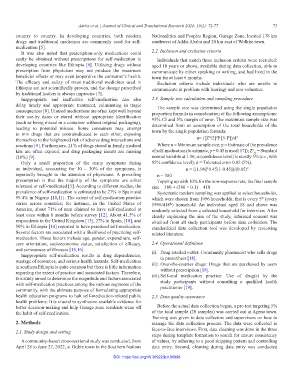
        leading  to potential  misuse. Some consumers may attempt   town by the single population formula:
        to mix drugs that are contraindicated  to each other, exposing                  α  2        2
        themselves to the heightened risk of adverse drug interactions and         n= ([Z /2] P [1-P])/d
        reactions [9]. Furthermore, 21% of drugs stored in family medical   Where n = Minimum sample size; p = Estimate of the prevalence
                                                                                                          α
        kits  are  often  expired,  and  drug  packaging  inserts  are  missing   of self-medication (to estimate, p = 0.45 is used [17]); Z  = Standard
                                                                                                           /2
        (18%) [9].                                              normal variable at 1.96; α (confidence level) is mostly 5% (i.e., with
          Only a small proportion of the many symptoms facing   95% confidence level); d = Tolerated error 0.05 (5%).
        an individual,  accounting  for 10 – 30% of the symptoms, is           n = ([1.96] 0.45[1-0.45])/(0.05) 2
                                                                                       2
        reportedly  brought to the  attention  of physicians. A  prevailing   n = 380
        presumption  is that  the majority  of the symptoms are either   Topping up with 10% for the non-response rate, the final sample
        tolerated or self-medicated [5]. According to different studies, the   size = 380 + (380 × 0.1) = 418.
        prevalence of self-medication is estimated to be 27% in Spain and   Systematic random sampling was applied to select households,
        99.4% in Nigeria [10,11]. The extent of self-medication practice   which were chosen from 1996 households, that is every 5  (every
                                                                                                              th
        varies across countries;  for instance,  in the United States of   1996/418 ) household.  An individual  aged 18 and above was
                                                                        th
        America, about 71% of men claimed to have self-medicated at   randomly selected from a selected household for interview. After
        least once within 6 months before survey [12]. About 41.5% of   clearly explaining  the aim of the study, informed consent was
        respondents in the United Kingdom [13], 27% in Spain, [10], and   obtained from all study participants before data collection. The
        50% in Ethiopia [14] reported to have practiced self-medication.   standardized  data collection  tool was developed by reviewing
        Several factors are associated with a likelihood of practicing self-  related literature.
        medication. These factors include age, gender, expenditure, self-
        care  orientation,  socioeconomic  status,  satisfaction  of  efficacy,   2.4. Operational definition
        and seriousness of illnesses [15,16].                   (i).  Drug retailed outlet: Community pharmacist who sells drugs
          Inappropriate  self-medication  results  in  drug  dependencies,
        wastage of resources, and serious health hazards. Self-medication   to prescribers [18].
        in southern Ethiopia is quite common but there is little information   (ii). Over-the-counter drugs: Drugs that are purchased by users
                                                                    without prescription [18].
        regarding the extent of practice and associated factors. Therefore,   (iii). Self-oral  medication  practice:  Use  of  drug(s)  by  the
        this study aimed to determine the magnitude and factors associated   study  participants  without  consulting  a  qualified  health
        with self-medication practices among the various segments of the   practitioner [19].
        community, with the ultimate purpose of formulating appropriate
        health education programs to halt self-medication-related public   2.5. Data quality assurance
        health problems. It is crucial to synthesize available evidence for
        better decision-making and help Gurage zone residents wean off   Before the actual data collection began, a pre-test targeting 5%
        the habit of self-medication.                           of the total sample (20 samples) was carried out at Agena town.
                                                                Training was given to data collectors and supervisors on how to
        2. Methods                                              manage the data collection process. The data were collected in
                                                                face-to-face interviews. First, data cleaning was done in the three
        2.1. Study design and setting
                                                                steps during template formation to search for ensure consistency
          A community-based cross-sectional study was conducted, from   of values, by adhering to a good skipping pattern and controlling
        April 28 to June 27, 2022, at Gubre town in the Southern Nations   data  entry. Second, cleaning  during data  entry  was conducted
                                                 DOI: https://doi.org/10.36922/jctr.00098

