


Page 80 - JCTR-10-1
P. 80
76                        Adeba et al. | Journal of Clinical and Translational Research 2024; 10(1): 72-77
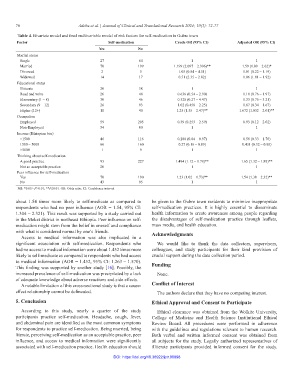
        Table 4. Bivariate model and final multivariable model of risk factors for self-medication in Gubre town
        Factor                                Self‑medication             Crude OR (95% CI)         Adjusted OR (95% CI)
                                          Yes              No
        Marital status
         Single                            27              64                    1                          1
         Married                           70              199            1.199 (2.097 – 2.996)**     1.59 (1.09 – 2.62)*
         Divorced                          2               5                1.05 (0.84 – 4.51)         1.01 (0.22 – 1.19)
         Widowed                           14              17               0.51 (2.35 – 2.82)         1.06 (1.01 – 1.92)
        Educational status
         Illiterate                        20              58                    1                          1
         Read and write                    26              48              0.636 (0.54 – 2.90)         1.10 (0.76 – 1.97)
         Elementary (1 – 8)                30              46              0.528 (0.27 – 4.47)         1.33 (0.75 – 3.21)
         Secondary (9 – 12)                26              93              1.02 (0.458 – 2.25)         1.87 (0.34 – 1.67)
         Higher (12+)                      11              40              1.25 (1.55 – 2.47)**      1.672 (1.032 – 2.01)**
        Occupation
         Employed                          59              205             0.39 (0.253 – 2.59)         0.93 (0.12 – 2.02)
         Non-Employed                      54              80                    1                          1
        Income (Ethiopian birr)
         <1500                             46              116             0.280 (0.04 – 0.97)         0.56 (0.33 – 1.76)
         1500 – 5000                       66              160              0.27 (0.16 – 0.89)        0.431 (0.32 – 0.90)
         >5000                             1               9                     1                          1
        Thinking about self-medication
         A good practice                   93              227            1.494 (1.12 – 1.78)**       1.65 (1.32 – 1.89)**
         Not an acceptable practice        20                                    1                          1
        Peer influence for self-medication
         Yes                               70              190             1.23 (1.02 – 1.73)**       1.54 (1.30 – 2.32)**
         No                                43              95                    1                          1
        NB: *0.05> P>0.01; **P≤0.01. OR: Odds ratio; CI: Confidence interval


        about 1.54  times more  likely  to self-medicate  as compared  to   be given to the Gubre town residents to minimize inappropriate
        respondents who had no peer influence (AOR = 1.54, 95% CI:   self-medication  practices.  It  is  highly  essential  to  disseminate
        1.304 – 2.321). This result was supported by a study carried out   health information to create awareness among people regarding
        in the Meket district in northeast Ethiopia. Peer influence on self-  the  disadvantages  of  self-medication  practice  through  leaflets,
        medication might stem from the belief in oneself and compliance   mass media, and health education.
        with what is considered normal by one’s friends.        Acknowledgments
          Access to medical  information  was also implicated  in a
        significant  association  with  self-medication.  Respondents  who   We would like to thank the data collectors,  supervisors,
        had no access to medical information were about 1.452 times more   colleagues, and study participants  for their kind provision of
        likely to self-medicate as compared to respondents who had access   crucial support during the data collection period.
        to medical information (AOR = 1.452, 95% CI: 1.263 – 1.570).
        This finding was supported by another study [16]. Possibly, the   Funding
        increased prevalence of self-medication was precipitated by a lack   None.
        of adequate knowledge about adverse reactions and side effects.
          A notable limitation of this cross-sectional study is that a cause-  Conflict of Interest
        effect relationship cannot be delineated.                  The authors declare that they have no competing interest.

        5. Conclusion                                           Ethical Approval and Consent to Participate
          According to this study, nearly a quarter of the study   Ethical clearance was obtained from the Wolkite University,
        participants  practice  self-medication.  Headache,  cough,  fever,   College  of  Medicine  and  Health  Science  Institutional  Ethical
        and abdominal pain are identified as the most common symptoms   Review  Board.  All procedures were performed  in adherence
        for respondents to practice self-medication. Being married, being   with the guidelines and regulations relevant to human research.
        literate, perceiving self-medication as an acceptable practice, peer   Both verbal and written informed consent was obtained from
        influence, and access to medical information were significantly   all subjects for the study. Legally authorized representatives of
        associated with self-medication practice. Health education should   illiterate  participants  provided  informed  consent  for the  study.
                                                 DOI: https://doi.org/10.36922/jctr.00098

