


Page 84 - JCTR-10-1
P. 84
80                        Covre et al. | Journal of Clinical and Translational Research 2024; 10(1): 78-84
        statement of use of psychotropic drugs during some period of their   by stimulants among 47.5% (n = 29) and benzodiazepines among
        lives, and the priority they give to mental health. It was found   37.7% (n = 23) students. A complete profile of the drugs used is
        that  the  largest  population  of this  sample  was female  (78.7%;   available in Figure 1.
        n = 96) and that the most prevalent age group was between 18 and   Of the  surveyed college  students, 21.3% (n = 26) reported
        24 years old with (74.6%; n = 91). The data showed that 95.1%   self-medication with psychotropic drugs. Evaluating this portion,
        (n = 116) of the interviewees considered that medical follow-up   69.2% (n = 18) declared that they have health insurance; 30.8%
        is required for assessing a good mental health state. Regarding   (n = 8) have regular medical appointments; 53.8% (n = 14) have
        the use of psychoactive substances, half of the population (50%;   regular medical appointments only when necessary; 15.4% (n = 4)
        n = 61), stated that they use or have used psychotropic drugs at   do not have regular medical appointments. As for mental health,
        some point in their lives.                              92.4% (n = 24) consider it a priority problem, which requires
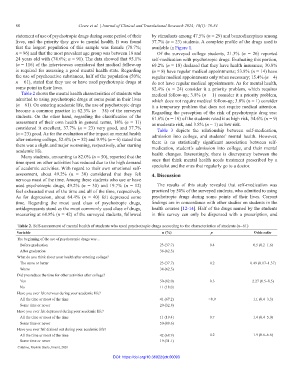
          Table 2 shows the mental health characteristics of students who   medical follow-up; 3.8% (n = 1) consider it a priority problem,
        admitted to using psychotropic drugs at some point in their lives   which does not require medical follow-up; 3.8% (n = 1) consider
        (n = 61). On entering academic life, the use of psychotropic drugs   it a temporary problem that does not require medical attention.
        become a common practice in 62.3% (n = 38) of the surveyed   Regarding the perception of the risk of psychotropic drug use:
        students.  On  the  other  hand,  regarding  the  classification  of  the   61.6% (n = 16) of the students rated it as high risk, 34.6% (n = 9)
        assessment of their own health in general terms, 18% (n = 11)   as moderate risk, and 3.8% (n = 1) as low risk.
        considered  it  excellent,  37.7% (n = 23) very good, and  37.7%   Table  3  depicts  the  relationship  between  self-medication,
        (n = 23) good. As for the evaluation of the impact on mental health   admission  into  college,  and  students’  mental  health.  However,
        after entering college, 52.4% (n = 32) and 9.9% (n = 6) stated that   there  is  no  statistically  significant  association  between  self-
        there was a slight and major worsening, respectively, after starting   medication,  student’s admission  into college,  and their  mental
        academic life.                                          health  changes. Interestingly, there is discrepancy  between the
          Many students, amounting to 82.0% (n = 50), reported that the
        time spent on other activities has reduced due to the high demand   ones that think mental  health  needs treatment  prescribed  by a
        of academic activities. With regard to their own emotional self-  specialist and the ones that regularly go to a doctor.
        assessment, about 49.2% (n = 30) considered that they felt   4. Discussion
        nervous most of the time. Among these students who use or have
        used psychotropic  drugs, 49.2% (n = 30)  and  19.7% (n  = 12)   The results of this study revealed that self-medication  was
        feel exhausted most of the time and all of the time, respectively.   practiced by 50% of the surveyed students, who admitted to using
        As for  depression,  about  64.4%  (n  =  40) felt  depressed  some   psychotropic drugs during some points of their lives. Current
        time.  Regarding the most used class of psychotropic drugs,   findings are in concordance with other studies on students in the
        antidepressants stand as the most commonly used class of drugs,   health courses [12-14]. Half of the drugs named by the students
        measuring at 68.8% (n = 42) of the surveyed students, followed   in  this survey  can  only  be  dispensed  with  a  prescription,  and

        Table 2. Self-assessment of mental health of students who used psychotropic drugs according to the characteristics of students (n=61)
        Variable                                                     n (%)               p                 Odds ratio
        The beginning of the use of psychotropic drugs was…
         Before graduation                                          23 (37.7)            0.4               0.5 (0.2–1.6)
         After graduation                                           38 (62.3)
        What do you think about your health after entering college?
         The same or better                                         23 (37.7)            0.2              0.49 (0.17–1.37)
         Worse                                                      38 (62.3)
        Did you reduce the time for other activities after college?
         Yes                                                        50 (82.0)            0.3              2.27 (0.5–8.5)
         No                                                         11 (18.0)
        Have you ever felt nervous during your academic life?
         All the time or most of the time                           41 (67.2)           >0.9               1.1 (0.4–3.3)
         Some time or never                                         20 (32.8)
        Have you ever felt depressed during your academic life?
         All the time or most of the time                           11 (19.4)            0.7               1.4 (0.4–5.0)
         Some time or never                                         50 (80.6)
        Have you ever felt drained out during your academic life?
         All the time or most of the time                           42 (68.9)            0.2               1.9 (0.6–6.6)
         Some time or never                                         19 (31.1)
        Colatina, Espírito Santo, Brazil, 2020
                                                DOI: https://doi.org/10.36922/jctr.00093

