


Page 83 - JCTR-10-1
P. 83
Covre et al. | Journal of Clinical and Translational Research 2024; 10(1): 78-84   79
        global issue [2]. In several international studies, the prevalence   complete the survey. The data were tabulated in GraphPad Prism
        of  self-medication  stands  at  an  average  of  12%  – 90%  [3-6].   9 software (Boston, MA, USA), with 95% reliability (P < 0.05).
        During COVID-19 pandemic, the self-medication rate increased   Fisher’s test was used for the analysis of the variables.
        exponentially and numerous adverse effects from self-medication   The research was approved by the Human Research  Ethics
        have been documented [7,8].                             Committee of the UNESC, following the ethical principles defined
          Some individuals self-medicate themselves with psychotropic   by Resolution 466/12 of the National Health Council for carrying
        drugs for better academic and professional performance or esthetic   out research involving human beings (Certificate of Presentation
        or recreational  purposes.  The prevalence  of psychotropic drug   for Ethical  Appreciation  [CAAE] in 33291620.1.0000.5062,
        misuse is found to be high among university students, professionals   opinion no. 4,091,372).
        who live  under a  high  level  of stress, and businessmen.  This   Colatina  has  111,788  inhabitants  and  is  a  regional  indicator
        practice  is deleterious  and can cause insomnia, anxiety, and   of health status in the entire Northwest macro-region of Espírito
        emotional ability in the short term. Moreover, it is associated with   Santo in Brazil. Colatina  is an important  medical  and hospital
        long-term physical or psychological dependence, cardiovascular,   care  center  that provides a  series of treatments,  ranging  from
        cognitive, motor alterations, and risk of overdose [9]. Therefore,   basic care to highly complex examinations. This hub comprises
        this study aimed to characterize the prevalence of indiscriminate   seven  hospitals,  54  municipal  health  units,  15  clinical  analysis
        use of psychotropic drugs among students in the health discipline   laboratories,  six radiology clinics, two hemodialysis  centers, a
        in Colatina, Espírito Santo, to decipher the factors that spur on this   Regional Specialty Center, a blood center, and a Municipal Health
        practice. A better understanding of these factors can help with the   Surveillance Center, among others. The university under study is
        formulation of preventive measures.                     responsible for training professionals for these institutions.
        2. Materials and Methods                                3. Results
          We evaluated  the use of psychotropic  drugs and associated   The sample obtained consisted of 122 students who agreed to
        factors among students enrolled in health courses at a university   answer the questionnaire, equivalent to 7% of the total population
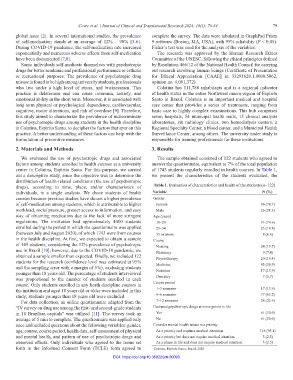
        center in Colatina, Espírito Santo. For this purpose, we carried   of 1743 students regularly enrolled in health courses. In Table 1,
        out a descriptive study, since the objective was to determine the   we present the characteristics  of the students evaluated,  the
        distribution of health-related conditions (the use of psychotropic
        drugs), according to time,  place, and/or characteristics  of   Table 1. Evaluation of characteristics and health of the students (n=122)
        individuals,  in a single analysis.  We chose students of health   Variable                            N (%)
        courses because previous studies have shown a higher prevalence   Gender
        of self-medication among students, which is attributable to higher   Female                           96 (78.7)
        workload, social pressure, greater access to information, and easy   Male                             26 (21.3)
        way of obtaining medication due to the lack of more stringent   Age (years)
        regulations.  The institution  had approximately  4000 students   18–24                               91 (74.6)
        enrolled during the period in which the questionnaire was applied   25–34                             23 (18.8)
        (between July and August 2020), of which 1743 were from courses   35 or above                          8 (6.6)
        in the health discipline. At first, we expected to obtain a sample   Course
        of 149 students, considering the 12% prevalence of psychotropic   Nursing                             24 (19.7)
        use in Brazil [10]; however, due to the COVID-19 pandemic, we   Pharmacy                               9 (7.4)
        obtained a sample smaller than expected. Finally, we included 122   Physiotherapy                     20 (16.4)
        students for the research (confidence level was estimated at 95%   Medicine                           45 (36.9)
        and the sampling error with a margin of 5%), excluding students   Nutrition                           17 (13.9)
        younger than 18 years old. The percentage of students interviewed   Dentistry                          7 (5.7)
        was proportional  to the  number  of students enrolled  in each
        course. Only students enrolled in any heath discipline courses in   Course period
        the institution and aged 18 years old or older were included in this   1–3 semester                   17 (13.9)
        study; students younger than 18 years old were excluded.  4–6 semester                                77 (63.2)
          For data collection, an online questionnaire adapted from the   7–12 semester                       28 (22.9)
        “IV survey on drug use among the first- and second-grade students   Had used psychotropic drugs at some points in life
        in 10 Brazilian capitals” was utilized [11]. The survey took an   Yes                                 61 (50.0)
        average of 5 min to complete. The questionnaire was applied only   No                                 61 (50.0)
        once and included questions about the following variables: gender,   Consider mental health issues is a priority
        age, course, course period, health data, self-assessment of physical   As a priority and requires medical attention  116 (95.1)
        and mental health, and pattern of use of psychotropic drugs and   As a priority but does not require medical attention  3 (2.5)
        observed effects. Only individuals who agreed to the terms set   As a phase in life and does not require medical attention  3 (2.5)
        forth in the Informed Consent Form (TCLE) form agreed to   Colatina, Espírito Santo, Brazil, 2020
                                                DOI: https://doi.org/10.36922/jctr.00093

