


Page 78 - JCTR-10-1
P. 78
74                        Adeba et al. | Journal of Clinical and Translational Research 2024; 10(1): 72-77
        by two data clerks using two computers in a blinded fashion;   Table 1. Social and demographic factors of self-medication practice
        principal  investigator  was responsible  for  counter  checking   and associated factors among adult household members of Gubre town,
        entered data, assessing 5 – 10% of daily-entered data. Third, after   Gurage Zone, Ethiopia
        data cleaning, we calculated simple frequency, tabulated variables   Variables  Category  Frequency   Percent
        for consistency, and addressed layers and missing values.  Sex            Male               117        29.4
                                                                                  Female             281        70.6
        2.6. Data processing and analysis procedure
                                                                 Age              18 – 24            96         24.1
          The data was compiled, analyzed, and presented with tables,             25 – 34            106        26.6
        and analysis was performed using SPSS  version  24 software.              35 – 44            118        29.6
        Logistic regression was performed and all variables with P < 0.25         45 – 54            41         10.3
        in  bivariable  logistic  regression  were  fitted  into  the  backward   ≥55                37         9.3
        stepwise multivariable  logistic  regression model.  Adjusted   Marital status  Single       91         22.9
        odds  ratio  (AOR)  along  with  a  95%  confidence  interval  (CI)       Married            270        67.8
        and P < 0.05 was used to interpret the findings of research from          Widowed            31         7.8
        final models of multivariable regression tables.                          Divorce             6         1.5
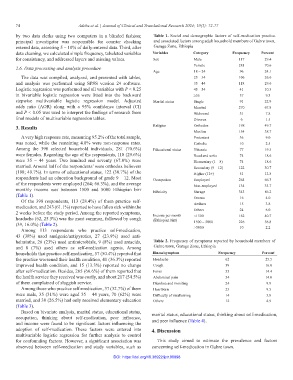
        3. Results                                               Religion         Orthodox           198        49.7
                                                                                  Muslim             154        38.7
          A very high response rate, measuring 95.2% of the total sample,         Protestant         36         9.0
        was noted, while the remaining 4.8% were non-response rates.              Catholic           10         2.5
        Among the 398 selected  household individuals,  281  (70.6%)   Educational status  Illiterate  77       19.3
        were females. Regarding the age of the respondents, 118 (29.6%)           Read and write     74         18.6
        were  35  –  44  years.  Two hundred  and  seventy  (67.8%)  were         Elementary (1 – 8)  74        18.6
        married. Around half of the respondents’ were orthodox believers          Secondary (9 – 12)  122       30.7
        (198; 49.7%). In terms of educational status, 122 (30.7%) of the          Higher (12+)       51         12.8
        respondents had an education background of grade 9 – 12. Most   Occupation  Employed         264        66.3
        of the respondents were employed (264; 66.3%), and the average            Non-employed       134        33.7
        monthly  income  was between  1500 and  5000 Ethiopian  birr   Ethnicity  Gurage             343        86.2
        (Table 1).                                                                Oromo              16         4.0
          Of the  398 respondents,  113  (28.4%) of them  practice  self-         Amhara             15         3.8
        medication, and 243 (61.1%) reported to have fallen sick within the       Others             24         6.0
        2 weeks before the study period. Among the reported symptoms,   Income per month   <1500     162        40.7
        headache (62, 25.5%) was the most common, followed by cough   (Ethiopian birr)
        (39, 16.0%) (Table 2).                                                    1500 – 5000        226        56.8
                                                                                                     10
                                                                                                                2.2
                                                                                  >5000
          Among 113 respondents who practice  self-medication,
        43  (38%) used analgesic/antipyretics, 27  (23.9%) used anti-
        helminths, 26 (23%) used antimicrobials, 9 (8%) used antacids,   Table 2. Frequency of symptoms reported by household members of
        and 8  (7%) used others as self-medication  agents.  Among   Gubre town, Gurage Zone, Ethiopia
        households that practice self-medication, 57 (50.4%) reported that   Illness/symptom  Frequency       Percent
        the practice worsened their health condition, 41 (36.3%) reported   Headache           62               25.5
        improved health condition, and 15 (13.3%) reported no change   Cough                   39               16.0
        after self-medication. Besides, 265 (66.6%) of them reported that   Fever              35               14.4
        the health service they received was costly, and about 217 (54.5%)   Abdominal pain    34               14.0
        of them complained of sluggish service.                  Diarrhea and vomiting         24               9.9
          Among those who practice self-medication, 37 (32.7%) of them   Heartburn             23               9.5
        were male, 35 (31%) were aged 35 – 44 years, 70 (62%) were   Difficulty of swallowing   14              5.8
        married, and 30 (26.5%) had only received elementary education   Others                12               4.9
        (Table 3).
          Based on bivariate analysis, marital status, educational status,
        occupation,  thinking  about  self-medication,  peer  influence,   marital status, educational status, thinking about self-medication,
        and income were found to be significant factors influencing the   and peer influence (Table 4).
        adoption of self-medication.  These factors were entered into   4. Discussion
        multivariable  logistic regression for further analysis to control
        for confounding factors. However, a significant association was   This  study  aimed  to  estimate  the  prevalence  and  factors
        observed  between  self-medication and study variables,  such as   concerning self-medication in Gubre town.
                                                 DOI: https://doi.org/10.36922/jctr.00098

